Product Review from Environmental Building News

Solargenix Energy Offers Leading-Edge Solar-Thermal Technology


Solargenix Energy, LLC is moving full-steam ahead on several exciting fronts in the solar-thermal industry. Solargenix began as Solar Roof International in 1987 with a number of partners including the architecture firm Innovative Design of Raleigh, North Carolina. In 1997, with the Israeli company Solel Solar Systems as a partner, the company entered into a joint venture with Duke Power Corporation (one of the nation’s largest utility companies) and changed its name to Duke Solar. The relationship with Duke Power ended in 2002, when the utility company sold its Duke Engineering & Services Division to the French nuclear-engineering company Framatome ANP. Duke Solar bought out Framatome’s interest in the venture and changed its name to Solargenix Energy in April 2003. The company offers solar-thermal technologies ranging from large utility-scale power generation systems to much smaller water heating, space heating, and cooling systems.

Power Generation

The Power Generation Division of Solargenix is picking up where the Luz Company left off when it went bankrupt in 1991. Luz built nine solar electric generating system (SEGS) power plants using high-temperature, solar-trough collectors in the Mohave Desert in the 1980s and early ‘90s, with a total generating capacity of 354 megawatts (MW)—see EBN Vol. 8, No. 7. When the Luz Company folded, Solel purchased the intellectual assets of the company, which have been brought to Solargenix. (The nine Luz plants, in Kramer Junction, California, are still functioning very well).

Here’s how the Solargenix solar-trough system works: Tracking, parabolic-trough collectors focus sunlight on pipes filled with mineral-oil heat-transfer fluid. The oil is heated to between 250 and 550°F (120–290°C), and then passes through a heat exchanger where a secondary fluid is vaporized. This high-pressure gas spins a turbine, generating electricity. The gas is then condensed back into a liquid and cycles back through the vaporizer to repeat the process.

On March 24, 2004, Solargenix broke ground on its first power-generation system: a 1 MW solar-trough power plant for APS (previously Arizona Public Service Company), Arizona’s largest electric utility. The plant, being built in Red Rock, approximately 30 miles north of Tucson, is expected to be completed in April 2005. The generating station will help satisfy Arizona’s renewable energy portfolio standard, which requires that APS generate at least 1.1% of its electricity from renewable sources by 2007—60% of it solar.

Gary Bailey, AIA, an architect with the Las Vegas office of Innovative Design and Solargenix, told EBN that they are hoping to break ground in July 2004 on a much larger, 50 MW solar-trough power plant in Las Vegas. The company is looking at opportunities to build additional power plants in Nevada, New Mexico, and California, and they are working on joint ventures for projects in Australia, Mexico, and Spain. According to Bailey, Governor Schwarzenegger is pushing to increase California’s renewable portfolio standard from 20% to 30% and achieve that by 2017 instead of 2020. “That’s a pretty aggressive timeframe,” says Bailey, suggesting that they won’t be able to meet that level of production with just wind and geothermal power. There is also a federal initiative to develop 1,000 MW of solar-thermal power in the Southwest that Solargenix hopes to plug into.

The Solargenix power generation technology is well suited for hybrid applications with other power production technologies, such as combined-cycle natural gas, wind, and biogas. The three 30 MW power plants that the company is planning in Australia are to be hybrid systems using methane from landfills.

Power Roof

Completed two years ago, this Power Roof system drives a 50-ton
(176 kW) cooling system for a 10,000 ft 2 office building in Raleigh.

At the commercial-building level, Solargenix is continuing to monitor a Power Roof™ system installed in July 2002 on a 10,000 ft 2 (930 m 2) office building in Raleigh, North Carolina. This system utilizes a fixed parabolic reflector and tracking receiver and provides 50 tons (176 kW) of cooling as well as heat. (Solargenix power generation systems, by comparison, use tracking reflectors.) Bailey says that system is doing extremely well—actually exceeding the designed 50-ton (176 kW) output. “If it can produce that well in Raleigh,” says Bailey in Las Vegas, “it will do even better out here.”

The Power Roof system in Raleigh produces 340–350°F (170–175°C) water that powers a double-effect absorption chiller manufactured by the Chinese Broad Air Conditioning Company, Ltd. The building-integrated system is also designed to deliver daylighting, provide an insulating radiant barrier, and serve as a watertight roofing system. Where needed, the thermal energy can be converted into electricity. In a Southwest climate, Bill Guiney of Solargenix says the Power Roof could achieve collection temperatures of 750°F (400°C) or higher. Power Roof sales have been slow, pending results of testing the system in Raleigh, but one contract is in place in Australia, and a system is being discussed for Denver.

Solar Hot Water Collectors

This 64-panel array of Solargenix CPC Collectors serves a mixed-use building in New York City.

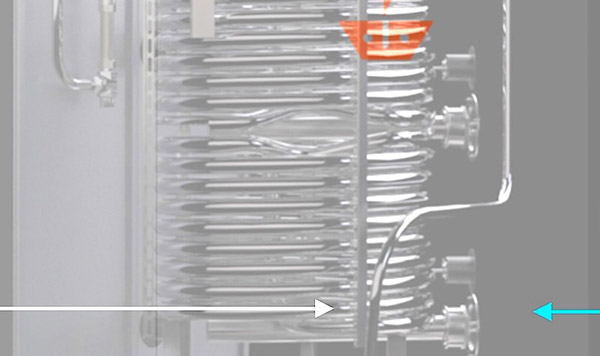
This demonstration cross-section shows the insulation, glazing, and concentrating parabolic collector configuration used in the Winston Series CPC collector.

The third product line from Solargenix is the Winston Series CPC Collector, which is used for residential and commercial solar water-heating systems. The basic collector is 42” by 82” by 3.3” thick (107 x 208 x 8.4 cm) and is comprised of 12 small compound parabolic concentrating (CPC) collectors within an insulated box glazed with low-iron glass (see photo, left). The parabolic reflectors focus light onto absorber tubes through which heat-transfer fluid is piped. The product line is named for Dr. Roland Winston, a physics professor who invented the non-imaging optics technology used by Solargenix while he was at the University of Chicago. Solargenix licenses the technology from the University.

Solargenix has sold several hundred systems since launching the CPC line, but sales are expected to ramp up significantly with the opening in March 2004 of a manufacturing facility for the collectors in Chicago. (Prior to this, the CPC collectors were manufactured in Florida, but all production has shifted to Chicago.) The City of Chicago has contracted to purchase $5 million worth of CPC collectors over the next three years—which should be a significant fraction of the company’s output.

The CPC collectors do not use evacuated tubes, though on first glance they look somewhat like evacuated-tube collectors (see EBN Vol. 8, No. 7). One, two, or three collectors are commonly used for residential solar water-heating systems: a single collector when a 50-gallon (190 l) hot-water storage tank is needed, two collectors with an 80-gallon (300 l) tank, and three collectors with a 120-gallon (450 l) tank. They are commonly sold as systems in one of two configurations. A roof-integrated thermosiphoning configuration is possible with new construction; the collectors are integrated into the roof with the glazed surface approximately flush with the roof surface and the storage tank located higher than the collector inside the attic. With a more conventional active-solar configuration, a small heat-exchange SolPac module sits next to the hot-water storage tank and transfers heat into the storage tank. “I believe in separating the solar from the water heater,” says Guiney, noting that conventional storage tanks are much less expensive than special tanks deigned for solar water heating.

The installed cost of a two-collector Winston Series CPC system varies widely by region, largely due to differences in labor cost but also affected by freeze-protection strategies. According to Guiney, the equipment cost for an 80-gallon (300 l), two-collector SolPac system runs about $2,500, while installed costs range from $3,500 to $6,500. The largest system installed to date using the CPC collectors is a 30-ton (105 kW) absorption-cooling system with 180 collectors installed for Austin Energy in Austin, Texas.

For more information:

Solargenix Energy, LLC
2101 Westinghouse Boulevard, #115
Raleigh, NC 27604
919-871-0423
www.solargenix.com

May 1, 2004

DISCUSSIONS

There are no comments for this page yet.

Log in to add comments - Help with comments

RELATED ARTICLES

EBN: Newsbrief - August 2007
EBN: Newsbrief - June 2006
EBN: Awards & Competitions - April 2006
EBN: Newsbrief - December 2005
EBN: Awards & Competitions - December 2004
EBN: Feature - July/August 1999

RELATED PRODUCTS
Product Image: Power Roof
Solargenix Energy, LLC
Product Image: Winston Series CPC Collector
Solargenix Energy, LLC

RELATED CATEGORIES

CSI DIVISIONS AND SECTIONS
CSI Section 26 31 00

LEED Credits
EA Credit 2

GREEN TOPICS


IMAGE CREDITS:
1. Photo: Solargenix Energy, LLC
2. Photo: Solargenix Energy, LLC
3. (no credit)
ARTICLE CONTENTS

DISCUSSIONS
There are no comments for this page yet.


RELATED ARTICLES
Image 1 Third-Largest Power Plant Goes On Line
EBN: Newsbrief - August 2007

RELATED PRODUCTS

RELATED LEED CREDITS
EA Credit 2

RELATED GREEN DESIGN

RELATED CSI LISTINGS
CSI Section 26 31 00