Natural Landscaping:
Native Plants and Planting Strategies for Green Development
While most green roofs in North America have been planted with European sedums or other nonnative plants, Conservation Design Forum is experimenting with native plants adapted to thin soils. Pictured is the green roof atop the Chicago City Hall, where the company has been testing the success rates of various species.
A Short History of the Lawn
Most Americans strive to emulate a landscape from 18th Century England, where broad, open pastoral vistas were maintained by wealthy landowners. In North America, Frederick Law Olmsted, the pioneering landscape architect and designer of New York City’s Central Park, popularized this landscape. According to John Ingram, author of When Cities Grow Wild (available online at www.for-wild.org), Olmsted’s Riverside development on the outskirts of Chicago was one of the first suburban residential developments to mandate broad, open lawns with scattered trees and houses set well back from the sidewalk. “Riverside set the tone for suburban landscape development,” according to Ingram. “Although Olmsted felt strongly about people having contact with nature, his was an ecologically denuded celebration of nature.” Our image of the ideal lawn has been further refined by advertising from the likes of Scotts, Monsanto, Ortho, ChemLawn, and hundreds of other companies that make up the multi-billion-dollar lawn-care industry in North America. We have been taught to strive for a monoculture of Kentucky bluegrass (not from Kentucky at all—or even North America, for that matter) and its ilk, maintained to a lush, deep green with nary a sprig of native vegetation. We punctuate this turf with periodic trees and shrubs, each perched on a mound of sterile mulch.What’s Wrong with the Conventional Lawn?
Benefits of Natural Landscaping
Just as there are significant environmental burdens and costs associated with conventional turf landscaping, there are benefits associated with natural landscaping. The primary benefits are described below.Environmental benefits
Reduced air pollution. Native landscaping generally does not require regular mowing, which eliminates or greatly reduces the air pollution resulting from turf landscapes. There can be pollution emissions from natural landscaping, however—see discussion below on pollution from fire management. Reduced nutrient runoff. Native landscaping does not require fertilizer, so the runoff and infiltration of nutrients is eliminated. Buffers of natural landscaping can be used to capture runoff from hard surfaces or less permeable turf to keep the pollutants in that stormwater from entering surface waters. Keeping nutrients out of the groundwater also protects surface waters, because groundwater surfaces in springs and flows into streams and rivers.Health benefits
Reduced pesticide use. Because natural landscaping involves the establishment of balanced ecosystems, the use of herbicides, insecticides, and other pesticides is generally not required (though herbicides are often used to remove invasive plants during the establishment of natural landscapes). Reduced operation of lawnmowers and other lawn-care-related power equipment reduces air pollution both locally and regionally, thus improving health. And keeping pollutants out of water supplies also protects our health.Ecological benefits
Increased biodiversity. Natural landscapes inherently support greater biodiversity than conventional turf landscapes. Native plants provide diverse food and habitat for birds, small mammals, insects, reptiles, and amphibians. In heavily developed urban areas, even small patches of natural landscape can be critical in maintaining populations of native fauna and flora.Economic benefits
Downsides of Natural Landscaping
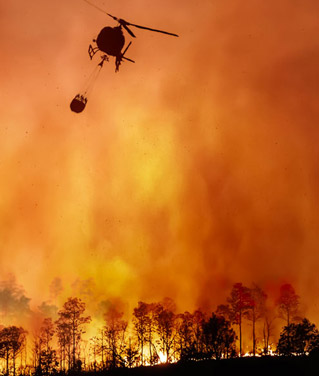
While the arguments for natural landscaping are compelling, there are some challenges: • The aesthetic palette is more limited. Strict adherence to an all-native landscaping program restricts plant choices, which many property owners (as well as landscape architects and landscapers) object to. • Establishing and maintaining natural landscapes requires new knowledge and skills. There are both direct and indirect costs associated with building these skills, and there is often inherent resistance to change in any profession. • Fire management, a key component of many—if not most—natural landscapes, poses obvious risk and liability. These risks gained national attention when, on May 4, 2000, a prescribed burn at Bandelier National Monument in Los Alamos, New Mexico, got out of hand and burned nearly 48,000 acres (19,400 ha), destroying 400 homes and causing more than a billion dollars in damage. • Fire management also generates air pollution. Depending on the type of landscape and the weather conditions during a prescribed burn, however, these emissions are usually fairly low, according to experts EBN spoke with. If only dried grasses and forbs are burned late in the growing season, fires burn quickly with relatively low pollution emissions.Understanding Terminology
A lot of terms get thrown around in green building; the same is true with landscaping. Here, we try to clarify distinctions between native and nonnative plants and between invasive and noninvasive plants. We recognize four distinct categories, as follows:Native noninvasive
According to the organization Wild Ones, native or indigenous plants are those that evolved naturally in North America or in a specific area of North America (native to the Upper Midwest or New England, for example). This means that the plants were growing here naturally and not introduced by humans from distant locations. As such, native plants are adapted to the area’s climate, precipitation patterns, soils, and other plant and animal communities. Note that while a particular species may be native to North America, an ecotype of that species from one location may not do well in another location, because most species evolve genetic adaptation to the conditions in a specific area. Native, noninvasive plants are ideal for natural landscaping around buildings because they establish balance with other plants and can easily be managed.Native invasive
Nonnative noninvasive
Nonnative or exotic plant species are those that were introduced from elsewhere—from outside North America, or in some cases from outside a more specific region. Thousands of nonnative species are grown very successfully around buildings without spreading beyond landscaped environments. Many garden annuals, many ornamental trees and shrubs, and most of the specialized plants used on green roofs are nonnative species, but, as long as they do not become invasive, their use can be acceptable.Nonnative invasive
The most problematic plants are nonnative plants that become invasive, outcompeting native plants and spreading widely. There are dozens of well-known invasives, including kudzu, oriental bittersweet, honeysuckle, crown vetch, purple loosestrife, garlic mustard, Japanese knotweed, Eurasian buckthorn, and cheatgrass. Some invasive plants take over because no native animals have adapted to feed on them. Others are simply more efficient photosynthesizers and grow more robustly than their native counterparts.Assessing the Quality of Vegetation
A relatively new method is being used in some areas to evaluate the quality of vegetative cover: floristic quality assessment. Introduced in 1994 by the late Floyd Swink and Gerould Wilhelm, then both with the Morton Arboretum in Lisle, Illinois (Wilhelm is now with Conservation Design Forum), this is the first system to quantify the floristic quality of vegetation in a natural area. “It was originally developed in Illinois to classify prairie remnants,” according to Diana Lane, Ph.D., a managing scientist with Stratus Consulting of Boulder, Colorado. The assessment method assigns a coefficient of conservatism of 0 to 10 to each plant species, based on its ability to tolerate disturbed conditions and fidelity to the presettlement conditions that are believed to have existed in the region. A low score, such as 0 or 1, indicates a species that can be found almost anywhere and is common on disturbed sites. A score of 9 or 10 indicates a species, such as an orchid, that is nearly always restricted to undisturbed, presettlement remnants of native ecosystem. These coefficients of conservatism for plants are developed by botanists and ecologists based on their collective knowledge of the plants and their communities—thus the rankings are subjective but based on a consensus of experts. Once these coefficients of conservatism have been assigned for a region (they are regionally specific), a site’s overall floristic quality can be assessed by aggregating the conservatism values for all of the plants present. Thus, it is possible to assess the quality of the plants on a site and, by extension, the health of the ecosystem. To date, coefficients of conservatism have been assigned for plants in Illinois, northern Ohio, Missouri, Michigan, and Wisconsin. Work is being done to extend this work to other regions. Leslie Sauer, author of the book The Once and Future Forest and a founder of the landscape architecture firm Andropogon Associates in Philadelphia (now practicing on her own in New Jersey), is enthusiastic about this approach and working to apply it in the Mid-Atlantic states. She is working on this through the Bowman’s Hill Wildflower Preserve in New Hope, Pennsylvania. With this floristic assessment method, which she prefers to call the Plant Stewardship Index, “you can specify a plant maintenance level,” she told EBN. “This is the first sampling methodology for monitoring a site.” The floristic quality assessment methodology (or plant stewardship index), once extended throughout North America, offers the potential for a green building rating system, such as LEED®, to address the health of ecosystems—by providing a credit for sites that achieve a certain threshold of floristic quality (say 7 or higher).Establishing Natural Landscapes
The key to establishing natural landscapes is careful planning. Conservation Design Forum prepares a detailed plan for every project it takes on. “This plan outlines the ongoing management and stewardship measures that will be conducted each year until the system is well established and management protocols become fairly minimal,” says Jim Patchett, the firm’s president. Since Conservation Design Forum is based in the Midwest, annual controlled-burn management is a part of nearly every native landscape initiative it works on. “Most species in North America are adapted to fire, which was largely a cultural phenomenon,” according to Patchett (see sidebar). Various experts EBN spoke with emphasized that natural habitat landscaping is not about individual plant species but about ecosystems. With natural landscaping, the goal is to create balanced, self-sustaining ecosystems, not just assemblages of individual native plants. Leslie Sauer argues that almost any ecosystem we find today has been degraded. “You don’t find landscapes that aren’t in need of significant restoration,” she says. Sauer doesn’t even worry too much about the native–nonnative issue. “The processes of invasion are natural, but we’ve greatly accelerated that process.” She also believes that some native species have changed. The common reed, Phragmites australis, (previously P. communes) has been here all along, and the plant occupied a very distinct and fairly small ecological niche in estuaries, according to Sauer, but at some point a nearly identical plant, a genetic variant of the same species, was introduced and Phragmites became invasive. She thinks the genetic makeup of Phragmites changed, resulting in its invasive characteristics.Dealing with invasive plants
Invasive exotic plants are the bane of natural landscaping. Hundreds of plant species are wreaking havoc in ecosystems throughout North America. In some places, such as the lower-elevation regions of Hawaii, nearly all of the vegetation is nonnative. Each region of the country has particular invasive plant species that are problematic: from kudzu in the Southeast to honeysuckle and Japanese knotweed in the Northeast to cheatgrass and garlic mustard in the Midwest and West. Strategies for removal of invasive plants all have advantages and disadvantages: hand-pulling is labor-intensive but safe for the environment; herbicides (such as Roundup®) are fast and easy but may have unintended consequences for other organisms in the ecosystem; turning over the soil (to kill turf grass, for example) avoids chemicals but may damage the soil structure and soil microorganisms; prescribed burns are often the best method to control invasives and allow the ecosystem to return to a pre-European settlement balance, but they cause safety concerns and air pollution. Patchett, whose firm has been a leader in ecosystem restoration, argues that invasive plants are often a symptom of the problem, rather than the problem itself. “Garlic mustard, purple loosestrife, reed canary grass, cattails, Phragmites, and many other nuisance plants become established because of alterations in the habitat that favor their establishment, often at the expense of locally native species,” he told EBN. When conditions that favor native species are restored through such restoration management tools as selective clearing to provide appropriate light levels and annual burn management, the invasive species are often gradually eliminated. There are a number of excellent books and manuals on ecological restoration, as well as a number of organizations committed to this field, including the Society for Ecological Restoration International, Wild Ones Natural Landscapers, and many regional and local arboretums, native plant societies, and offices of The Nature Conservancy.Converting turf to natural landscapes
A number of approaches can be taken to convert turf or other invasive vegetation to natural (restored) ecosystems. Conservation Design Forum relies on either mechanical means or herbicides, or a combination of the two. “Obviously Roundup, or a similar short-lived herbicide, is effective in the initial eradication process,” says Patchett. But they have also used a variety of mechanical strategies, including discing and harrowing. “You can disc the existing turf, let it set for a period of 10–14 days, then disc it again.” Through this process, they have been able to restore prairie without any use of herbicides. Lane suggests that in replacing a fast-growing species like bluegrass, herbicides can be advantageous because “the biomass stays in the ground and helps to prevent erosion.” Sauer points out in The Once in Future Forest that it may be possible to simply ease off the mowing to allow native species to gradually come back. Lane agrees that this strategy sometimes works, but “what you end up with would be much less controlled than if you did a wholesale replacement.” Also, points out Patchett, in relying on natural reseeding, you are dependent on what’s growing nearby in the way of native plants. “In most cases, you can’t rely on natural reseeding, because there are very few intact habitats that are adjacent to restoration sites,” he says. Conservation Design Forum uses a combination of seeding and planting of seedling plugs to establish native vegetation.Increasing people’s comfort with natural ecosystems
Given the American infatuation with lawns, social and psychological factors often emerge as barriers to natural landscape designs. Joan Nassauer, Ph.D., FASLA, of the University of Michigan, has researched human responses to various landscape designs. Her research suggests that most Americans (indeed, people in most Western cultures) are uncomfortable with landscapes that they perceive to be wild or unmaintained, but are attracted to natural plantings within an obviously managed context. Signs of human care and attention to a space, whether it is a recently mown lawn or a freshly painted picket fence, represent what Nassauer calls “cues to care.” Thus, boundaries of well-maintained turf around naturally landscaped areas not only provide fire breaks but also increase most people’s comfort level with the native plantings.Sourcing native plants
While a plant species may be native to North America, the genetic makeup of that plant may vary widely depending on where it was grown. A burr oak tree growing in the Flint Hills of Kansas, for example, may differ markedly from the same species growing along Lake Champlain in Vermont. The Flint Hills burr oak is probably adapted to fairly dry, sunny, windy, tall-grass prairie conditions, while the Lake Champlain burr oak is adapted to higher precipitation levels, cloudier conditions, and perhaps different soils. Plant ecologists refer to these as different ecotypes. The plants are similar enough to be considered the same species, but they have significant differences. In sourcing native plants for a landscaping project, efforts should be made to find locally adapted seed or nursery stock. This can be difficult. Many of the leading native plant nurseries (see EBN Vol. 10, No. 2) are located in the Midwest, and plant stock from these sources may not do well in areas with significantly different growing conditions. To ensure the greatest likelihood of success, an effort should be made to find native plants that were grown (or the seeds collected) from your region. Seeds from native plants can be collected from the wild, though this needs to be done responsibly. The Native Plant Society of New Jersey offers guidance on seed collection on their website: www.npsnj.org/collecting_seeds.htm.Final Thoughts
An underlying goal of green building is to create structures that exist in greater harmony with the environment. It makes sense that we should also strive for that goal with the landscapes around our buildings. An important strategy for getting there is to maintain or restore natural landscaping. With most sites—even so-called greenfield sites that have not been built on—the ecosystem will have already been significantly degraded, and ecological restoration will be necessary in recreating a natural landscape. This may involve removing invasive plants, planting native species, and adopting a management plan that will maintain a healthy ecosystem. In pursuing such a strategy, the first step should be hiring an expert in ecological restoration or natural landscaping. Replacing turf with such a landscape will necessitate an investment, but that investment should be repaid over the course of a very few years through reduced management cost.For more information:
Conservation Design Forum, Inc.
Elmhurst, Illinois
630-559-2000
www.cdfinc.com
Society for Ecological Restoration International
Tucson, Arizona
520-622-5485
www.ser.org
Online
Directory of Restoration Expertise
Evergreen
Toronto, Ontario
416-596-1495
www.evergreen.ca
Wild Ones Natural Landscapers, Ltd.
Appleton, Wisconsin
920-730-3986
www.for-wild.org
Morton Arboretum
Leslie, Illinois
630-968-0074
www.mortonarb.org
There are no comments for this page yet.
| Log in to add comments - Help with comments |
|
EBN: Feature - April 2004
|
EBN: Feature - February 2001
|
||
|
EBN: Feature - January 2001
|
Books |
|||
|
by Hillary Brown et al.
(2005)
|
by Peter Jeswald
(2005)
|
||
|
by James M. Knopf
(2005)
|
by Guy Sternberg et al.
(2004)
|
||
IMAGE CREDITS:
1. Photo: Conservation Design Forum, Inc.
2. Photo: Lynn Betts
3. Photo: Conservation Design Forum, Inc.
4. Photo: Peggy Greb
5. Photo: Jeff Vanuga
DISCUSSIONS
There are no comments for this page yet.
RELATED ARTICLES
RELATED BIBLIOGRAPHY
High Performance Infrastructure Guidelines
: Best Practices for the Public Right-of-Way
by Hillary Brown et al.
(2005)
RELATED GREEN DESIGN
|
||||||||||||||||||||||||||||||||||||||||||||||||||||||||||||||||||||||||||||||||||||||||||||||||


More related articles