The Problem with Net-Zero Buildings (and the Case for Net-Zero Neighborhoods)
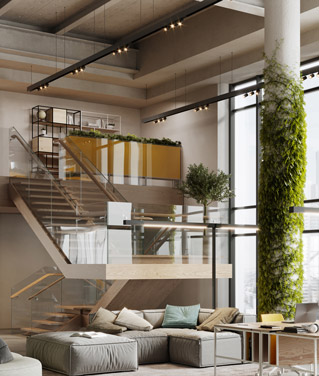
SERA is working with Portland State University as one of five pilot EcoDistricts designated by the Portland Sustainability Institute in a program aimed at removing institutional barriers to creating sustainable neighborhoods. The team is looking at cogeneration, waste-to-energy, lots of heat exchange among the energy strategies they’re hoping will help them get to net-zero.
The Problem with Net-Zero Buildings
Net-zero energy is an ambitious goal for any building—one that can’t be achieved without scrupulous attention to every aspect of a building’s design, construction, and operation. Like the related goal of creating a carbon-neutral building, any net-zero building has to first achieve significant load reductions and system efficiencies, and then meet the remaining loads with onsite energy generation. In some ways, net-zero is a tougher goal than carbon-neutral: By most definitions, a project could become carbon-neutral using biofuels from off-site—that’s not as widely recognized a solution for achieving net-zero. On the other hand, carbon calculations often account for the energy and carbon expended to create a building—its embodied carbon—which is not usually the case with net-zero energy.Not every building can get there
Other impacts ignored—or worse
Even if cost is not an obstacle and the building has a low profile, getting to net-zero means that the solar panels can’t be shaded by trees or adjacent structures. That means that sprawling suburban homes are much more likely to achieve the net-zero goal than dense urban townhouses or apartments, and suburban office parks have a leg up on central business districts. This is a problem we’ve seen before, according to architect Muscoe Martin, AIA, of M2Architects: “In the ’80s a few solar architecture pioneers like Doug Kelbaugh and Peter Calthorpe noted that most of the highest–performing solar buildings were in rural or suburban locations, ignoring transportation and infrastructure energy use.” Martin notes, “Single-scale problem-solving leads to solutions that don’t always make sense.”
The King Abdullah University of Science & Technology (KAUST) is a new 5.3 million ft2 (500,000 m2) campus in Saudi Arabia designed by a team led by HOK. The $20 million dollars spent covering the roof in roughly 400,000 ft2 (37,000 m2) of PV and solar thermal provides about 7.8% of the total campus energy use. That’s not nearly as cost-effective as the free 3%–4% overall energy savings achieved by changing the chiller utilization controls, notes HOK’s Colin Rolfing. Controls also help campus-wide. The Inter-Campus Automation System (ICAS) helps take advantage of the diversity of energy loads by sending excess electricity, chilled water, and steam from the solar panels and from the central utility plant to buildings that need it the most.
Opportunities with Communities
Neighborhoods and communities, being larger than individual buildings, can support many technologies for low-impact heating, cooling, and electricity generation better and more cost-effectively. To some extent, this is simply a matter of scale: combined heat and power systems—especially those using biomass—are more efficient in larger sizes. Perhaps more important, they can support dedicated operations and maintenance staff to keep them working properly. The same is true for community-sized boilers, chillers, and many other high-tech solutions. Many colleges and universities already have centralized energy infrastructure, as well as an entire community under common ownership, making them natural candidates for becoming net-zero. “University campuses are going to be the early adopters in this game,” says Eric Ridenour of SERA Architects in Portland, Oregon, citing long-term ownership of their buildings and access to patient capital (as opposed to investment funds seeking a quick return). One example of a community-scale cooling system that would not have been feasible for an individual building is Cornell University’s deep-water cooling system in Ithaca, New York, using water from Cayuga Lake to replace three existing chiller plants. Reaching two miles out and 250 feet into the lake for cold water, this system cost about $60 million, some of which would have been spent anyway replacing chillers and CFC refrigerants. It saves about 25 million kWh annually, reducing Cornell’s total electricity bill by 10 percent.More cost-effective energy generation
Load diversification and cascading uses of energy
Communities also have a mix of occupancies and uses, which can support more efficient use of infrastructure and cascading uses of energy. Offices use most of their energy by day and can go dark at night, while for residences it’s just the opposite. That means that a single heating or cooling plant serving both can be not much bigger than a plant serving just one of them. It is also sometimes possible to share energy—using waste heat from data centers, for example, to heat water for use in apartments. Looking into the benefits of this diversification for neighborhoods in Portland, Oregon and Seattle, the architecture firm Mithun found the ideal mix of residential to commercial uses to be 75% to 25%, according to president Bert Gregory, FAIA.
A more inclusive scope
In Freiburg, Germany, the Vauban district is recognized internationally for its efforts to discourage car ownership and promote alternative transportation. This 5,000-person community, built on a former French army base abandoned in 1992, also has highly efficient buildings. Over 100 are built to the Passivhaus standard, and the “Solar Settlement” neighborhood boasts 59 “Plus Energy” houses, designed by architect Rolf Disch, that generate more energy than they use. Most of the community’s remaining energy needs are supplied by a biomass-fired cogeneration system.
Better control of orientation and massing
For an individual building project, site constraints and preexisting street grids may make it impossible to orient the building for optimal daylighting and passive solar heating or cooling. “As much as 50% of the heating and cooling energy can be saved by going from the worst orientation to the best orientation, and street layout has a tremendous impact on the orientation of buildings,” said Norbert Lechner, architect and professor emeritus at Auburn University. When designing at the community scale, those considerations can be addressed in ways that help make the individual buildings more efficient at minimal cost. The best example of this is Village Homes in Davis, California, where all 200 houses are on east-west streets even though the parcel of land is mostly north-south, according to Lechner. “Not only does every house save energy by receiving mostly winter sun and little summer sun but the cooling systems are also smaller and less expensive,” he said. Village Homes was built in the 1970s with a focus on solar design of individual homes and innovative stormwater management, but it doesn’t appeal to transportation-minded planners today, who see it as yet another example of a car-dependent, suburban neighborhood.Challenges at the Community Scale
Despite all the advantages, there are many reasons why community-scale approaches are not more common.Ownership and financing
Large, developer-led, mixed-use projects such as Dockside Green in Victoria, British Columbia, or London’s Beddington Zero-Energy Development (BedZED) consolidate the ownership and management into one entity, so that they can coordinate design, construction, and management of an integrated project. There is even greater potential in revitalizing existing urban neighborhoods, but doing that introduces many new challenges. Mithun has explored several projects that could become urban ecodistricts, linking together many different buildings and uses, owned by separate entities, into a coordinated network. In the process, they’ve discovered a range of challenges. Who owns the infrastructure that’s needed to share utilities? How do you create governance structures that encourage private investment while coordinating it in a way that optimizes community-scale design? How do you get permission to connect buildings across public streets? And what do you do about utility regulations that make it difficult to create small, neighborhood-scale utility companies? Without a single owner to be accountable and responsible for these systems, all kinds of legal and commercial problems emerge.Phasing
Most large, mixed-use projects are created in phases rather than all at once. That makes it hard to invest early in efficient, centralized infrastructure such as HVAC systems, transportation networks, and ecological wastewater solutions. But if those systems are not in place early on, then individual buildings and units have to build separate systems to meet those needs, creating obstacles to doing centralized systems later. Financing those investments before there is a critical mass of occupants to use them is a key challenge for many large projects.Overly complicated technologies
The more sophisticated systems that are possible in a community-scale project require dedicated management, so there has to be an organizational infrastructure in place to support the physical infrastructure. This problem gets even worse for communities that are pursuing the goal of net-zero energy, because they tend to seek out the most advanced technologies available rather than the tried and true. At BedZED, the combined heat and power system using biomass never worked as advertised and was replaced by gas boilers after a couple of difficult years for residents, who endured winters with limited heating. The onsite wastewater treatment system also failed repeatedly. Overreaching for unreliable technologies is one problem, but any large, mixed-use project lends itself to complicated systems and potentially unwieldy design and construction, warns Mithun’s Sandy Mendler, AIA. “Added size sometimes creates complexity that pushes against the efficiencies of scale, and there is an extra coordination effort when a large team is involved.” That complexity gets even worse when there are multiple owners and regulatory agencies involved.Letting buildings off the hook
Losing touch with the inhabitants
Every net-zero-energy project depends on the full participation of its occupants to get that way. “In the case of individual buildings, the onus is on the owner or occupants to balance consumption with generation,” notes University of Florida’s Charles Kibert, Ph.D. “I don’t see this as achievable at larger scale because we are back to the ‘commons’ again—there is no vested interest for all the individual recipients of energy to limit their consumption,” he adds.
The Oregon Sustainability Center, intended to serve as a hub and incubator for sustainable enterprises near Portland State University, is seeking Living Building certification. The design was scaled back from 230,000 ft2 to 200,000 ft2 (21,000 m2 to 18,500 m2) based on feedback that it could not achieve net-zero at the intended size. It has since evolved further, to 150,000 ft2 (14,000 m2).
What’s the Right Scale?
“The right scale is the scale that you have before you,” says Muscoe Martin, arguing that it’s better to do what you can within the scope you’re given than to do nothing at all. At the same time, he notes, it’s useful to think in terms of “nested scales” and consider the impact of your project on the products and systems within it, and on the systems in which it fits. Every project should help make its neighborhood more pedestrian-friendly, for example, even if it can’t redesign the entire streetscape. Net-zero is a compelling goal, both for individual buildings and for communities. Like any generic goal, however, it has to be applied wisely. “There is no question that you have to focus on every individual building because you want to drive down the loads as much as possible,” says Malcolm Lewis, president of CTG Energetics. “The trap is thinking that you have to make each building completely self-sufficient, because in doing that you sacrifice opportunities.” Some buildings won’t get there—so how do you set equally compelling targets that those buildings can achieve? Other buildings might get there, but with unfortunate side effects, such as increasing car-dependence. In those cases it’s important to expand the scope of the challenge to include transportation impacts and other community level impacts, and optimize the design based on a wider view of the goal. It’s not all about technology and design, however. No matter how cleverly they are built, we won’t have net-zero buildings or communities unless we change the way that we live and work in them. That’s a challenge that we’re all facing together.Continuing Education
Receive continuing education credit for reading this article. The American Institute of Architects (AIA) has approved this course for 1 HSW/SD Learning Unit. The Green Building Certification Institute (GBCI) has approved the technical and instructional quality of this course for 1 GBCI CE hour towards the LEED Credential Maintenance Program.
Learning Objectives
Upon completing this course, participants will be able to:
- Describe several unintended consequences of focusing on net-zero-energy buildings.
- List at least three advantages of pursuing net-zero-energy neighborhoods (rather than buildings).
- List at least three challenges with pursuing net-zero-energy neighborhoods.
- Describe several strategies used in the net-zero-energy projects.
To earn continuing education credit, make sure you are logged into your personal BuildingGreen account, then read this article and pass this quiz.
Reader-contributed comments related to The Problem with Net-Zero Buildings (and the Case for Net-Zero Neighborhoods) - EBN: 19:8. Comments are listed with newest at the top.
In Favor of Zero Energy Buildings
Posted by Scott Shell on Aug 13, 2010, 01:53 AMNadav, thanks for an excellent article, as always. Our work at EHDD on net zero buildings(NZBs?)--and trying to work at the community scale—certainly reflects many of the points you make. I’m an advocate for NZBs because:
1. NZBs are the right scale of improvement relative to the scale of the climate challenge. Incremental improvements will take too long, a paradigm shift towards zero is necessary, at both the building AND the community scale. The Stabilization Wedges analysis convinced me that we need multiple large scale approaches.
2. The building design process is often a good venue to take on a big issue like a NZB: you have the attention of the leaders of the organization, talking about their vision and goals, they have a significant funding stream in place, and they have a talented integrated design team helping them.
3. NZBs make the profound shift from the design team’s intent, to the actual, real world--plug loads and everything, including how people behave and operate the building. It certainly does change the way you design, expanding the boundary of integrated design. It’s a clear goal people can understand, and they can see if they meet it every year (no one ever knows if they actually met their XX% better than 90.1-2004 goal)
4. NZBs are something most of us can act on now, and speed is critical. The really interesting community scale work is impressive and very important, but the barriers have been challenging in our experience. We certainly need more Planning, but our client’s are usually need a single building. Other sustainability issues may actually be easier to address at the community scale due to existing institution structures: transit, water, stormwater, etc.
5. NZBs have cost less than I expected. In a half dozen projects the cost for the PVs (after efficiency strategies) have ranged from 1.5 to 6% of construction cost. Not insignificant, but we routinely have to VE more than this out of projects. The cost of retrofitting these buildings to NZBs will be MUCH higher.
6. NZBs clearly link new consumption to new supply. We’ll need to use new community scale renewables for existing buildings, and there will have to be a mechanism for the many new projects that won’t make sense as NZBs--but it needs to be a genuine mechanism, that forces the owner and design team to push just as aggressively on efficiency as a NZB goal does.
7. We’re in the learning phase now, with early adopters trying to figure out how to achieve NZBs for different building types, climates, etc so they can be more readily replicated. We need to advance the state of the profession quickly, so we need a lot of teams learning by doing.
Scott Shell
Residential Net Zero Rules of Thumb - and Behavior
Posted by Ted Bardacke on Aug 10, 2010, 08:13 PMGlobal Green's work on two net-zero electricity affordable housing projects (see case studies at: http://www.globalgreen.org/publications/greenurbanism/archive) has led us to develop a rule-of-thumb about residential building heights and net-zero buildings for California's climate and solar exposure. Until some massive technological breakthrough in solar PV efficiency, 2 stories is your max if your units are air conditioned. Without AC, 4 stories is your max. This lead us to worry that the push for net zero residential buildings by code in CA by 2020 could result in sprawl and densities that do not support public transit. Maybe taller buildings should get to go down further on the NREL rigor scale, allowing offsets?
On the behavior side, identical units in terms of size, orientation, and equipment (including appliances and lighting) are showing differences of up to 600% in electricity consumption. The lowest consumers use 6 times less electricity on an annual basis than the highest consumers. In-unit feedback devices have no significant impact. We attribute most of this to plug load -- that is, how many X-boxes, flat screens, computers, Wii, cell phone chargers, etc., etc. you have plugged in and on 24/7. In this case, net zero is about consuming less electronically and increasing the efficiency standards of electronics.
behavior and design
Posted by Nadav Malin on Aug 4, 2010, 09:32 PMGreat point, Alex!
I'd love to hear what others have to say about the interrelationships between behavior and design as it relates to the pursuit of super-low-energy buildings and communities.
And thanks for pointing out that embarrassing mistake regarding Dockside Green! It's fixed now.
behaviour and design
Posted by Alex Zimmerman on Aug 4, 2010, 06:32 PMNadav, the last paragraph about occupant behaviour needs further exploration because behaviour drives design and vice versa. For example, at a recent charrette in India for a net-zero house that I helped facilitate, we learned that we couldn't just cover the roof with PV because occupants expected to use the cool night roof as a sleeping space in the hottest season. Had we done so, the occupants would be forced inside to use the A/C in the bedrooms, regardless of preference. By finding other locations for the PV, it enables occupants to choose to use the roof and avoid A/C use.
by the way, Dockside Green is in Victoria, British Columbia, on Vancouver Island, not in Vancouver
| Log in to add comments - Help with comments |
|
EBN: What's Happening - November 2012
|
EBN: What's Happening - April 2012
|
||
|
EBN: Newsbrief - November 2011
|
EBN: Newsbrief - September 2011
|
||
|
EBN: What's Happening - September 2011
|
EBN: Feature - November 2010
|
IMAGE CREDITS:
1. Rendering: SERA Architects
2. (no credit)
3. (no credit)
4. (no credit)
5. Photo: Tom Brehm
6. (no credit)
7. (no credit)
8. Courtesy of: DOE/NREL, Photo: RNL Design
9. Graphic: SERA Architects/GBD Architects
DISCUSSIONS
Nadav Malin
Aug 13, 2010 RELATED ARTICLES
RELATED LEED CREDITS
SS Credit 2
RELATED GREEN DESIGN
|
||||||||||||||||||||||||||||||||||||||||||||||||||||||||||||||||


More comments

More related articles
In Favor of Zero Energy Buildings
Posted by Nadav Malin on Aug 13, 2010, 09:22 AMWow, great comments, Scott! Thanks for sharing based on your hard-won experience!
How do you recommend dealing with the NZEB goal for project types that just can't get there with current technology?