Feature from Environmental Building News
February 1, 2006
Polished Concrete Outshines Other Flooring Options
An Executive Summary is available for this article.
The longer I research green building practices, the more I appreciate innovations that are not just functional and environmentally responsible, but also cost-effective. Such is the case with polished, densified (hardened) concrete flooring. Stone polishing techniques from Europe, coupled with mineralizing chemical treatments developed in the U.S., are allowing us to turn one of the oldest materials in building—concrete—into one of the newest, greenest, and most affordable flooring options available.
This article examines the relatively new practice of grinding and polishing a concrete slab floor (new or existing) to a high sheen in a process that also involves hardening the material using silicates or related compounds. Used primarily in schools, warehouses, big-box retail stores, and industrial buildings, this practice also applies to commercial office buildings and even homes.
Because polished-concrete floors look a lot like terrazzo, one might assume that the system evolved from terrazzo; it did not. The polished, densified concrete floors described in this article were developed in 1996 when Advanced Floor Products, Inc. (known primarily by its brand name RetroPlate™) of Springville, Utah, combined its sodium silicate chemical expertise with diamond stone-polishing technology pioneered in Europe in the early 1990s. The company’s system has now been used to treat 100 million ft
2 (9.3 million m
2) of concrete floor.
Several similar systems are on the market, including FGS
® PermaShine from L&M Construction Chemicals, Inc., and Certi-Shine™ from Vexcon Chemicals, Inc. Each of these systems has its own proprietary chemicals and application procedures. HTC Sweden AB, represented here by HTC-America, pioneered concrete polishing in Europe in 1992 and is the leading supplier of grinding and polishing equipment; it maintains a sales staff to support practitioners with information on concrete polishing, including its own HTC Superfloor™ system (which does not include densifying).
Polished, densified concrete flooring provides a significantly better alternative to film and wax coatings on concrete floors. Both epoxy and moisture-cured polyurethane film coatings have been used on concrete slab floors for a number of decades. These are relatively inexpensive—typically $0.75 to $2/ft
2 ($8 to $22/m
2). They achieve a hard, shiny epoxy or polyurethane surface that is resistant to most chemical attacks and stains, and effectively prevents dusting of the concrete surface. However, these coatings are just that—coatings. They deteriorate with wear and have to be reapplied periodically—as often as every five years.
Floor wax on concrete is even less expensive to apply and it also creates a smooth, shiny surface. But the wax wears through quickly and has to be reapplied. Worse, the old wax layers periodically have to be chemically stripped prior to the application of a new layer. Both the stripping and the waxing generate significant volatile organic compound (VOC) emissions.
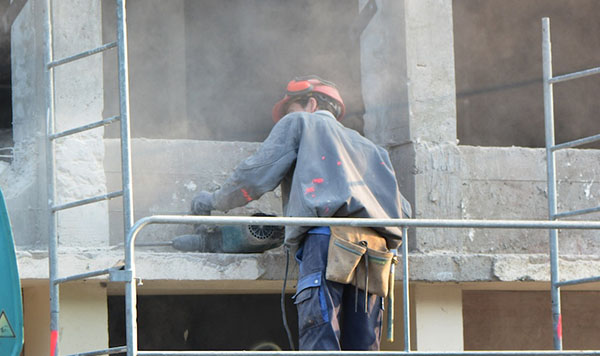
In discussions here, we focus primarily on the RetroPlate system; procedures are somewhat different for competing systems, though all are applied by trained professionals using sophisticated equipment. Here’s how the process works. Large, walk-behind machines with rotating diamond-abrasive heads remove the surface layer of the concrete and achieve a fine polish. Progressively finer diamond-abrasive wheels are used, starting with 30- or 40-grit, a very coarse grinding abrasive that removes thickness quickly, and moving to 150- and then 300-grit grinding using metal-bonded diamond heads. From there,
resin-bonded diamond heads achieve various degrees of polishing—for example 800-, 1,000-, 1,500-, and 3,000-grit. The final 3,000-grit polish creates a highly reflective sheen.
The better grinding and polishing machines have one large drive with a 19"- to 32"-diameter (50–80 cm) disk that rotates in one direction, with several smaller heads mounted on it that rotate in the opposite direction. The result is that the diamond abrasives travel randomly over a large diameter, producing a flatter grind.
The grinding and polishing machines can operate either wet or dry. Dry grinding shortens the life of some grinding heads, due to heat build-up; integral high-efficiency vacuum systems capture nearly all of the dust generated. Wet grinding and polishing does not generate dust, but it does produce a slurry that has to be disposed of. Some processes start with dry grinding, then switch to a wet process when the densifying chemicals are applied (see below).
The grinding and polishing machines are heavy and expensive, and they use a lot of power. Often, they operate at 220 or 460 volts using three-phase power at up to 30 amps; some require transformers to step the voltage up or down. Floor grinders and polishers weigh from 300 to 1,500 pounds (136–680 kg) and cost from $8,000 to $30,000, according to
Concrete Construction magazine. Heavier machines are beneficial when significant thickness has to be removed.
At some point in the grinding process, sodium silicate (or a related silicate or siliconate) is applied to the floor to densify, or harden, the concrete. The solution is absorbed into the concrete matrix, filling the pores. Chemically, the silicate reacts with the calcium hydroxide in the concrete to produce calcium silicate hydrate. Sodium silicate is the most common hardener, and a proprietary formulation of it is used in the RetroPlate process. Potassium silicate, lithium silicate, and various siliconates are also used in other proprietary formulations. After the silicate infuses into the concrete, it crystallizes in place. Then the polishing continues. This silicate-hardening process is very similar to what happens chemically with mineral silicate paints (see
EBN
Vol. 12, No. 10 and
Vol. 12, No. 12).
The thickness of the concrete floor that is removed depends on the condition of the slab and the needs and preferences of the client. With older slabs, or where a terrazzo look is desired (with aggregate exposed), it may be necessary to remove as much as 1⁄4 inch (6 mm). More commonly, a much thinner layer is removed (about 1⁄16 inch, 1.6 mm); this does not extend into the concrete aggregate, but only into the hardened cement fines or paste.
With new concrete, it is possible to obtain various appearances by adding colored aggregate (glass cullet, bits of metal, colored stone, etc.), by “seeding” the surface of the slab with additional aggregate before the concrete sets, and by adding integral pigments or other ingredients to the concrete. Various tips, such as using a low-slump mix (to keep aggregate near the surface) and avoiding walking through the wet concrete (which can push the aggregate down and result in noticeable pattern differences in the polished surface), will help to ensure an attractive finish. With new concrete applications, the polishing and hardening process cannot be done for at least 28 days—some suggest 45 days—to allow the concrete to set fully.
Silicate-densified, polished concrete floors have a number of significant environmental, health, and economic benefits.
The polishing and densifying process creates a very hard, durable surface. The RetroPlate system increases the abrasion resistance of the concrete surface by up to 400% and the impact strength by up to 21% (based on ASTM C805 tests), according to the company. The surface is not affected by ultraviolet (UV) light, and it resists liquid penetration. RetroPlate carries a ten-year warranty, though significantly longer life is expected.
From an economic perspective, the biggest selling point of polished, hardened concrete is its very low maintenance requirements. (See table for life-cycle costs on page 14.) Keith Powell, whose company, Summit Industrial Maintenance, Inc., in Dayton, Ohio, offers a wide range of floor-finishing systems, including epoxy coatings, has seen his business increasingly shift toward concrete polishing and densification. “The case for maintenance really changes people’s minds,” he told
EBN. “We don’t see any reason to coat floors,” he says. “There’s no stripping or waxing, ever.”
RetroPlate was initially developed as a way to solve dusting and spalling problems with old warehouse floors, and it is still widely used for restoring concrete floors. Roughly half of the 700,000 ft
2 (65,000 m
2) of floor that Summit has treated with concrete polishing and densification in the past two years have been older floor slabs. Concrete polishing and densification makes an old slab new again—actually far better than when it was new. Acid stains can be added during the process to adjust the color of older slabs.
When a fairly standard concrete slab is converted into an attractive, shiny, finished floor, adding a separate finish floor is unnecessary. Conventional practice with concrete floor slabs has been to add topping slabs, glue on resilient flooring materials (VCT, sheet vinyl, rubber, etc.), provide underlayment and carpeting, or build some other type of new floor system on top of the concrete. By polishing and densifying the concrete, all these options are avoided, saving raw materials and money and reducing environmental impacts. As noted above, the appearance of polished slabs, especially new concrete, can be enhanced in various ways. For more discussion of the benefits of using structural components as finishes, see
EBN
Vol. 9, No. 3.
Other than the sodium silicate—an inert compound that has been used in laundry detergents for 120 years and is considered very safe—RetroPlate’s concrete polishing and densification uses no chemicals. There are no VOCs, epoxies, polyurethanes, waxes, or strippers, and no caustic or acidic cleaning compounds are needed. Jeff Greene, of Greene & Gasaway Architects in Federal Way, Washington, has used RetroPlate on several schools, including Federal Way’s Todd Beamer School, completed two years ago. “The basic driving issue has been indoor environmental quality,” he told
EBN. A number of architects and specifiers
EBN spoke with expect to see this type of product increasingly replace VCT in hallways, cafeterias, and, to some extent, even classrooms in schools.
Because densifying concrete reduces its porosity, chemical spills can much more easily be cleaned up before staining or otherwise damaging the floor. Peter Wagner, the marketing director at RetroPlate, describes a finished floor like GoreTex
®—it allows moisture vapor to escape, yet causes liquid to pool so it can be cleaned up. The more highly polished the slab, the easier the cleanup of spills.
Polished, densified concrete is totally fire resistant. Unlike carpeting and many other types of flooring, no chemicals, such as brominated flame retardants, need to be added for fire resistance, and the floor surface does not contribute in any way to fire spread.
Increasing the reflectivity of the floor surface may allow ambient lighting levels to be reduced. RetroPlate claims that finishing a slab floor with its system increases reflectivity by up to 30%. At a Volkswagen distribution warehouse in Richmond, British Columbia, the floor was so much brighter and reflective than expected after finishing the slab with RetroPlate that the company was able to turn off one-third of the lighting, saving a significant amount of energy.
Because a layer with lower thermal conductivity is not added on top of the slab (as it is with resilient flooring or carpeting), the thermal mass of that slab can fully contribute to heat storage in the building. Any facility relying on passive solar heating or night-flushing for cooling can benefit from this feature.
Not everyone is thrilled with the results from polished concrete, for various reasons. At the recently completed Sequoyah Middle School in Federal Way, Washington, “we had a number of problems with the installer and were not happy with the polishing they did in tight corners, at threshholds, and in other difficult spots,” reports Kristian Kicinski of Bassetti Archtitects in Seattle. Kicinski has also heard that staff at West Seattle High School are unhappy with their RetroPlate installation because they continue to polish and wax it as if it were VCT.
Slip resistance is a concern with many floor systems, but particularly with as hard a floor as concrete. Risk of injury is one of the biggest drawbacks to concrete. Intuitively, one might suspect that a highly polished concrete floor would become highly slippery—and thus more of a problem. It turns out that’s not the case. “Even the high sheen exceeds OSHA and Americans with Disabilities Act (ADA) requirements for slip resistance, according to Powell and materials supplied by RetroPlate. “It isn’t slippery,” says Powell. “You have to put your feet on it to believe it.”
Just as densifying concrete increases its light reflectivity, it may also slightly increase sound reflectivity. Though
EBN has not seen data to this effect, a polished, densified concrete floor may be acoustically
brighter than a standard concrete floor, and it would assuredly be louder than a floor covered in a softer material, such as linoleum, cork, or carpeting.
As with ceramic tile, terrazzo, and other concrete floors, polished concrete floors are more thermally conductive than most other flooring options. If not insulated beneath, the concrete slab floor may provide a significant conductive pathway for heat loss from a building, and it will reduce the mean radiant temperature (MRT) of a space, making occupants feel colder at a given air temperature. While this can be beneficial in the cooling season or when a building is being cooled, allowing the air temperature set point to be kept slightly higher, it does the same in the heating season, which carries an energy penalty—making it necessary to keep the air temperature higher. Even if a concrete slab is insulated underneath (and at the same temperature as the air), it can feel cool to the touch, leading to occupant discomfort and requiring a higher thermostat set point.
Like other hard-surface flooring, polished concrete causes fatigue for those who have to stand on it for long periods of time. Appropriate area carpets or mats should be used to avoid these problems.
RetroPlate and other densified, polished concrete flooring systems are not the least expensive flooring options when it comes to first cost—though they are far from the most expensive. Powell told
EBN that costs range from $2.50 to $5/ft
2 ($27–$54/m
2), depending on the integral colorant or dyes, the difficulty of working in the space, and the size of the job. This is consistent with data provided by RetroPlate, though an article in
Concrete Construction put the upper price range somewhat higher, at $8/ft
2 ($86/m
2).
With most materials—but especially with flooring—total life-cycle costs are far different from installed (or first) costs. With some flooring options, the cost of maintenance can exceed the installation cost during the first year! Polished, densified concrete has very low maintenance cost, as noted above. The material’s long life and low annual maintenance cost contribute to the lowest life-cycle costs of any common flooring type, according to RetroPlate. Typical installed costs, annual maintenance costs, life expectancies, and ten-year life-cycle costs for common flooring types are shown in the table.
With such significant advantages of polished, densified concrete floors, it is quite likely that this will become the flooring option of choice for hard-surface flooring in schools, retail stores, industrial buildings, and a wide range of other commercial buildings. It is also likely that we will begin to see greater use of concrete polishing and densification for residential floors. It makes sense from a performance and maintenance standpoint, from an appearance standpoint, and from an economic standpoint.
– Alex Wilson
For more information:
RetroPlate™
Advanced Floor Products, Inc.
Provo, Utah
888-942-3144, 801-812-3420
Peter Wagner, Marketing Director
pbwagner@retroplatesystem.com
www.retroplatesystem.com
FGS® PermaShine
L&M Construction Chemicals, Inc.
Omaha, Nebraska
800-362-3331, 402-453-6600
www.lmcc.com
Certi-Shine™
Vexcon Chemicals, Inc.
Philadelphia, Pennsylvania
888-839-2661, 215-332-7709
www.vexcon.com
HTC Superfloor™
HTC-America
Knoxville, Tennessee
877-482-8700, 865-689-2311
www.htc-america.com

DISCUSSIONS
There are no comments for this page yet.

RELATED ARTICLES
|
|
EBN: Awards & Competitions - December 2006
|
|
EBN: Letters - April 2006
|
|
|
EBN: Awards & Competitions - December 2003
|
|
EBN: Product Review - October 2003
|
|
|
EBN: Feature - March 2000
|

RELATED PRODUCTS
|
Werk Industries / Fab-u-Floors Refinishing Services
|
|
Advanced Floor Products, Inc.
|
|
Kaufman Products, Inc.
|
|
L&M Construction Chemicals, Inc.
|
|
Advanced Floor Products, Inc.
|
|
|
|

RELATED CATEGORIES
GREEN TOPICS
IMAGE CREDITS:
1.
Photo: RetroPlate
2.
Photo: HTC-America
3.
Photo: RetroPlate
4.
Source: RetroPlate. Data from the National Terrazzo and Mosaic Association, Concrete Construction magazine, and other independent sources.