LIVE image

Affordable Housing Summit at Greenbuild - Report

Posted November 19, 2008 12:01 AM by Peter Yost
Related Categories: The Industry, LEED, Greenbuild '08, Politics
 

By Peter Yost and Allyson Wendt, posted live from Greenbuild.

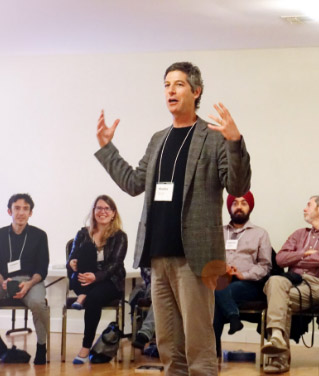
It's common knowledge that green building is anything but affordable. Or is it? You would have had a pretty hard time convincing the 100 or so folks at the USGBC's Affordable Housing Summit. They are convinced that green is actually affordable, both in terms of investment and operations budgets.

Heather Clark — from one of the largest property owners of housing in the U.S., Winn Development — stated that water efficiency improvements alone in 76 of their properties cost only $376,000 and saved them over $1.2 M in the first year! In this case, they were paying the water bills, but even if the retrofits had benefited the tenants directly, saving money is still saving money. And saving water is saving water.

I (Peter) have to confess that if I hear the term net present value one more time in the context of green building, I may pass out.

Net present value is based on an assumed discount rate. And just what discount rate should we use for the next 5 years, much less 10, 20, 30, or 40 years? We have to stop supporting the myth that we can evaluate the "worth" of really long term investments in high performance building enclosures (energy-efficient and durable) by "predicting" just what the price will be 25 years from now for materials much less energy. We continue to do this when, in less than one business quarter, oil went from nearly $150 a barrel to nearly $50. Lenders, investors, insurers, appraisers — they all need to stop this Ouija board nonsense. Our hyperfocus on payback periods simply does not work for conventional buildings, much less green affordable ones.

Another myth that got some busting at the Affordable Housing Summit was single-minded green building. We could call this "green damage." It happens when we focus on just energy efficiency and ignore moisture. It happens when we reduce green building to the right product selections rather than the right construction processes that go with those materials. Considerable time was spent discussing ways to document and value comprehensive building performance, rather than just one or two aspects of it.

While Peter was learning about net present value and green damage, I (Allyson) was learning about the struggles of building green when you can't pass the incremental costs onto your clients, homeowners below the median income. Payback figures don't mean much to the developers in these cases, since the savings are realized by the homeowner, who hasn't paid for the up-front costs. As we enter a recession, finding funding for all projects is getting more difficult, and "extras" like solar hot water or super insulation are almost out of the question. And certification? Unless you're lucky enough to get a grant, forget it!

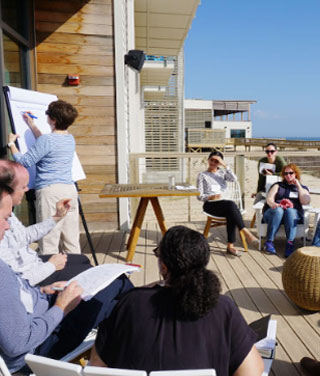
The summit attendees spent the afternoon in ten groups: charrettes for a wide range of real housing projects, ranging from hundred-plus unit partial rehabs to one single family detached Habitat for Humanity (HFH) home on Nantucket. It felt to me (Peter, in the HFH Nantucket group) that we did a lot of green wondering and wandering. But interestingly, our group and the others felt that they had learned a ton — from what in the world is a vapor profile to how USGBC and The Home Depot Foundation financially support LEED certification for affordable housing projects.

In my (Allyson's) group, we were looking at a retrofit of an old mill building in Lawrence, Massachusetts. Un-insulated brick walls, solid wood floors, older double-pane windows — and restrictions because of historic building tax credits. The group discussed options for insulating the walls and insulating the units acoustically from each other. The design was already pretty far along, so we probably didn't affect the architect's choices much, but it was helpful to think through the issues as a group. I think we all learned quite a bit.

The long and short of it is this: of all those who need durable, low maintenance, energy and water efficient homes, it is the folks dedicating the most of their income to those same costs that need green building. We can't afford for green building NOT to be affordable!

For more information from the Affordable Housing Summit, go to the LEED for Homes website next week.

Comments (0) | Send | | 3248 Views

Comments

(Comment Moderation is enabled. Your comment will not appear until approved.)


Get new posts via e-mail:


Recent Comments

Redefining What Makes a Building Product Green

Rick Duncan says, “Jennifer, I just received the January 2012 EBN yesterday and your feature article written with Paul...” More...

Paula Melton says, “Ramakrishna, I don't think anyone's suggesting that we do without any biobased materials. Right no...” More...

Ramakrishna Venkatasamy says, “I hardly think any building can do without wood or other bio-based materials. There is still the iss...” More...


Energy Modeling, Building Size, and BIM—What’s Cost-Effective?

Robert Riversong says, “I've found that basic energy modeling is so cost-effective, it would be crazy not to use it, prefera...” More...


Redefining What Makes a Building Product Green

Robert Riversong says, “Rick Duncan, I realized that the study I quoted might be considered a bit out of date (even if the ...” More...


Follow BuildingGreen
Follow us on Twitter Follow us on Facebook Follow us on Linkedin