LIVE image

Green Economies of Scale (post-Greenbuild ruminations)

Posted November 30, 2009 4:42 PM by Jennifer Atlee
Related Categories: Op-Ed, Greenbuild '09, The Industry
 

By the end of Greenbuild, I was exhausted/troubled/elated with all sorts of conundrums swirling around in my head — not to mention a few partly written blogs, abandoned in favor of the next conversation...

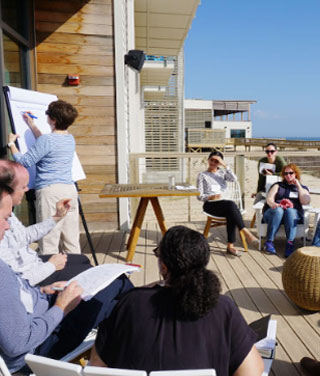
... I had wanted to write about the 'executive roundtable' that happened that Wednesday — and responses to the twitter-submitted question "what single thing would have to change to make buildings actually regenerative?" (as in, way past 'less damaging' — past neutrality, even). I was encouraged to hear the execs express what I see as core issues (summarized and/or quoted below — no, I didn't record who said what):

  • Waste and consumption is ridiculously cheap. If energy costs go up to the tune of $150/barrel for oil (or on-site renewables became radically cheaper), and/or if a cost is attached to emissions (not just air — also sewer and solid waste), we could get there.
  • Our financial accounting systematically discounts the future. "We're trapped in a paradigm of net present value (NPV) — one of the worst tools known to man.... We need a new tool — 'Net Future Value'... and to start to reconceptualize buildings to see them as multigenerational assets."
  • Corporations have to focus on shareholder's financial return above all else. Yes, the technology is there to do zero energy buildings but "for a profit making business with shareholders expecting a return they cannot generally be duplicated over and over."

On the last point, the phrasing I found interesting — because later they were asked how to tell green from greenwash — and one of them said "you'll know a business has credibility when they stop talking about one-off projects and demonstrate [that performance] across the board."

I put these two quotes together, out of context, because what I think it points to is that if we're really going to take green to the scale that is needed, we can't kid ourselves that we can do it all within the current economic rules-of-the-game that stack the deck against stewardship and the future. (Don't get me wrong, the Green Building movement is doing an incredible job within this context, but that doesn't mean the system works — rather, it's a testament to the smarts, creativity, passion, and perseverance of folks making change despite an imperfect market designed to thwart their best efforts).

At another session, the speaker reminded us that our economic system is a social construct — it's a story we've created, and we can revise that story. Let's not forget that, because ultimately if we don't find a way to align individual and corporate financial success with the wellbeing of future generations and the environment, we'll find ourselves without either.

Comments (2) | Send | | 3530 Views

Confronting Water Shortages — Post-Greenbuild Travels in Southern Arizona


(click photos for larger versions)
Greenbuild in Phoenix was the usual high-energy panoply of educational sessions, new product introductions in an ever-larger trade show, networking events, and — the reason our company sends so many of us — opportunities to promote our green building information resources.

But this year, I was also looking forward to some vacation time following the conference. Jerelyn and I took five days' of vacation after Greenbuild to explore southern Arizona and celebrate our 25th anniversary. As day transitions to night on the flight back east, I reflect on that time.

On Saturday morning, we traveled southeast from Phoenix, past Tucson, to the Hacienda Corona do Guevavi bed & breakfast in Nogales, Arizona, just a stone's throw from the Mexican border. The region is rich with wildlife and draws thousands of birders and others from throughout the world each year. Along with hundreds of bird species in the canyon oases sprinkled throughout Cochise Country (we saw about 60 species in our travels) are such exotic mammals as coati, ringtail, antelope jackrabbit, collared peccary (javalina), cougar (mountain lion), bobcat, and maybe (at least before the border fence) the rare cats ocelot and jaguar. Other than the antelope jackrabbit, we didn't see any others of those mammals, but it was great imagining them watching us from hidden spots rock ledges during our daily hikes.

On all of these hikes, at least when I wasn't trying to identify another new bird species, I spent time thinking about — and discussing with Jerelyn — the water crisis facing this region.

Read more...

Comments (5) | Send | | 4376 Views

Overheard (live from Greenbuild)

Posted November 12, 2009 4:41 PM by Mark Piepkorn
Related Categories: Greenbuild '09
 

Two guys were walking down the hall. Professional-looking guys, architectorial. One of them said to the other, "It's called, um, energy... recovery ventilator."

BAM! That's what it's about. Yeah, there's greenwash, there's cynicism, there's impatience. But there's also people finding their way forward. We're all spread out along the learning curve, and that's something I have a difficult time keeping in mind. It's easy to feel like everything's too-little-too-late, and hard for me to give credit for good intentions where it's due.

And with that, I'm going to break with the blogging. I have an early flight, and am going to get ready for that. Perish the thought, I'm even going to skip our after-party. (Hey, it's my birthday — I'll do what I want.)

I may follow up with more yet today, depending on how tired I am after I get packed up and ready to flee. But most likely, the deluge will abate...

Comments (0) | Send | | 2242 Views

Plyboo's New Soy Adhesive (live from Greenbuild)

Posted November 12, 2009 2:34 PM by Mark Piepkorn
Related Categories: Greenbuild '09


Dan Smith of Plyboo bumped into me and we took a walk over to the Smith & Fong booth. They rolled out a new soy-based adhesive just today... and unlike some things that call themselves soy-based, I'm comfortable saying that about this adhesive. It's 60% soy.

It was formulated specifically for bamboo, Smith told me, and they expect to have a complete conversion of their plywood and flooring by the first quarter of 2010 — no more MDI (their current zero-VOC offering — which is zero-VOC for the consumer, but not for the fabricating workers), and no more PF. Both of those adhesives will be discontinued in favor of the new SoyBond.

It's a move up in pretty much every way, he said: Better for the makers, the users, and the environment. "At the end of the lifecycle, having an organic based adhesive that will break down better than other current alternatives is a step forward all by itself — but it also really responds to the challenge of working in China." (See Bamboo in Construction: Is the Grass Always Greener?)

Their non-emitting MDI line carried a bit of a price premium over the low-emitting PF line; now, all product will be non-emitting. It seems that the price difference that existed between the two lines will about average out — it will all be the most righteous glued-bamboo stuff available, and will cost less than the previous most righteous glued-bamboo stuff available due to manufacturing economics. It's easier to make more of one line than less of two, even if there's no cost savings on the resin.

Testing to verify compliance with California 1350 begins next week.

As you'll recall, these are also the folks who offered the first FSC certified bamboo products.

Comments (0) | Send | | 3338 Views

Top-10 Green Building Products (live from Greenbuild)

Posted November 12, 2009 1:45 PM by Mark Piepkorn
Related Categories: Greenbuild '09
 

I normally post the Top-10 green building products list just as Alex is starting the presentation. And this year, I just totally spaced it out.

BuildingGreen Announces 2009 Top-10 Green Building Products

Phoenix, AZ, November 12, 2009 — BuildingGreen, LLC, publisher of the GreenSpec Directory and Environmental Building News, today announced the 2009 Top-10 Green Building Products. This eighth annual award, announced at the U.S. Green Building Council's Greenbuild Conference, recognizes the most exciting products drawn from recent additions to the GreenSpec directory and coverage in Environmental Building News.

"Our selections of the Top-10 Green Building Products represent a wide range of product types in many different application areas," noted BuildingGreen founder and executive editor Alex Wilson. This year's list is particularly diverse, ranging from a recycled-content concrete block, to a flywheel energy storage system for data centers, a mobile solar generator for job-site power, and an advanced modular classroom for schools.

Energy-saving products among the Top-10 include a line of mineral wool insulation, an integrated rain-screen / insulation wall cladding for commercial buildings, a heat-pump water heater, and an energy control system for lighting in commercial buildings. A structural matrix system, Silva Cell, provides a support system for urban tree roots, helping trees survive in largely impervious environments and helping to manage stormwater runoff.

One of the nation's most innovative furniture makers, Baltix, is being recognized for new products that incorporate a variety of biobased, FSC-certified, and recycled-content materials. "Many of the Top-10 products this year have multiple environmental attributes," said Wilson.

BuildingGreen's Top-10 product selections, as in previous years, are drawn from new additions to the company's GreenSpec product directory. About 200 product listings have been added to the GreenSpec database during the past year. "New products are being introduced all the time, making it a challenge for our staff to keep up," said Wilson. [No kidding — Mark] "We also continue to come across products that have been on the market for years, but were under our radar screen." The GreenSpec database includes more than 2,100 product listings.

A major driver of the development of green products continues to be the U.S. Green Building Council's LEED Rating System (Leadership in Energy and Environmental Design), which awards points for the use of certain product types, such as certified wood, or for the energy savings that green products can achieve. "Designers of LEED buildings are looking for green products, and manufacturers are responding," said Wilson. In the online version of GreenSpec, users can find products organized by LEED credits as well as by building category and the CSI MasterFormat structure.

The 2009 Top-10 Green Building Products are listed below. Complete descriptions and contact information are provided on BuildingGreen.com:

  • Pozzotive Plus CMUs and Concrete Brick from Kingston Block
  • Thermafiber Mineral Wool Insulation Products
  • Invelope Integrated Wall Insulation and Rainscreen System
  • Baltix Recycled- and Biobased-Content Office Furniture
  • Project FROG Modular Green Classroom
  • Rheem HP-50 Heat-Pump Water Heater
  • Convia Energy-Management Infrastructure
  • Pentadyne GTX Flywheel Energy Storage
  • Silva Cell Subsurface Tree Protection and Stormwater System
  • Mobile Solar Power Generator

Comments (0) | Send | | 4104 Views

"The Perfect Conversation Piece" (live from Greenbuild)

Posted November 12, 2009 1:04 PM by Mark Piepkorn
Related Categories: Greenbuild '09
 

You know my card went into that bowl. It's a Sloan Uppercut, and yes — the flush handle toggles the light. It would go great with my Christmas Story leg lamp.

Comments (0) | Send | | 2034 Views

LEEDuser Booth Talk/s (live from Greenbuild)

Posted November 12, 2009 12:48 PM by Mark Piepkorn
Related Categories: Greenbuild '09


Despite my expo-only access, I haven't had a lot of time for product-crawling.

Our booth is all about LEEDuser.com this year, fresh from its full launch. Throughout the Expo we've had guest experts from the LEEDuser team in to discuss specific LEED points. I've been tasked with videotaping those smart people talking about this fascinating stuff — fascinating for anybody who happens to be bent that way, not just LEEDies. The schedule has included:

  • Josh Radoff of YRG Sustainability on NC SSc8: Light Pollution Reduction

  • Penny Bonda on CI MRc3: Materials Reuse

  • Erik Dyrr of KEMA Services on CS EAc1: Optimize Energy Performance

  • Carli Bullock Jones on CI IEQc8.1: Daylight and Views — Daylight

  • Lauren Yarmuth of YRG Sustainability on NC WEc2: Innovative Wastewater Technologies

  • Chris Lander of Veridian on NC WEc2: Enhanced Commissioning

  • Jenny Carney of YRG Sustainability on EBOM WEp1: Minimum Indoor Plumbing Fixture and Fitting Efficiency

  • Nadav Malin of BuildingGreen – LEEDuser on NC MRc5: Regional Materials

  • Valerie Walsh of LEED Management Services on NC MRc2: Construction Waste Management

The idea is that parts or all of this footage will end up on LEEDuser.

Even though I haven't been getting around the floor all that much this year, I suspect the post-show repercussions will be more intense than usual. Jane Kolleeny, the tireless Managing Editor of GreenSource, has been doing an amazing job of handing out my cards at booths with potential GreenSource products as she makes her rounds. Never has my contact information been distributed with such frequency and intensity. Go Jane go! Where does she get the energy? (Where will I?)

Comments (0) | Send | | 2499 Views

The Plenary – Rick, Al, Sheryl, and the World (live from Greenbuild)

Posted November 12, 2009 8:14 AM by Mark Piepkorn
Related Categories: Greenbuild '09
 

When I found out about a week ago that I was going to Greenbuild after all — on an exhibitor registration — I didn't think Al Gore and Sheryl Crow were in the cards for me. I was prepared to accept that. Then folks at Cosentino North America came through with an invitation to their private box — and it turned out that not only did that invitation get me into a private box in the stadium, it was a pass onto the field level.

I don't have attendance figures for the conference; I've heard guesses of 30,000 or more. I asked a cop directing traffic last night if he'd heard anything; "No," he said, "but it's a lot."

The opening remarks by Rick Fedrizzi were the usual fare — we're fantastic, we're visionaries, we're saving the world.

Watching the plenary in Cosentino's box

A really nice touch, I thought, is that they had the leaders of green building movements from around the world also making statements. This is a global thing, it has to be.

Video is going to be available at the Greenbuild website (and presumably at greenbuild365.org as well). Since none of it was earth-shattering, I'm not going to get into who said what; check it out in a few days at one or the other of those websites. It was about as reported in the Arizona Republic.

I watched the opening statements and the plenary from Cosentino's box, up on the third tier and a little behind the stage. The audio in the stadium back there was unintelligible, so everyone trouped into the box to watch it on closed-circuit TV.

After the plenary, I went down to field level; ran into some people I work with, some people I don't. The thing I like best about Greenbuild is the opportunity to see people that I never see anywhere else — once a year, at Greenbuild. One thing stressed in the opening remarks is that this stuff we're doing is about people, and I can get behind that completely.

Sheryl Crow put on a fine show.

Rick Fedrizzi says so

In Cosentino's box

Al Gore, live on TV

Watching the plenary in Cosentino's box

Cosentino's third-tier box from the field

Sheryl Crow

Comments (0) | Send | | 2175 Views

Eight Essentially Random Photos From Around Greenbuild (live from Greenbuild)

Posted November 11, 2009 10:49 AM by Mark Piepkorn
Related Categories: Greenbuild '09
 
Comments (0) | Send | | 2088 Views

Better Living With Chemicals (live from Greenbuild)

Posted November 11, 2009 7:58 AM by Jennifer Atlee
Related Categories: Greenbuild '09
 

I seem to be on the chemical redlist circuit this month.

Last night at GreenBuild I attended Perkins + Will's panel-and-schmooze event to discuss their brand new precautionary list of 25 chemicals that P+W wants to see out of building products. They've created a publicly available website with their avoid list and you can view the list by MasterFormat divisions, or by health effect, not just by chemical. So instead of glazing over while scanning a list of chemicals, a designer can quickly skip to say, Div 07 and find 14 chemicals to watch out for AND a list of alternative materials. P+W is already actively scrubbing the listed chemicals out of their material libraries and specs in favor of alternatives.

Last week I spoke at the Toxics Use Reduction Institute's 20th anniversary conference. TURI and the TUR Act is a model for pragmatic work helping manufacturers in Massachusetts reduce toxics in their processes and products and adopt alternatives that make sense. I spoke about how GreenSpec deals with known and unknown chemical and other constituent hazards in evaluating products (more on that sometime post-Greenbuild) — and also heard some of the latest research on health impacts of nano materials...

As the P+W panel was discussing, a lot comes down to how you deal with what we DON'T know. That's because there's a lot more unknown than known: Few of the some 80 thousand chemicals in use today have been thoroughly tested for environmental, health, and safety; many product constituents are considered trade secret or just too small in quantity to be on the MSDS; and we're discovering that certain classes of compounds (endocrine disrupters, nano materials) don't follow our general understanding of how harm occurs.

Do we ignore what we don't know or do we actively acknowledge this uncertainty as part of making the best decisions we can? When a design firms steps in to lead — and share — in the way Perkins + Will is doing here, it raises the bar.

Next up on the circuit is Pharos — I keep hearing rumors about their new online chemical database. Sometime in the Greenbuild whirlwind I'll make it to their booth for a tour.

Comments (0) | Send | | 2130 Views

  1 2   >   >>

Get new posts via e-mail:


Recent Comments

Redefining What Makes a Building Product Green

Paula Melton says, “Ramakrishna, I don't think anyone's suggesting that we do without any biobased materials. Right no...” More...

Ramakrishna Venkatasamy says, “I hardly think any building can do without wood or other bio-based materials. There is still the iss...” More...


Energy Modeling, Building Size, and BIM—What’s Cost-Effective?

Robert Riversong says, “I've found that basic energy modeling is so cost-effective, it would be crazy not to use it, prefera...” More...


Redefining What Makes a Building Product Green

Robert Riversong says, “Rick Duncan, I realized that the study I quoted might be considered a bit out of date (even if the ...” More...

Jennifer Atlee says, “Richard and Robert, We at BuildingGreen have long been advocates of considering the full lifecycle o...” More...


Follow BuildingGreen
Follow us on Twitter Follow us on Facebook Follow us on Linkedin