Described below are the Top-10 Green Building Products for 2006, selected by the editors of GreenSpec® and Environmental Building News™. These products have either been added to GreenSpec during the past year (though some may have been on the market longer), or covered in Environmental Building News. Additional information on these products is available in the online edition of GreenSpec or Environmental Building News, both of which are available through the subscription-based BuildingGreen Suite (www.BuildingGreen.com).
[view GreenSpec listing]
Polishing concrete is a relatively new technique for turning both new and old concrete slabs
into attractive, durable, finished floors. RetroPlate™ (from Advanced Floor Products, Inc.) of
Provo, Utah, pioneered this process of grinding, polishing, and chemically hardening (densifying)
concrete in the 1990s, and its system has now been used on more than 100 million square feet of
flooring. The RetroPlate process was developed by combining European stone-grinding and polishing
technology with concrete hardening and densifying agents that had been used in North America. In the
process, large walk-behind diamond-wheel grinders remove between 1/16th and 1/4 inch of the concrete
floor surface. Consecutively finer-grit grinding and polishing wheels achieve a fine polish (up to
3,000-grit). During the polishing process, sodium silicate is applied; this is absorbed and reacts
with the calcium hydroxide in the concrete to form calcium silicate hydrate, which crystallizes
within the concrete matrix. The resultant concrete surface is highly durable, easy to maintain, free
of VOC emissions, and more reflective (which can reduce light level requirements). The system
enables the concrete slab to serve as the finished floor surface, thus reducing material use.
[view GreenSpec listing]
Triton Logging, Inc. harvests underwater standing trees from forests that were submerged
decades ago by reservoirs created by hydroelectric dams. In British Columbia alone, Triton estimates
that there are five billion board feet of salvageable underwater timber, and worldwide the total
could exceed 100 billion board feet. The company uses its proprietary Sawfish™ logging submarine,
which is tethered to a surface ship and controlled remotely. The Sawfish clamps onto a standing
tree, attaches inflatable floats, then cuts the trunk with an electric chainsaw; the tree floats to
the surface where it is processed and loaded onto a barge. Because the trees are cut the reservoir
floor, sediments are not disturbed in the process. The company recovers Douglas fir, western white
pine, lodgepole pine, hemlock, and other species year-round using three Sawfish submarines. All of
the milled wood is certified as SmartWood Rediscovered by the Rainforest Alliance. The company
produces a range of lumber products and is launching a line of glulam beams made from
underwater-salvaged timber.
[view GreenSpec listing]
SageGlass® is an electronically tintable exterior glazing that provides glare control on
demand while preserving views. Unlike earlier switchable glazing products that degraded with
exposure to UV light, SageGlass is a multi-layer, thin-film tungsten-oxide coating that is as
durable as low-emissivity coatings. The glazing uses 0.28 W/ft2 to switch the glass from clear to
tinted state, a process that takes several minutes, and 0.1 W/ft2 to maintain that tinted state.
Used with typical clear glass in an insulated glazing unit, SageGlass reduces the visible
transmittance from 62% to 3.5% while reducing the solar heat gain coefficient from 0.48 to 0.09.
Sage Electrochromics, Inc. is partnering with numerous window, skylight, and curtainwall
manufacturers to produce both commercial and residential products with this glazing control options;
these products can provide energy savings, control peak electricity demand, enhance comfort, and
potentially result in higher worker productivity. The product is available from such partners as
Velux®, Architectural Wall Systems, Inc., Harmon, Inc., the Vistawall Group, Wausau Window and
Wall Systems, and YKK AP America, Inc. While SageGlass is currently very expensive (increasing the
cost of insulated glass six- to seven-fold), Sage Electrochromics expects the cost to eventually
become competitive with standard high-performance glazing combined with interior mechanized shades.
[view GreenSpec listing: Composition Siding]
[view GreenSpec listing: Countertops]
[view GreenSpec listing: Toilet Partitions]
PaperStone™, from KlipTech Composites, is a dense, hard, water-resistant, solid-surface
composite material used for skateboard ramps, countertops, toilet partitions, and exterior
rainscreen siding. It is made from cellulose fiber (paper) and a non-petroleum phenolic resin
derived in part from a natural phenolic oil in the shells of cashews. KlipTech offers two versions
of the product: standard PaperStone contains at least 50% post-consumer recycled paper; the newer
PaperStone Certified has 100% post-consumer recycled paper. The latter product is third-party
certified by SmartWood to carry the Forest Stewardship Council (FSC) recycled-content label.
Overall, the product is 60% paper fiber by weight and 40% resin. KlipTech has been producing the
PaperStone rainscreen product (PaperStone XV) exclusively for Starbucks until November, 2006, when
it rolled out the product for broader uses. While PaperStone Certified today includes some
coal-derived phenolic resin, company founder and vice-president Joel Klippert expects to convert to
100% natural resins in 2007.
[view GreenSpec listing: 100 Percent]
[view GreenSpec listing: Varia]
Two interior panel products from 3form, Inc. offer interior designers a wide range of design
opportunities coupled with recycled content and low emissions. Varia™ is 3form's line of
eye-catching transparent and translucent panels made from its 40% pre-consumer recycled-content
Ecoresin™, which is a copolyester (PETG) that is chemically similar to the PET used in beverage
containers. Some of the Varia products include plant materials—collected by indigenous peoples using
environmentally responsible practices—that impart biophilic design features to the product, helping
building occupants feel more connected to nature. The opaque 3form 100 Percent product is made from
100% post-consumer recycled high-density polyethylene (HDPE). Available in a range of colors and
patterns, 100 Percent is appropriate for such applications as toilet partitions, interior
workstations, and interior trim. The company has recently added UV-inhibitors that make the product
appropriate for outdoor applications. Scientific Certification Systems has certified the recycled
content of 3form Varia and Greenguard Environmental Institute has certified its low emissions;
similar certifications for 3form 100 Percent are expected in 2007.
3form, Inc.
2300 South 2300 West, Suite B
Salt Lake City, UT 84119
Phone: 801-649-2500
Toll-free: 800-726-0126
Fax: 801-649-2699
www.3-form.com
Jennifer Voros, Marketing Coordinator
3form, Inc.
Phone: 801-649-2592
Cell: 801-641-0808
jen.voros@3-form.com
[view GreenSpec listing]
Timbron® International, Inc. produces interior molding in a variety of profiles that
are made from at least 90% recycled polystyrene—75% post-consumer and 15% pre-consumer,
certified by Scientific Certification Systems. (The company claims that the typical
recycled content is 95%-97%.) The product, first introduced in 2000, is made from both
expanded polystyrene packaging foam and high-impact polystyrene from such sources as
compact disc jewel cases; small quantities of a coloring agent, a UV stabilizer, and a
foaming agent; additional flame retardants are not added. Timbron is highly durable,
waterproof, termite-proof, paintable (though also suitable unpainted as white), and fully
workable with carpentry tools. The manufacturer is planning to have third-party VOC
emissions testing conducted and expects Timbron to be certified as non-emitting. While
usable anywhere indoors, the product is especially appropriate for kitchens, bathrooms,
laundry rooms, and basements, where moisture or humidity levels may be high. Timbron is
manufactured in Stockton, California, distributed nationally, and available in more than
1,700 Home Depot stores. Cost is comparable to or slightly higher than finger-jointed
pine.
[view GreenSpec listing]
In April 2006, Delta Faucet Company introduced a revolutionary showerhead that
delivers superb performance using just 1.6 gallons of water per minute. Delta worked with
Bowles Fluidics Corporation to develop their H2Okinetic Technology™, which produces
droplets that are fairly large, resulting in good heat retention and body wetting. By
comparison, many low-flow showerheads either create very small droplets or aerate the
water, either of which can allow the water to cool quickly and make showering less
satisfactory. The showerhead is currently available only with a chrome finish, but a
stainless steel model and other designs are coming in early 2007.
[view GreenSpec listing]
The best option for outdoor landscapes is usually native, climate-appropriate
plantings that do not require irrigation, but where irrigation is required, efficiency is
essential. HydroPoint® Data Systems, Inc. has revolutionized irrigation management in
North America through its WeatherTRAK® irrigation control systems that create watering
schedules based on physical landscape features (soil type, slope, and plantings) as well
as weather data that is beamed wirelessly to the controllers each day. While most
irrigation controllers base water delivery on time-of-day metering, sometimes with
override controls for soil moisture, the WeatherTRAK system uses actual local weather
conditions to examine evapotranspiration (ET) rates and regulate water delivery
accordingly—so that irrigation will occur in the correct amounts and not if rainfall is
occurring or predicted. According to HydroPoint, 60%-65% of urban water use goes to
outdoor irrigation, and 30%-60% of that is wasted. The WeatherTRAK system has been shown
to reduce outdoor water use by up to 59%, according to the Santa Barbara County Water
Agency and reduce non-point source runoff pollution by as much as 71%, according to
various agencies, including the U.S. Bureau of Water Reclamation. Both residential and
commercial WeatherTRAK systems are fully compatible with most irrigation systems, and they
also offer an Internet control unit. The company has partnerships with irrigation
equipment providers The Toro® Company and Irritrol® Systems.
[view GreenSpec listing]
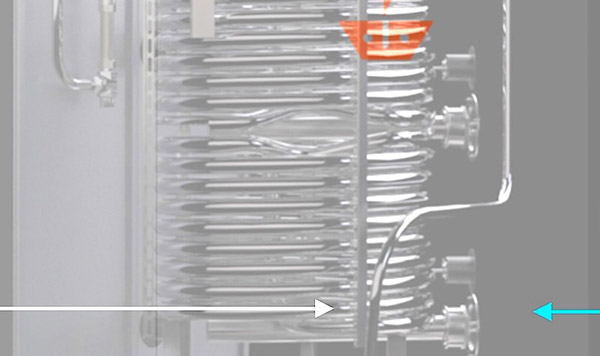
The Coolerado Cooler is a revolutionary air conditioning system that relies on the
evaporation of water (latent heat of vaporization) to cool a space, but its similarity to
standard evaporative coolers, or swamp coolers, is so remote that the company does not
even use the term "evaporative" to describe its product. Conventional (direct) evaporative
coolers cool the air that is blown into the living space by evaporating water into that
air, raising the humidity. Direct-indirect evaporative coolers introduce less moisture,
but still raise humidity. The Coolerado is an all-indirect system that does not add any
moisture. (Because of this, it can be used in some areas of the country that are
inappropriate for direct or direct-indirect evaporative coolers, though it still makes the
most sense in drier areas in the western U.S.) It can be used in series or parallel with
conventional compression-cycle air conditioning, because it won't add moisture and make
the conventional system work harder. The Coolerado R600 delivers four to six tons of
cooling with electricity consumption of 1,200 watts—750 watts if specified with an
electronically commutated motor (ECM). The cooling output depends on the temperature and
humidity of the outside air; in Las Vegas the cooling output in tons will be much greater
than in Boston. The energy efficiency ratio (EER) is 40-plus, according to the company—two
to three times as efficient as the best compression-cycle air conditioners. Water
consumption can be significant; it is comparable to or slightly lower than that of direct
evaporative coolers—as much as 12 gallons per hour at peak load, but typically averaging
about 4 gallons per hour over the cooling season.