Product Review from Environmental Building News
December 1, 2009
Pentadyne GTX:
Backup Power from a Flywheel
In a power outage, facilities such as data centers, factories, and hospitals use generators, or gensets, when the power goes out, but gas- and diesel-powered generators don’t come online immediately, so short-term backup power is required. This is the function of uninterruptible power supply (UPS) systems, most of which use lead-acid batteries. Unfortunately, these lead-acid battery systems pose serious environmental problems. There is a more responsible alternative: the Pentadyne GTX flywheel.
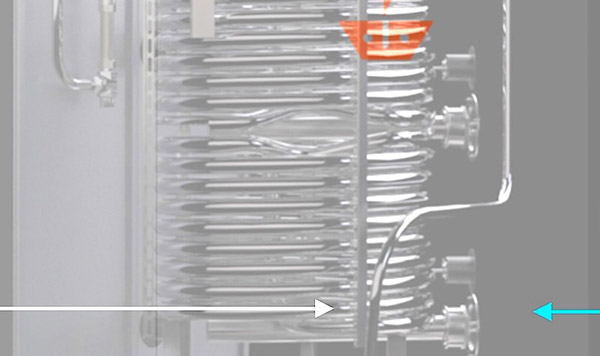
Flywheels are spinning disks that store kinetic energy for use as a short-duration power supply. These systems have been around since the 1960s, but older units used heavy steel discs weighing as much as 6,000 pounds (2,700 kg) that spun at relatively low speeds of less than 4,000 rpm. Newer steel flywheels are lighter and spin faster but still require special installation and regular maintenance, consume a lot of power, and generate a lot of heat. Pentadyne flywheel systems, however, store power using a lightweight hub and carbon-fiber flywheel weighing just 58 pounds (26 kg) and spinning at up to 52,000 rpm.
“Kinetic energy is equal to mass times velocity squared,” said Jeff Colton, senior vice-president of sales and marketing at Pentadyne, “so doubling the rotational speed quadruples energy storage.” Using high-speed rotation, the GTX can supply 200 kilowatts of continuous power for over 12 seconds and recharges in less than 15 seconds; the units can also be linked in parallel for larger kilowatt demands or run time. This may not seem like a useful amount of coverage, but 98% of all power anomalies last less than ten seconds, according to the Electric Power Research Institute.
Pentadyne’s high speeds are possible because the flywheel is suspended using magnetic levitation and spins in a vacuum. The vacuum is unique because it doesn’t require a pump, and with no friction from bearings and no pump, the system uses only 250 watts of standby energy—far less than the 2000–3000 watts used by competing steel flywheel systems.
The energy consumption of the Pentadyne GTX is roughly the same as a comparable battery backup system, but the company claims that its flywheel system is far more reliable, with over 6 million hours of operation since 2004. “When a backup power system fails, 40% of the time it’s because a battery failed to hold the load,” according to Colton. He claims that the GTX is at least 20 times more reliable than a battery backup system, which is comprised of hundreds of 2-volt cells in series, so it only takes a problem in one cell for the entire system to fail. The GTX comes with a five-year warranty and an estimated lifespan of over 20 years. If power is completely lost, the flywheel provides the power to the magnetic field, keeping the disk spinning until it can slow down enough to come to rest without damaging the unit.
Though reliability and performance are vital to a backup system, Pentadyne can also claim an impressive environmental payoff. A 200-kilowatt battery system (roughly equivalent to the GTX) contains 80 103-pound (47 kg) lead-acid batteries (60% lead and 20% sulphuric acid) that are made from virgin (not recycled) lead to improve reliability. The lead is mined overseas and shipped to the U.S., and the batteries need to be replaced about every four years. According to Colton, a battery system can generate 33,000 pounds (15,000 kg) of waste lead and sulphuric acid over a 20-year span; all that waste must be contained and disposed of.
Further, battery banks require specially constructed rooms and energy-intensive HVAC systems because fully-charged batteries can emit explosive hydrogen gas and need to be held at 77ºF (25ºC). The GTX can operate at temperatures up to 122ºF (50°C) and, at 33" x 25" x 71" (83 x 63 x 180 cm) and 1,300 pounds (590 kg), the system can be moved on casters and installed without additional floor support or ventilation.
The Pentadyne GTX does not come cheap. Sold through Emerson/Liebert, Toshiba, and General Electric, a GTX costs around $65,000, whereas a comparable battery backup system is about $25,000. But a battery system requires regular maintenance and battery replacement, so over a 20-year lifespan, the cost of the Pentadyne flywheel should be significantly lower. The only regular maintenance for the GTX includes recharging the vacuum once after six months of use, followed by a yearly checkup as part of regular servicing.
Jon Harris, electric/electronic supervisor at Sparrow Hospital in East Lansing, Michigan, switched the building from battery backup to Pentadyne in 2007. Patient safety is critical, as is maintaining power to electronic medical records and sensitive medical equipment. “By code, hospitals are required to have power back within ten seconds,” said Harris. “We don’t need our CAT scan going down in the middle of a trauma.” He mentioned that after installation, one of Sparrow Hospital’s flywheels had a problem with its vacuum, but the unit’s monitoring software detected the problem and Pentadyne fixed it promptly. “Pentadyne stands behind its products,” he stated. “We now have 16 of these flywheels on our systems. They work great.”
– Brent Ehrlich
For more information:
Pentadyne Power Corporation
Chatsworth, California
818-350-0370
www.pentadyne.com

DISCUSSIONS
There are no comments for this page yet.

RELATED ARTICLES
|
|
EBN: Product News - December 2009
|

RELATED PRODUCTS
|
Pentadyne Power Corporation
|
|
Pentadyne Power Corporation
|
|
|
|

RELATED CATEGORIES
CSI DIVISIONS AND SECTIONS
CSI Section 26 32 33
GREEN TOPICS
IMAGE CREDITS:
1.
Photo: Keith Field