Posted October 30, 2007 12:37 PM by Mark Piepkorn
Related Categories: Authors, Behind the Scenes

I am an associate editor here at BuildingGreen, which means that I contribute to and edit Environmental Building News, edit case studies for our High Performance Buildings Database, and work on other projects as they come along. I also receive, organize, and catalog all of the books that come through the door, and review a good chunk of them for the newsletter and our online bibliography.

Unlike others in the company, I haven't been in the green building world all that long. Before I was here, I was pursuing a doctorate in American literature, and before that, I was a roustabout with a small circus for a couple of summers.

So how does a gal with a love of literature end up discussing articles on waterless urinals at editorial meetings? I blame Google. A desire to leave graduate school, move back to Vermont, and have a job that involved writing led to an internship BuildingGreen, thanks to the search engine. The internship led to a full-time job, and here I am, still loving it!

When I'm not working, I can usually be found fixing up the 1870 house I just bought with my husband, growing vegetables with varying degrees of success, cooking said vegetables, and all manner of fiber arts. I read a lot, mostly 20th century American fiction and books related to work. Oh, yes, and I'm hoping to build a trapeze in my barn.

Comments (0) | Send | | 2 Views

Recent Entries by this Author

Posted March 17, 2010 1:55 PM by Allyson Wendt
Related Categories: Editorial Radar

If you've been following this blog for a while, you know that I wrote about urine-separating toilets last year. You'll also know that I'm rather enamored of the image at right. So you can imagine how gleeful I was when I discovered I had another reason to use it!

It turns out researchers in Europe have found that people are not at all grossed out by the concept of urine-separating toilets. In fact, they like them!

75%-85% of people surveyed found the toilets as easy to use and as clean and hygienic as conventional toilets. And 80% of those surveyed supported the idea of using urine as fertilizer.

Comments (1) | Send | | 203 Views
Posted December 4, 2009 3:44 PM by Allyson Wendt
Related Categories: The Industry

In this month's feature article, I talk about the risks of green building. I note that one of the problems with model contracts, such as those from AIA, is that they don't adequately address issues of green building technology, performance, or certification.

Of course, a few days after that article goes live, AIA releases a model scope of services defining an architect's role in LEED certification.

That document is available (for $6) here.

Comments (3) | Send | | 1850 Views
Posted November 18, 2009 10:31 AM by Allyson Wendt
Related Categories: The Industry

In October, we published an article on social justice and green building. We've gotten several responses, including a letter from Raphael Sperry of Architects/Designers/Planners for Social Responsibility (below).

Sperry makes several good points, and is right that a proper discussion of social justice and the built environment includes much larger inequities than any single building can fix. But designers have an opportunity to make a difference with every project they touch--not just the buildings for socially conscious clients--and most need practical guidance on where to start. Our goal with the article was not to end a discussion, but to start one that we hope will continue for some time to come.

This blog post and its comments section are the first step in that conversation. Stay tuned for more!

Your October feature on "Integrating Social Justice into Green Design" contains some good first steps for designers who may be unfamiliar with the issue, but leaves the most important topics in this area undiscussed. Providing healthy interior spaces and shared community amenities are a good start, but "social justice" generally refers to redressing the major inequities in society today, especially socio-economic disparity and discrimination against minority groups. For example, the amply-documented abominable treatment of construction workers in the Persian Gulf states on projects striving to be "green" raises serious questions about the ethical place of green building. Back at home, the ongoing failure of our country to provide dignified housing, school facilities, and other basics of community life to all its residents is a major social justice issue with clear implications for the planners of physical facilities. These disparities have increased in recent years as our country, including much of our green building movement, has built more and more for the haves and less and less for the have-nots. The injustices exposed around hurricane Katrina and the foreclosure crisis gripping the country are only two recent manifestations of the major failures in social justice we continue to experience.

To leave readers with the impression that social justice can be approached on the basis of design details without looking at the hard facts of inequality in our society does not give a realistic understanding of the issue. For example, USGBC's Social Equity Task Force recently noted the need for USGBC as an organization to consult with disadvantaged communities and reach across social and racial lines. At the deeper level, as green building evolves to address social justice, more of our practitioners and more of our projects will have to address the un-sustainability of having our built environment and its planned development owned and controlled by a small, wealthy elite whose interests do not overlap with that of society as a whole.

Fortunately, architects and planners have experience working to further social justice through (among other things) building affordable housing, practicing community design, and advocating for greater economic equality and civil rights. That the article failed to mention the efforts of groups such as the Association for Community Design (or any of the 100+ community design centers that are its members), Design Corps, Public Architecture, Architects / Designers / Planners for Social Responsibility (where I am a national board member), or other like-minded groups does a real disservice to your readership. Members of these organizations constitute the largest base of expertise within the profession in dealing with social justice issues. I urge EBN to continue to learn about, and educate readers about, the larger questions of social justice as they are part of green building, and of making the world a better place in general. I hope future efforts will include more voices, including those who have taken the issue to heart for the longest time.

Raphael Sperry, AIA
National Board Member
Architects / Designers / Planners for Social Responsibility

Comments (8) | Send | | 1834 Views
Posted September 25, 2009 1:09 PM by Allyson Wendt
Related Categories: The Industry

Social justice--it's a topic of conversation throughout the green building industry, but what does it mean, exactly? And how does it relate to buildings?

I worked with the following definition while writing this month's feature article:

Social justice ensures that all people have the ability to fulfill their basic needs and pursue social, economic, and personal fulfillment and success.

It's a working definition, and is open to change and interpretation, but I had to start somewhere. So what does this mean for buildings? Well, it means that architects have the opportunity to foster social justice with every building they design, through location, transportation access, public spaces, materials, indoor amenities, and construction labor practices.

As I researched this article, I began to see that social justice and environmental performance often go hand in hand. Putting an office building in the middle of nowhere means that everyone has to commute to it, raising their carbon footprint. This commute is hardest for those who have the least money and those who rely on public transit--often effectively disqualifying them from jobs at that building. Put the same building in an urban infill location, and suddenly you have access to transit and jobs closer to where many people live. Maybe you put retail on the ground floor, creating more jobs and adding to the amenities of the neighborhood.

Location is a big change, and often determined well before the design team comes to the project. But small changes can make a big difference to social justice. Keep the janitorial offices out of the basement and provide them with windows, and you have spatial equity within the building. Make the lobby a place for monthly public art openings, and you've got a cultural attraction. Allow for a public courtyard with benches and tables, and you mitigate the urban heat island effect and make the building more welcoming.

It's easy to think of social justice as applicable only in those projects designed for underserved communities: affordable housing, nonprofit organizations, and homeless shelters, for example. But every design decision in every building has an impact on the social fabric of a community--making that impact conscious and positive is what social justice is all about.

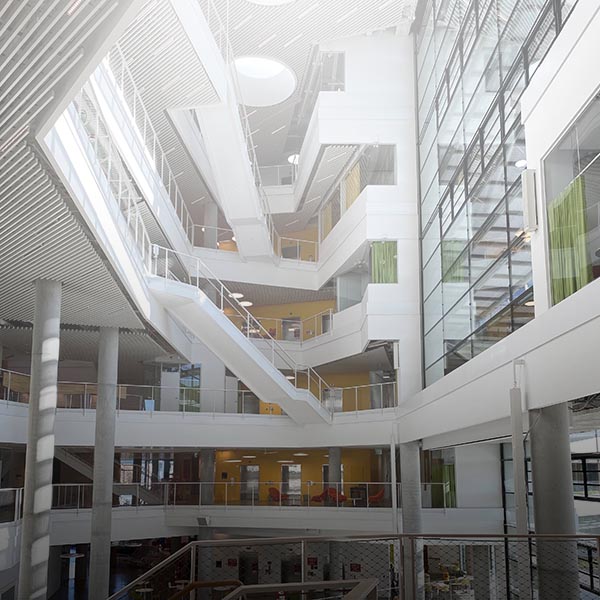
(Image: Institute for the Built Environment at Colorado State University)

Comments (4) | Send | | 1382 Views
Posted August 21, 2009 8:37 AM by Allyson Wendt
Related Categories: Miscellania

Steven Chu, Ph.D, the U.S. Energy Secretary, has a Facebook page. I have no idea if it's actually him posting, but I'm still a fan, meaning I get regular updates.

Yesterday, he posted this chart that shows exactly where the 40% of energy used in the U.S. by buildings goes. This is not new information to me--I've heard it several times before in various ways--but it is an unusually powerful graphical representation. You can see immediately that while heating is a big energy hog in residences, lighting is the big deal in commercial buildings.

I love this kind of graphic: it's simple, straightforward, and contains a whole lot of information that easily accessible. Now, if only the psychrometric chart were this easy!

Comments (2) | Send | | 1637 Views
Posted August 18, 2009 5:21 PM by Allyson Wendt
Related Categories: Op-Ed, Behind the Scenes, Nature & Nurture, Product Talk

Men should pee sitting down.

Now before you call me a strident feminist, let me say that I'm backed up on this one by male colleagues and the reasons aren't what you think. I'm not arguing for toilet equality here.

I'm talking about urine-separating toilets, which are much easier to use for men and women when sitting down. The bowl of these toilets takes urine in the front, feces in the back. It's hard enough to aim for the whole bowl (or so the evidence of many bathroom floors tells me), much less the front part of the bowl. One guy put a pee can in the corner, but that seems inefficient: pee in the can, then pour it down the toilet. Why not just pee in the toilet?

Why should you care? Because urine contains up to 90% of the nitrogen and 50% of the phosphorous in domestic wastewater. Those chemicals make for great fertilizer — stuff we have to use a lot of energy to produce artificially. In healthy populations, urine is sterile, and removing it from feces makes composting the solids easier and more effective.

Two models of these toilets are available in the U.S., both from Ecovita. But before you rush out to buy one and change your life, remember that composting solids and using urine to irrigate your tomatoes isn't legal in most places. You might be able to get special dispensation from the building code folks, but like most things involving wastewater treatment alternatives, it won't be easy.

Watch for the coming article in the September issue of EBN.

Update - the article is online (members only, though). Urine Separation: The Next Wave of Ecological Wastewater Treatment

Comments (7) | Send | | 2912 Views
Posted July 29, 2009 2:14 PM by Allyson Wendt
Related Categories: The Industry

The U.S. Green Building Council just sent out information from a report written by McKinsey and Company about energy efficiency and its role in U.S. mitigation of climate change. Here's what they found:

  • Energy-efficiency of buildings (along with other non-transportation efforts) could reduce U.S. energy consumption by 23% by 2020.
  • Such efforts would save $1.2 trillion and reduce emissions by 1.1 gigatons annually.
  • Getting to this point would require an annual investment of $50 billion for ten years.

In other words, the report puts numbers on what many of us knew intuitively: buildings are a really big piece of the climate puzzle.

The report (in PDF download) is available here.

Comments (0) | Send | | 1713 Views
Posted July 9, 2009 10:11 AM by Allyson Wendt
Related Categories: The Industry

One of the biggest hurtles in designing to Living Building Challenge standards is finding local materials, as we discuss here.

The folks at Cascadia Green Building Council have found a website that may help: www.stillmadeinusa.com.

It's not perfect, but it's a start. Now, if only we could figure out how to incorporate manufacturing locating information into product listings in all of the various databases out there.

Comments (1) | Send | | 1544 Views
Posted May 1, 2009 3:03 PM by Allyson Wendt
Related Categories: LEED

From the USGBC:

The consensus-based process that drives the development of the LEED rating systems is key to ensuring LEED encourages the very best in building, design and development practices. As LEED grows to cover the way we plan and build our neighborhoods, it's especially vital that we hear as many diverse voices as we can.

The second public comment period for LEED for Neighborhood Development opens today, Friday, May 1, and will close Sunday, June 14, at 11:59 p.m. PDT. Please don't miss this chance to be part of the development of the rating system!

See the updated rating system draft and submit your comments »

During the first public comment period that ended earlier this year, we received more than 5,000 comments, and we have posted responses to each of those comments at the link above. Please note that, in the second public comment period, only changes to the draft that were made after the first public comment period are open for comment.

The LEED for Neighborhood Development rating system integrates the principles of smart growth, new urbanism and green building into the first national rating system for neighborhood design. The program is the result of a collaboration among USGBC, the Congress for the New Urbanism, and the Natural Resources Defense Council. The rating system has been in pilot since July 2007, with nearly 240 projects participating. Feedback gathered from those projects, as well as countless hours of USGBC volunteers' time, have led to the current, more-sophisticated and market-responsive draft of LEED for Neighborhood Development.

Comments (0) | Send | | 1526 Views

More Entries

Get new posts via e-mail:


Recent Comments

People Like Urine-Separating Toilets

ted hettick says, “I like the illustration, too!” More...


Alex's Cool Product of the Week: Zehnder’s High-Efficiency HRV Systems

Buzz says, “Every aspect of this system is long overdue and sounds terrific. Except of course, for the price. ...” More...


LEED AP Credential Maintenance: Cracking the Code

Mara Baum says, “I suspect that many people will need to weigh the pros and cons of "opting in" in terms of...” More...


Green Building Myth #3: Green Products Don’t Work as Well as Standard Products

Bill Swanson says, “CFL's put LESS mercury into the environment then typical incandescent lamps. By a 1:2 ratio per the...” More...

Tony Marshallsay says, “CFLs are still an ecological disaster: non-recyclable; contain poisonous mercury; far more embodied ...” More...


Follow BuildingGreen
Follow us on Twitter Follow us on Facebook Follow us on Linkedin