LIVE image

Is America Ready for a Home Urinal?

Posted August 19, 2010 10:15 AM by Alex Wilson
Related Categories: GreenSpec Insights, Water Wise Guys
 

The Waterless Company's new residential Baja urinal begins shipping this week. Photo: Waterless Company. Click on image to enlarge.
There are some significant advantages to urinals when it comes to bathroom maintenance (I won't go into the messy details of splashing that happens when males stand and urinate into a toilet). With ultra-efficient urinals (often called one-pint urinals) and waterless urinals, there are also very significant water savings that are achieved.

The Waterless Company, which invented the non-water-using urinal in the early 1990s (see our February 1998 EBN product review of their first product--log-in required), has now introduced a waterless urinal designed specifically for the residential market. The Waterless Company's Baja urinal, which should start shipping this week, according to company president Klaus Reichardt, is somewhat smaller than a commercial urinal, and available in vitreous china for easy cleaning.

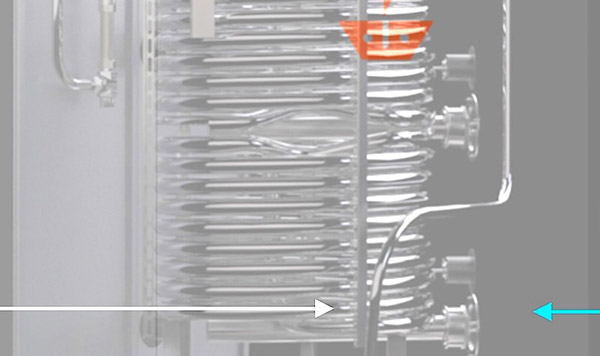
The Baja urinal works on the same principle as other Waterless-brand urinals--using the company's EcoTrap system (see schematic). The EcoTrap uses a lighter-than-urine, plant-based oil (EcoBlue) that serves as the sanitary trap. The EcoBlue fluid is topped off as needed, and the entire trap is replaced about once per year, assuming typical usage. Because the urinal dries out between uses, waterless urinals are actually more sanitary than conventional urinals, according to the Waterless Company and other manufacturers.

In commercial buildings, with typical usage patterns, a waterless urinal saves about 40,000 gallons per year. For residential applications, the savings will be significantly lower. Reichardt estimates that if there are two males in a home, each using the urinal three uses per day, times 340 days at home, the Baja urinal will replace about 2,040 toilet flushes per year, providing annual water savings of about 3,250 gallons (assuming 1.6 gpf toilets). The savings go up with more males (family members or friends).

Reichardt told me that they're getting a lot of calls from diabetics who have to urinate frequently and who hate to waste all the water. While these water savings should not be dismissed, I suspect that the primary motivation for purchases--if it succeeds--will be more about sanitation and reduced cleaning needs than it is about water savings.

The EcoTrap and a lighter-than-urine plant-based oil provides the sanitary trap in the Baja urinal. Photo: Waterless Company. Click on image to enlarge.
I should note that waterless urinals are not without problems. We've been using one at our office for 12 years or so, and salt build-up on the drain line forced us to remove and clean out those lines once, and it's showing signs of needing that servicing again. Some argue that it's important to periodically flush a urinal to prevent the build-up of deposits, or that ultra-efficient urinals make more sense than waterless models. Clearly, regular maintenance is required to ensure good performance.

The suggested retail price of the Waterless Baja urinal is $248. The product is distributed through plumbing wholesalers and the company's sales reps.

For more information:

Waterless Co.
Vista, California
888-663-5874
www.waterless.com

Alex Wilson is the executive editor of Environmental Building News and founder of BuildingGreen, LLC. In addition to this product-of-the week blog, he writes the weekly Energy Solutions blog. To keep up with his latest articles and musings, you can sign up for his Twitter feeds. Products covered in his product-of-the-week column are--or soon will be--listed in BuildingGreen's GreenSpec database.

See more on this product in the GreenSpec Guide

Comments (6) | Send | | 4876 Views

Comments

add in a collection tank and have farmers come around and collect the sterilized urine for fertilizer, like they're doing in sweden and china - and i'm sold.

although the usage of urinals in residences will probably not be quick to take on.
Posted 8/19/10 12:31 PM by mike eliason
Any idea what happened to the "Mr. Miser" urinal that was out a few years ago? Seemed like a pretty ideal solution, but it seems to have disappeared.
Posted 8/19/10 4:15 PM by Eric Woodhouse
Eric,
Good question. In August 2006 we wrote about the return of Mr. Miser, a residential urinal that closed up into a wall pocket when not in use (product news pasted below), but it appears that that reemergence was short-lived. I don't see evidence that the product is still around.

The Return of Mister Miser

Originally designed, manufactured, and marketed 20 years ago, the Mister Miser urinal (see EBN Vol. 6, No. 8) has been reintroduced. According to Rocco Corbino of Mister Miser, LLC, the product’s first incarnation—designed, manufactured, and marketed by his business partner’s father—was in some ways a victim of its own success. “It sold so well that he couldn’t handle the volume. Since he was running a multi-million-dollar injection molding business, he just let it drop rather than deal with it.” Designed primarily for residential use, the compact units—made of acrylonitrile butadiene styrene (ABS) plastic with a porcelain-like coating—install at any height between 2x4 studs. A hinged cover folds down for use; the nearly silent, 10-ounce (0.3 l) flush activates when the lid closes, providing adequate surface wash and enough liquid to evacuate the built-in P-trap. Mister Miser is online at http://www.mistermiser.net.
Posted 8/22/10 8:10 AM by Alex Wilson
That site for Mister Miser does not work. Is there another?
Posted 11/13/10 11:55 PM by Dieter Schmied
A mother of three boys, I'm trying to locate one to three of these for residential use. Any idea how to get ahold of the last manufacturers to discuss this?
Posted 8/11/11 3:23 AM by Andrea Cantin
Andrea, contact info and websites are in the article and comments above. Good luck and let us know how it goes!
Posted 8/11/11 6:54 AM by Tristan Roberts
(Comment Moderation is enabled. Your comment will not appear until approved.)


Get new posts via e-mail:


Recent Comments

Redefining What Makes a Building Product Green

Rick Duncan says, “Jennifer, I just received the January 2012 EBN yesterday and your feature article written with Paul...” More...

Paula Melton says, “Ramakrishna, I don't think anyone's suggesting that we do without any biobased materials. Right no...” More...

Ramakrishna Venkatasamy says, “I hardly think any building can do without wood or other bio-based materials. There is still the iss...” More...


Energy Modeling, Building Size, and BIM—What’s Cost-Effective?

Robert Riversong says, “I've found that basic energy modeling is so cost-effective, it would be crazy not to use it, prefera...” More...


Redefining What Makes a Building Product Green

Robert Riversong says, “Rick Duncan, I realized that the study I quoted might be considered a bit out of date (even if the ...” More...


Follow BuildingGreen
Follow us on Twitter Follow us on Facebook Follow us on Linkedin