Seattle's Environmental Home Center Burns Down

News Brief

Seattle's Environmental Home Center Burns Down

Seattle’s

Environmental Home Center (EHC), profiled in “Getting the ‘Right Stuff’: A Guide to Green Building Materials Retailers” (EBN

Vol. 10, No. 4), lost its main warehouse, showroom, and offices to a fire on August 11, 2004. Two warehouses remain standing, however, and the company has laid out an aggressive recovery plan in a bid “not to make our problems our customers’ problems,” according to its Web site. Even while the fire burned, the EHC team began searching for temporary office space, and the company hopes to retain all of its employees. EHC is accepting help “because it gives others a way to contribute to our success, and because we need it.” Contact EHC at 800-281-9785 or customer service@environmentalhomecenter.com. The recovery process is being documented at

www.environmentalhomecenter.com/fire.shtml.

Published December 31, 1969

(2004, September 1). Seattle's Environmental Home Center Burns Down. Retrieved from https://www.buildinggreen.com/departments/newsbrief

Add new comment

To post a comment, you need to register for a BuildingGreen Basic membership (free) or login to your existing profile.

Boy-Girl Ratio Among the Aamjiwnaang People

News Brief

Boy-Girl Ratio Among the Aamjiwnaang People

The Aamjiwnaang First Nation near Sarnia, Ontario is experiencing an increasingly

skewed ratio of female to male births, according to a July 31 article in the

Globe and Mail. Until recently, the community tracked normally, but in 1994, the ratio suddenly shifted and has been heavily skewed toward females ever since. In 2003, the tribe welcomed 19 new girls, but only 9 boys—a nearly two-to-one ratio. Aamjiwnaang women have also been experiencing elevated rates of miscarriage, and more and more children show signs of developmental problems. Although the cause is uncertain, many suspect the oil refineries and chemical plants that ring the reservation. A number of chemicals, including PCBs and hexachlorobenzene, have been linked to high female births rates; these and other chemicals have been found at elevated levels in a creek running through the community. Sarnia’s so-called “chemical valley” is home to 20% of Canada’s refineries and produces about 40% of its petrochemicals, according to the article.

Published December 31, 1969

(2004, September 1). Boy-Girl Ratio Among the Aamjiwnaang People. Retrieved from https://www.buildinggreen.com/departments/newsbrief

Add new comment

To post a comment, you need to register for a BuildingGreen Basic membership (free) or login to your existing profile.

JLC Warns of Arsenic in Plaster

News Brief

JLC Warns of Arsenic in Plaster

Old plaster may contain arsenic

, warns an article in the July 2004 issue of the

Journal of Light Construction (JLC). According to Kevin Hansen, who recently investigated abandoned tannery sites in the Wilmington, Delaware region for Tetra Tech, Inc., the leather-making industry used to soak animal hides in a slurry of lime and arsenic to soften them and remove hair. The waste product was then sold for use in rat poison or as filler in plaster. “I can’t say that the presence of hair means that there is arsenic,” Hansen told

JLC. “But one has to wonder, where did that hair come from?” Industrial labs will measure arsenic levels in plaster samples for around $50 each, he says. The Tetra Tech report on tannery locations is online at www.tetratech-de.com/tanneries/.

Published December 31, 1969

(2004, September 1). JLC Warns of Arsenic in Plaster. Retrieved from https://www.buildinggreen.com/departments/newsbrief

Add new comment

To post a comment, you need to register for a BuildingGreen Basic membership (free) or login to your existing profile.

Ecodesign Education Seminar

News Brief

Ecodesign Education Seminar

The day-long seminar “Educating the Educators: A Crash Course on Eco Design™” is intended to quickly

bring design educators up-to-speed on green design. David Bergman, architect and teacher at Parsons School of Design, and Erika Doering, interior designer and teacher at Parsons and Pratt Institute, developed the program with the recognition that green design’s short history means that many educators were never trained in it. “Our goal is not to facilitate ecodesign courses,” said Bergman and Doering. “It is to ... have ecodesign become an integral part of design education, to break down the separation and ‘niche-ing’ of ecodesign.” More information is online at www.eco4edu.net.

Published December 31, 1969

(2004, September 1). Ecodesign Education Seminar. Retrieved from https://www.buildinggreen.com/departments/newsbrief

Add new comment

To post a comment, you need to register for a BuildingGreen Basic membership (free) or login to your existing profile.

Greening Chicago's Bungalows

News Brief

Greening Chicago's Bungalows

One of every three single-family homes in the Windy City is a

Chicago Bungalow, constructed by the tens of thousands in the early 1900s to house the city’s working class. Bungalow owners can now take advantage of matching grants from the Chicago Department of Environment for up to $2,000 toward improvements in windows, doors, and insulation, and for water-efficient fixtures and appliances. Additionally, $1,000 vouchers are available for energy-efficient appliances. Bungalow owners can also tap into a $3.5 million grant from the Illinois Clean Energy Community Foundation to purchase or upgrade efficient furnaces, air-conditioners, water heaters, and solar technologies. Mayor Daley launched the Historic Chicago Bungalow Association in 2000 to promote the purchase and restoration of these homes. “Now these homeowners have new resources to make their homes more energy- and water-efficient, saving themselves money in the long run and helping further improve Chicago’s environment,” he said. To qualify for these incentives, homes must be certified by the Historic Chicago Bungalow Association, online at www.chicagobungalow.org.

Published December 31, 1969

(2004, September 1). Greening Chicago's Bungalows. Retrieved from https://www.buildinggreen.com/departments/newsbrief

Add new comment

To post a comment, you need to register for a BuildingGreen Basic membership (free) or login to your existing profile.

Climate Change Worsens Smog

News Brief

Climate Change Worsens Smog

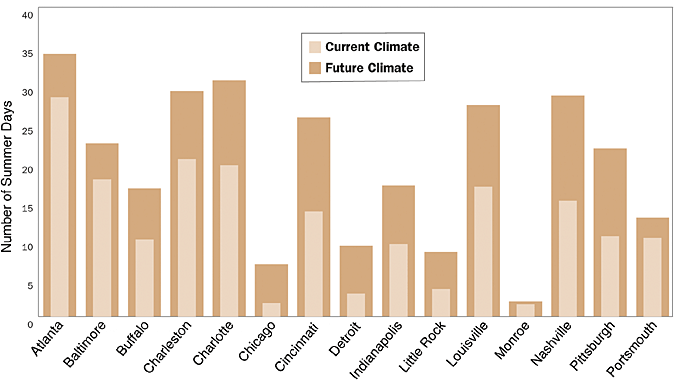
By mid-century, climate change will increase by 60% the number of days when

ozone levels in the eastern half of the U.S. exceed air quality standards set by the U.S. Environmental Protection Agency (EPA), predicts a report published by the Natural Resources Defense Council (NRDC). The study,

Heat Advisory: How Global Warming Causes More Bad Air Days, was prepared by researchers at Johns Hopkins and Columbia Universities, in collaboration with Yale University, SUNY Albany, and the University of Wisconsin at Madison. The study also predicts a 20% drop in the number of summer days with “good” air quality and a doubling of “red alert” air quality days, as defined by EPA. The complete report is posted online at www.nrdc.org.

Published December 31, 1969

(2004, September 1). Climate Change Worsens Smog. Retrieved from https://www.buildinggreen.com/departments/newsbrief

Add new comment

To post a comment, you need to register for a BuildingGreen Basic membership (free) or login to your existing profile.

Portland Cement Shortages

News Brief

Portland Cement Shortages

Several regions of the country are experiencing a

shortage of portland cement, the key ingredient in concrete. According to the Portland Cement Association (PCA), among the chief causes for this shortage are increased demand in the residential sector and limited availability of ships to carry imported cement, which in turn is blamed largely on booming Asian economies. Cement companies are expanding production to meet demand, but PCA says that “the short-term solution is to import more cement.” Others see a solution in the replacement of portland cement with flyash, a byproduct of coal-fired power plants (see

EBN Vol 8, No. 6). According to Keith Bargaheiser, marketing manager for the American Coal Ash Association, in

Waste News (August 2), flyash demand has risen 15–20% in the past year. Replacing each ton of portland cement prevents emission of approximately one ton of greenhouse gas.

Published December 31, 1969

(2004, September 1). Portland Cement Shortages. Retrieved from https://www.buildinggreen.com/departments/newsbrief


Add new comment

To post a comment, you need to register for a BuildingGreen Basic membership (free) or login to your existing profile.

India's President Kalam Innagurates CII Building

News Brief

India's President Kalam Innagurates CII Building

India’s president, Dr. A. P. J. Abdul Kalam, inaugurated the CII Sohrabji Godrej Green Business Center on July 14. The Center became the first Platinum-rated building under LEED

® v.2 in late 2003 (see

EBN

Vol. 12, No. 12). Kalam praised the Center’s achievements and laid out a goal of

reducing the average energy efficiency of India’s buildings from 300 kWh/m2 (30 kWh/ft2) to 100 kWh/m2 (10 kWh/ft2) by 2010. “When the environment is beautiful and happy,” he said, “the mind is also happy, which leads to creativity.”

Published December 31, 1969

(2004, August 1). India's President Kalam Innagurates CII Building. Retrieved from https://www.buildinggreen.com/departments/newsbrief

Add new comment

To post a comment, you need to register for a BuildingGreen Basic membership (free) or login to your existing profile.

Debbi Allen Memorial

News Brief

Debbi Allen Memorial

Debbi Allen of Portland, Oregon, a long-time proponent of responsible construction waste management and other green building practices in the Pacific Northwest, has died of complications from cancer. According to Kathleen O’Brien of O’Brien & Company, Bainbridge Island, Washington, “Debbi was always hopeful and especially good-hearted . . . an inspiration to those of us who needed a ‘boost’ when progress got stalled. We will sorely miss her good spirit.”

Published December 31, 1969

(2004, August 1). Debbi Allen Memorial. Retrieved from https://www.buildinggreen.com/departments/newsbrief

Add new comment

To post a comment, you need to register for a BuildingGreen Basic membership (free) or login to your existing profile.

Energy Star for Commercial Building Designs

News Brief

Energy Star for Commercial Building Designs

In order to recognize the role design professionals play in determining the energy efficiency of buildings, the U.S. Department of Energy and the U.S. Environmental Protection Agency have begun

awarding the Energy Star

® label to commercial building designs. “A building design will be eligible for the new designation if the building is expected to qualify for the Energy Star label once in operation,” EPA’s Web site explains. Occupied commercial buildings have been eligible for Energy Star designation since 1999 (see

EBN Vol. 8, No. 4). More information is online at www.energystar.gov.

Published December 31, 1969

(2004, August 1). Energy Star for Commercial Building Designs. Retrieved from https://www.buildinggreen.com/departments/newsbrief

Add new comment

To post a comment, you need to register for a BuildingGreen Basic membership (free) or login to your existing profile.