DOE Announces Energy Fitness Program

News Brief

DOE Announces Energy Fitness Program

The U.S. Department of Energy has announced a new

Energy Fitness Program, aimed at promoting the role of energy service companies (ESCOs) in financing and implementing energy improvements in buildings. The Program is participating, with the National Association of Energy Service Companies, in an accreditation program for qualified energy service providers. Two reports are available: “Energy Savings Performance Contract Case Studies,” and “The Energy Efficiency Project Manual.” The program appears to be aimed primarily at state and local government bodies but is available to all interested parties. For more information, visit the Web site: www. ornl.gov/EFP/, or contact Patrick Hughes at Oak Ridge National Laboratory: 423/574-9337, 423/574-9329 (fax), pj1@ornl.gov (e-mail).

Published December 31, 1969

(1998, March 1). DOE Announces Energy Fitness Program. Retrieved from https://www.buildinggreen.com/departments/newsbrief

Add new comment

To post a comment, you need to register for a BuildingGreen Basic membership (free) or login to your existing profile.

Eley Seeks Energy Efficient Projects

News Brief

Eley Seeks Energy Efficient Projects

The first load-bearing straw-bale home in the State of Washington is now offered as the prize of an essay contest by Michael and Spring Thomas of the IronStraw Group. The home, which has been monitored by Habitat for Humanity International for their research on affordable, straw-bale houses, consists of two structures situated on a seven-acre site in Port Townsend, Washington, with dramatic views. The one-page essay, on the topic of why you would want to win the house and why the use of alternative building materials is important to the environment, must be received by June 1, 1998 along with a $100 entry fee. Contact IronStraw Group at 360/379-3577, ironstraw@olympus.net, or read

details on the group’s website at www.olympus.net/ironstraw.

Published December 31, 1969

(1998, February 1). Eley Seeks Energy Efficient Projects. Retrieved from https://www.buildinggreen.com/departments/newsbrief

Add new comment

To post a comment, you need to register for a BuildingGreen Basic membership (free) or login to your existing profile.

ASHRAE's Standard 90.1 Will Go onto "Continuous Maintenance"

News Brief

ASHRAE's Standard 90.1 Will Go onto "Continuous Maintenance"

Following its Winter Meeting in San Francisco, the American Society of Heating, Refrigerating and Air-Conditioning Engineers (ASHRAE) announced that its energy performance guide, Standard 90.1, will follow in the footsteps of the indoor air quality document (Standard 62) by going onto “continuous maintenance” instead of the current “periodic revision” process (see

EBN

Vol. 6, No. 9). Substantial effort has already gone into a major revision (Standard 90.1-1989R), and this revision will become the starting point for the continuous maintenance process as long as it can be completed and accepted before June 1999.

Published December 31, 1969

(1998, February 1). ASHRAE's Standard 90.1 Will Go onto "Continuous Maintenance". Retrieved from https://www.buildinggreen.com/departments/newsbrief

Add new comment

To post a comment, you need to register for a BuildingGreen Basic membership (free) or login to your existing profile.

RMI seeks Green Development Services Consultant

News Brief

RMI seeks Green Development Services Consultant

Roughly four billion pounds (1.8 billion kg) of old carpeting are landfilled each year. Comprised of different materials—nylon, polyester, latex backing, etc.—the stuff is inherently difficult to reprocess back into carpet (see

EBN

Vol. 6, No. 6). So how ‘bout simply shredding the stuff and turning it into a fiber insulation material? That’s exactly what entrepreneur Tom Deem wants to do.
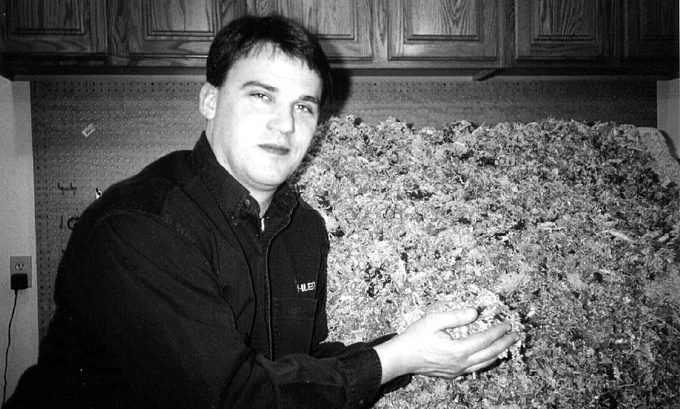
Deem is an inventive sort of guy who works in a plumbing supply store in Philco, Illinois. When he wasn’t cutting pipe or finding the right plumbing fixtures for customers a few years ago, he thought a lot about the huge quantity of old carpet making its way into landfills. In 1993 he came up with the idea of turning old carpeting into loose-fill insulation for attic applications. So he bought a used brush chipper and tried shredding samples of carpeting.

That worked pretty well—the chipper broke the backing apart and left a fluffy fiber with a density of about 2 lb/ft3 (32 kg/m3). The product was not unlike cellulose insulation, and he found that it could be blown into attics using cellulose-blowing equipment.

Over the years, Deem had the good fortune of getting to know building scientist Bill Rose (with the Small Homes Research Council at the University of Illinois). He gave Rose a sample to carry out some quick thermal testing, and the stuff achieved a respectable R-3.3 per inch (RSI-0.6)—about the same as most fiberglass batt insulation and somewhat better than loose-fill fiberglass, though not quite as high as cellulose.

Deem has a patent pending on the insulation material, he’s experimenting with more advanced industrial shredding equipment, he has just incorporated his fledgling business as Recycled Carpet Technologies, Inc., and he’s having fire safety testing done by Underwriters Laboratories (UL). Just which standards this insulation material needs to meet are uncertain, however, because it is neither cellulose nor mineral fiber insulation. UL is going ahead with ASTM E-84 flame tunnel tests. Deem is optimistic that the material will do well in the testing, since carpeting passes the E-84 tests. If the insulation does not pass, he plans to mist it with fire retardants, as is done with cellulose.

Based on some quick tests at the

EBN product testing laboratory, we suspect the fire retardant will be necessary. A small sample maintained a flame when ignited with a match. In similar tests with other fiber insulation materials (fiberglass, cellulose, cotton), we have found none that will maintain flame. In addition to the flame, a noxious black smoke was given off.

In several calls to the carpet industry, we found no one who had heard about such an idea. Tim Blount, who manages the carpet recycling program at carpet resin supplier BASF has heard discussion of producing such a product from natural-fiber carpet (wool or cotton), but not from synthetic carpet. Blount doesn’t know of any inherent problems with the idea. “It should work for that,” he told

EBN.

Deem plans to package the insulation into 40-pound (18 kg) bags, each of which will cover roughly 19 square feet (1.8 m2) at a rating of R-38 (RSI-6.7). He expects the retail price to be $3.50 per bag. Some local price checking in Vermont and New Hampshire by

EBN found this to be 50% to 70% the cost of cellulose and about 40% the cost of loose-fill fiberglass for comparable insulation value and area coverage. Pending the outcome of fire testing, Deem hopes to begin selling his recycled carpet insulation by June of this year. He hasn’t yet set up any distribution agreements but expects to distribute the insulation through established channels. There remain lots of questions about recycled-carpet insulation, including indoor air quality issues, but this is a product we will definitely be keeping an eye on.

For more information:

Tom Deem, President

Recycled Carpet Technologies, Inc.

108 E. Stahl

Philco, IL 61864

217/684-2038

rct100@aol.com (e-mail)

Published December 31, 1969

(1998, January 1). RMI seeks Green Development Services Consultant. Retrieved from https://www.buildinggreen.com/departments/newsbrief

Add new comment

To post a comment, you need to register for a BuildingGreen Basic membership (free) or login to your existing profile.

Haywood Lumber's Green Building Materials Division

News Brief

Haywood Lumber's Green Building Materials Division

Louisiana-Pacific Corp. has sold its Fiberbond gypsum panel product to USG, and has put a number of other divisions, including Nature Guard Roofing Shakes, on the auction block. These sales are part of a large-scale restructuring initiative intended to focus the company more strongly on building products with a national market, according to spokesman Barry Lacter. A California pulp mill and extensive redwood holdings in California, including three sawmills, are among the other units up for sale.

L-P is standing firm with its other green building products, however, including the Cocoon™ cellulose insulation line, which is the new name for the merged Nature Guard insulation and Greenstone cellulose products.

For more information:

Barry Lacter

Louisiana-Pacific

111 SW Fifth Avenue

Portland, OR 97204

503/221-0800, 503/796-0204 (fax)

Published December 31, 1969

(1998, January 1). Haywood Lumber's Green Building Materials Division. Retrieved from https://www.buildinggreen.com/departments/newsbrief

Add new comment

To post a comment, you need to register for a BuildingGreen Basic membership (free) or login to your existing profile.

Standard Practices for Cellulose Insulation Released

News Brief

Standard Practices for Cellulose Insulation Released

Cellulose insulation should now be easier to specify in wall cavities with the release of a new “Standard Practice for the Installation of Sprayed Cellulosic Wall Cavity Insulation” from the Cellulose Industry Manufacturers Association. Until now each manufacturer had its own guidelines, varying in length and quality, according to the December 1997 issue of

Energy Design Update. Copies of the three-page manual are available from CIMA, 136 S. Keowee Street, Dayton, OH 45402, 937/222-2462, 937/222-5794 (fax), assocoffice@ delphi.com (e-mail).

Published December 31, 1969

(1998, January 1). Standard Practices for Cellulose Insulation Released. Retrieved from https://www.buildinggreen.com/departments/newsbrief

Add new comment

To post a comment, you need to register for a BuildingGreen Basic membership (free) or login to your existing profile.

Conger Fuller Architects Replaces Trees

News Brief

Conger Fuller Architects Replaces Trees

The design firm Conger Fuller Architects of Aspen, Colorado has taken a unique approach to addressing resource consumption of its residential building projects. At the end of 1997 the company donated enough money to the Oregon Forest Resources Trust to replenish 6.5 acres of trees—the amount they calculated were used to build the houses they designed during the year. Conger Fuller Architects’ stated purpose is to “design and develop inspirational projects that serve and enhance its clients, the community, and the environment.” For information, contact Lauren Broder at 970/925-3021.

Published December 31, 1969

(1998, January 1). Conger Fuller Architects Replaces Trees. Retrieved from https://www.buildinggreen.com/departments/newsbrief

Add new comment

To post a comment, you need to register for a BuildingGreen Basic membership (free) or login to your existing profile.

NY and CA Allow Unvented Gas Appliances

News Brief

NY and CA Allow Unvented Gas Appliances

New York and California have recently passed legislation allowing the use of unvented gas appliances, according to the November 1997 issue of

Energy Design Update (EDU). The legislation in both states has been signed by the governors, but will not go into effect until after review by the state health agencies. New York passed similar legislation in 1996, but it was vetoed by Governor Pataki, who asked the New York State Energy Research and Development Authority (NYSERDA) to study the issue. Dr. Brian Leaderer of the Yale University School of Medicine was hired to conduct the research. His findings were released in the report “Critique of Guidelines on Use of Unvented Gas Space Heaters,” which expresses serious concerns about the safety of these heaters. According to

EDU, observers both inside the state government and outside are perplexed that the legislature passed the law anyway. Apparently, there was strong lobbying pressure from industry organizations. Only a handful of states regulate unvented gas appliances, and only Massachusetts and Alaska have outright prohibitions on their use. For more on unvented gas appliances see

EBN

Vol. 5, No. 3, page 4.

Published December 31, 1969

(1998, January 1). NY and CA Allow Unvented Gas Appliances. Retrieved from https://www.buildinggreen.com/departments/newsbrief

Add new comment

To post a comment, you need to register for a BuildingGreen Basic membership (free) or login to your existing profile.

Study Shows Perceived Link Between Alleviating Climate Change and Economic Growth

News Brief

Study Shows Perceived Link Between Alleviating Climate Change and Economic Growth

According to the Solar Energy Industries Association (SEIA), a recent

New York Times poll found that a majority of Americans believe that measures to alleviate climate change will actually help the economy and save money. This is in marked contrast to the message being delivered “by polluting energy industries and their puppets in Congress,” according to a press release by the organization. SEIA is calling for a significant increase in federal funding for renewable energy and energy efficiency programs, from the current level of approximately $1 billion per year to $1.4 billion per year. The organization is further recommending a package of tax incentives for renewables to be paid for by a roll-back in fossil fuel subsidies, which contribute to our climate change problem. For information, call SEIA at 202/383-2600.

Published December 31, 1969

(1998, January 1). Study Shows Perceived Link Between Alleviating Climate Change and Economic Growth. Retrieved from https://www.buildinggreen.com/departments/newsbrief

Add new comment

To post a comment, you need to register for a BuildingGreen Basic membership (free) or login to your existing profile.

Plans for World's Largest PV Manufacturing Plant

News Brief

Plans for World's Largest PV Manufacturing Plant

Plans for construction of the world’s largest PV manufacturing plant—a 25 MW polycrystalline facility to be built in Gelsenkirchen, Germany—were announced on November 4, 1997. The plant will be built by Royal Dutch Shell, Pilkington Solar International, and Bayer Solar and is expected to be completed by mid-1999. This news comes on the heels of the mid-October announcement by Royal Dutch Shell that renewables will become an important part of their business during the next century (see

EBN

Vol. 6, No. 10, page 4). Meanwhile, Paul Maycock of

PV News reports that worldwide photovoltaic cell/module shipments in 1997 were 125.8 megawatts (MW) in peak capacity, a remarkable 42% increase over 1996 shipments. For details, and information on

PV News, contact PV Energy Systems at 540/349-4497 (www.pvenergy.com).

Published December 31, 1969

(1998, January 1). Plans for World's Largest PV Manufacturing Plant. Retrieved from https://www.buildinggreen.com/departments/newsbrief

Add new comment

To post a comment, you need to register for a BuildingGreen Basic membership (free) or login to your existing profile.


