Los Angeles "Congestion Pricing" Considered Successful

News Brief

Los Angeles "Congestion Pricing" Considered Successful

An innovative section of highway near Los Angeles with “congestion pricing” is considered successful after six months of operation, and it could be the wave of things to come. The July issue of

Planning described a 10-mile segment of Route 91 with two lanes in either direction, known as FasTrak, in which tolls vary from $0.25 during the middle of the night to $2.50 during peak commuter hours. Tolls are deducted automatically from cars that have to carry transponders. The plan was adopted as a strategy to reduce air pollution, and more than 50,000 commuters so far have gotten the transponders.

Published December 31, 1969

(1996, September 1). Los Angeles "Congestion Pricing" Considered Successful. Retrieved from https://www.buildinggreen.com/departments/newsbrief

Add new comment

To post a comment, you need to register for a BuildingGreen Basic membership (free) or login to your existing profile.

Country's First Commuter Bike Station Opens in Long Beach

News Brief

Country's First Commuter Bike Station Opens in Long Beach

The country’s first commuter bike station has opened in Long Beach, California, according to the Urban Land Institute’s June 1996

Land Use Digest. The Bike Station, modeled after similar facilities in Japan and the Netherlands, provides secure parking for 150 bicycles, along with bike rentals, repairs, and accessories. It is located in a transit mall that includes a light rail stop (for the Blue Line into Los Angeles), Orange County buses, and a free downtown shuttle, and connects to 33 miles of bike paths. The $150,000 facility was built with support from Intermodal Surface Transportation Efficiency Act (ISTEA) funds and local agencies.

Published December 31, 1969

(1996, September 1). Country's First Commuter Bike Station Opens in Long Beach. Retrieved from https://www.buildinggreen.com/departments/newsbrief

Add new comment

To post a comment, you need to register for a BuildingGreen Basic membership (free) or login to your existing profile.

Some Cities Revert Pedestrian Malls Back to Regular Streets

News Brief

Some Cities Revert Pedestrian Malls Back to Regular Streets

Closing off streets to cars to create pedestrian malls doesn’t always work.

Land Use Digest, published by the Urban Land Institute, reported in its May 1996 issue that Chicago is joining such cities as Eugene, Little Rock, and Norfolk in reverting pedestrian malls back into regular streets. Merchants have complained in these cities that street closure created a “ghost town atmosphere and caused a sharp decline in shopping,” according to the article. Chicago will spend $24.5 million to convert nine blocks of pedestrian mall with widened sidewalks created in 1979 back into conventional street. These failures represent only a small percent of pedestrian malls in the U.S. and Canada.

Published December 31, 1969

(1996, September 1). Some Cities Revert Pedestrian Malls Back to Regular Streets. Retrieved from https://www.buildinggreen.com/departments/newsbrief


Add new comment

To post a comment, you need to register for a BuildingGreen Basic membership (free) or login to your existing profile.

World's Largest Rooftop PV Array Inaugurated at Atlanta Olympics

News Brief

World's Largest Rooftop PV Array Inaugurated at Atlanta Olympics

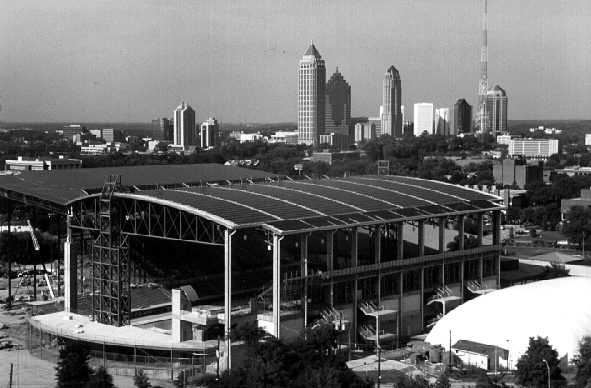
The world’s largest rooftop photovoltaic (PV) array was inaugurated at the Atlanta Olympics.

The new Georgia Institute of Technology Aquatic Center has 2,800 solar modules generating 344.5 peak kilowatts (kW) of electricity. One section of the array, with an output of 4.5 kW, is comprised of Solarex’s new 240-watt alternating-current (AC) architectural modules. For more information, contact Solarex at 301/698-4200 or on the Internet at http://www.solarex.com.

Published December 31, 1969

(1996, September 1). World's Largest Rooftop PV Array Inaugurated at Atlanta Olympics. Retrieved from https://www.buildinggreen.com/departments/newsbrief
Add new comment

To post a comment, you need to register for a BuildingGreen Basic membership (free) or login to your existing profile.

Stratospheric Levels of Chlorine to Peak by 2000

News Brief

Stratospheric Levels of Chlorine to Peak by 2000

Newsbriefs

Stratospheric levels of chlorine should peak by the year 2000, according to the 14 June issue of

Global Environmental Change Report. Scientists at the National Oceanic and Atmospheric Administration in Boulder, Colorado, have been measuring levels of various CFCs and HCFCs in the lower atmosphere (troposphere) since 1991 and using those measurements to extrapolate stratospheric levels. (Chlorine in the stratosphere destroys ozone and permits higher levels of ultraviolet light to reach the Earth’s surface.) Tropospheric chlorine peaked in 1994 at 3,700 parts per trillion (ppt) and is now decreasing by about 25 ppt per year. The scientists predict that this will result in chlorine peaks in the stratosphere between 1997 and 1999.

Published December 31, 1969

(1996, September 1). Stratospheric Levels of Chlorine to Peak by 2000. Retrieved from https://www.buildinggreen.com/departments/newsbrief

Add new comment

To post a comment, you need to register for a BuildingGreen Basic membership (free) or login to your existing profile.

EBN Finalist in Utne Reader Selection

News Brief

EBN Finalist in Utne Reader Selection

Environmental Building News

was a finalist in

Utne Reader’s 8th Annual Alternative Press Awards this year. While we were not a winner, we were pleased to be recognized in the “Service” category.

Published December 31, 1969

(1996, September 1). EBN Finalist in Utne Reader Selection. Retrieved from https://www.buildinggreen.com/departments/newsbrief

Add new comment

To post a comment, you need to register for a BuildingGreen Basic membership (free) or login to your existing profile.

US commitment on greenhouse gases

News Brief

US commitment on greenhouse gases

The United States took a surprisingly strong position on cutting greenhouse gas emissions this summer at the Second Conference of the Parties to the Framework Convention on Climate Change (COP2) in Geneva. On 17 July, Undersecretary of State Timothy Wirth announced that the U.S. will seek an amendment to the existing treaty to create “binding” emissions targets. Specifics on such an amendment, including emission targets and time-frame, have not yet been developed, but in comments following the speech reported in 26 July issue of

Global Environmental Change Report he said that “very early target dates are not possible."

Published December 31, 1969

(1996, September 1). US commitment on greenhouse gases. Retrieved from https://www.buildinggreen.com/departments/newsbrief

Add new comment

To post a comment, you need to register for a BuildingGreen Basic membership (free) or login to your existing profile.

Canadian Utility Consortium to Cut Greenhouse Gas Emissions

News Brief

Canadian Utility Consortium to Cut Greenhouse Gas Emissions

Canada’s largest energy producers have formed a nonprofit alliance, the Greenhouse Emissions Management Consortium (GEMCo), to manage the companies’ carbon emission offset activities. GEMCo president Aldyen Donnelly was quoted in the 28 June issue of

Global Environmental Change Report that the formation of GEMCo highlights a growing perception in the energy industry that “the climate change issue is a source of business risk, whether or not the science is solid.” The consortium also hopes that voluntary action by energy producers may head off more costly regulatory action by the Canadian government. For information, contact GEMCo at 604/691-5066.

Published December 31, 1969

(1996, September 1). Canadian Utility Consortium to Cut Greenhouse Gas Emissions. Retrieved from https://www.buildinggreen.com/departments/newsbrief

Add new comment

To post a comment, you need to register for a BuildingGreen Basic membership (free) or login to your existing profile.

Schuller Acquires NRG Barriers

News Brief

Schuller Acquires NRG Barriers

Schuller Corporation, a publicly traded manufacturer of fiberglass insulation based in Denver, Colorado, announced on May 17 that it is acquiring NRG Barriers of Portland, Maine, one of the nation’s leading producers of polyisocyanurate foam insulation. Both Schuller and NRG have been leaders in improving the environmental characteristics of their products: Schuller has the highest post-consumer recycled glass content of any fiberglass manufacturer, and NRG was the first polyisocyanurate foam manufacturer to eliminate CFCs from its formulation. NRG operates five plants in Maine, Pennsylvania, Indiana, Florida, and Washington and had sales of $150 million in 1995.

Published December 31, 1969

(1996, July 1). Schuller Acquires NRG Barriers. Retrieved from https://www.buildinggreen.com/departments/newsbrief

Add new comment

To post a comment, you need to register for a BuildingGreen Basic membership (free) or login to your existing profile.

Big Creek Sells First "Well-Managed" Redwood Lumber

News Brief

Big Creek Sells First "Well-Managed" Redwood Lumber

The world’s first independently certified, “well-managed” redwood lumber is now available from the Big Creek Lumber Company of Davenport, California in the Santa Cruz Mountains. Big Creek sells redwood, Monterrey pine, and Douglas fir from its 6,800 acres (2,750 ha) of forestland. The Scientific Certification Systems evaluation team called Big Creek’s redwood forest management “an example of superior forest stewardship,” noting that the company’s management philosophy places riparian and aquatic concerns above timber harvesting. Contact Janet Webb, Big Creek Sales Director, at 408/457-5023.

Published December 31, 1969

(1996, July 1). Big Creek Sells First "Well-Managed" Redwood Lumber. Retrieved from https://www.buildinggreen.com/departments/newsbrief

Add new comment

To post a comment, you need to register for a BuildingGreen Basic membership (free) or login to your existing profile.

