
News Analysis
Most builders today own one or more portable, battery-powered tools. While properly maintained nickel-cadmium (Ni-Cad) batteries should last for years (averaging over 650 charging cycles), the batteries do eventually wear out, and disposing of them can cause environmental problems.
Portable tool... Read more
Op-Ed
Sirs,
I caution you not to ignore the unique needs of the eco-conscious remodeler. They are not the same as those of a new builder.
Thank you for your efforts.
David Jones
News Analysis
By exposing mice to fumes from samples of carpet, scientists at Anderson Laboratories, Inc., have demonstrated significant toxicological effects. In the most severe sample tests, four out of four mice exposed to the fumes died. Of samples purchased at random off-the-shelf, 25% showed some effect, according to Mark Goldman... Read more
Explainer
Product Review

Product Review

Lead poisoning is arguably the most significant health risk faced by remodelers and restoration contractors. According to HUD, 57 million homes in the United States contain at least some lead paint. To work safely in older houses, you have to know whether lead paint is present. Analysis using sophisticated x-ray... Read more
News Analysis
On January 19th the U.S. Environmental Protection Agency announced its proposed regulations for complying with the Copenhagen Amendments to the Montreal Protocol for phase-out of ozone-depleting substances (see EBN,
Vol. 2, No. 1). Under the proposed rules, HCFC-141b (the foaming agent being... Read more
News Brief
155 Pine St., Amherst, MA 01002; 413/549-3616. $15/year individual, $30/year group.
As a regional CoHousing newsletter, Northeast CoHousing Quarterly (NCQ) has two primary missions. The first is provide a forum in which the many CoHousing groups can network and learn of each other’s progress. The second is to provide general information... Read more
Feature
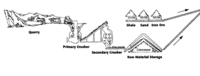
Concrete and other cementitious materials have both environmental advantages and disadvantages. This article takes a look at how these materials are made, then reviews a number of environmental considerations relating to their production, use, and eventual disposal.
Editor's Note:For more information about concrete in green building projects, we recommend our 43-page special report, "What You Need to Know About Concrete and Green Building." The report is free with a trial membership to BuildingGreen Suite. Learn more.
Cement and concrete are key components of both commercial and residential... Read more
News Analysis
The 1992 Energy Policy Act, signed into law in October, sets maximum water use standards for most plumbing products manufactured after January 1, 1994. Most toilets will be limited to 1.6 gallons per flush (a higher limit of 3.5 gpf will apply to most commercial toilets). Kitchen and... Read more
News Analysis
NRG Barriers, Inc. of Saco, Maine, has become the first polyisocyanurate foam insulation manufacturer to totally phase out CFC-11 use in a complete product line. As of January 1, 1993, 100% of NRG’s commercial roofing insulation products will be produced with HCFC-141b, according to Technical... Read more
Feature
News Analysis
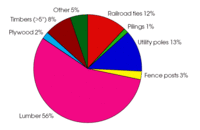
In what is described as a major policy change, the Western Wood Products Association (WWPA) is launching a campaign to emphasize the environmental benefits of wood and appeal to growing public awareness about the environment. “We want the [building] industry to know that we’re concerned about the... Read more
Product Review
Non-exposed Wood
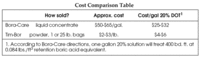
Boron has long been recognized as an effective and very safe pesticide in wood. In part, it effectiveness comes from its ability to diffuse freely throughout the wood, thus protecting even the center of large timbers, which are not affected by pressure treating. Unfortunately, the diffusability... Read more
News Analysis
from NAHB
With the upcoming release of its booklet
What Remodelers Need to Know and Do About Lead, the Remodelers Council of the National Association of Home Builders is providing a valuable service. The booklet, to judge by a late draft, will be effective in educating builders and remodelers about the dangers... Read more
News Brief
Andrew St. John, Editor. Boston Society of Architects, 52 Broad St., Boston, MA 02109; 617/951-1433 x221, 617/951-0845 (fax), $25.
The Sourcebook for Sustainable Design is a true labor of love. It is the first attempt we know of at a comprehensive listing of products and materials that are useful,... Read more
Op-Ed

CoHousing development—is it sustainable? Kathleen O’Brien thought maybe; I think yes. Yes because CoHousing offers another scale of social organization—an intermediate scale between the single family and the town or municipality—thereby expanding the palette of technologies that can be applied. It does this simply by being a... Read more
News Analysis

Op-Ed
In recent months we've seen increasing signs that timber interests and environmentalists are beginning to talk. After years of finger-pointing and scapegoating, some serious, constructive communication is long overdue. In the words of Tim Lovlien, a voice of reason from Boise Cascade, “anytime you open the forum to discuss the issue, it’s... Read more
News Analysis
On November 25th, international delegates in Copenhagen, Denmark, completed negotiations on a second major revision to the Montreal Protocol for the phaseout of ozone-depleting substances. Under the Copenhagen Amendments, the schedule for eliminating CFCs is moved up to January 1, 1996, four years ahead of the schedule... Read more


