
News Brief
Environmental Committee, Denver Chapter, AIA, and Colorado Chapter, ADPSR. 1995. Loose-leaf (without binder) or diskette (PC or Macintosh), $29.95. Order from: AIA Denver/SDRG, 1562 15th Street, Denver, CO, 80202; 303/446-2266, 303/446-0066 (fax).
Greatly improved from last year’s first edition, this... Read more
News Analysis
Choosing an environmentally friendly siding material has never been easy. Often the more “natural” products, such as wood clapboards, are associated with depletion of sensitive forest resources, while materials that are highly manufactured—such as vinyl—raise questions about chlorine and petrochemicals as... Read more
Explainer
now being manufactured in Perrytown, Texas, can be used in place of both framing and drywall in partition walls. At $19 each for 4’ by 8’ (1200 mm by 2400 mm) panels, they are very competitive with conventional stud framing within a reasonable shipping distance from the plant. The panels... Read more
News Brief
The Woodworker’s Alliance for Rainforest Protection (WARP), a leading promoter of lesser-known species and other lumber from environmentally preferable sources, is changing its name to the “Good Wood Alliance.” Reasons for the change included a recognition that the environmental issues addressed are not limited to rainforests and that not all... Read more
Product Review
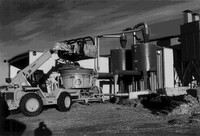
The company uses Norwegian manufacturing equipment to produce 4’ x 8’ (1200 mm x 2400 mm) panels in 1⁄4” (6 mm) and 1⁄8” (3 mm) thicknesses. Thicker, 1⁄2” (13 mm) panels were initially produced as well, but... Read more
News Brief
The Rainforest Action Network (RAN) has a new “Wood Reduction Clearinghouse” to disseminate information on ways to reduce waste and find environmentally sound alternatives to wood. Reducing wood use in construction is a primary goal of the service. Contact Dana Harmon at RAN, 450 Sansome Suite 700, San Francisco, CA 94111; 415/398-4404, 415/... Read more
Product Review
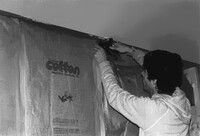
As you might imagine, information about new building products comes into the
EBN office all the time. When a new product strikes our fancy, we extract what information we can from manufacturers, we play with samples (often mutilating them in the process), we talk with any users we can track... Read more
News Brief
Steven Winter Associates, Inc., of Norwalk, Connecticut, has been awarded a grant through the U.S. Department of Energy’s 1995 Small Business Innovative Research program to design advanced modular townhouses for urban infill sites. The company has been charged with designing townhouses that employ renewable energy and energy conservation... Read more
Op-Ed
I very much appreciate your recognition of the need for and efforts to identify priorities for “green building” (whatever that is). Such priorities can either be defined implicitly by the buildings a “green designer” creates or by some systematic process based on a hierarchy of environmental problems. Your... Read more
News Brief
Researchers at the U.S. Bureau of Mines (USBM) and the National Renewable Energy Laboratory (NREL) are looking into the idea of producing perlite using concentrated solar energy. Perlite is a natural volcanic rock that is expanded by rapid heating to between 870° and 1100°C. It is used as an insulation material and as a lightweight... Read more
News Brief
Even as environmental regulations are being widely threatened by Congressional initiatives, a broad new effort to protect the nation’s water is now underway. Sixteen months after it first convened, the National Forum on Nonpoint Source Pollution has released a report that urges new approaches for cleaning up water pollution. The general thrust... Read more
Op-Ed
I read your article “Steel or Wood Framing, Which Way Should We Go?” in the Volume 3, Number 4 issue of EBN with considerable interest and anticipation, but did not see a sufficient discussion on the major reason for building differently with steel studs: the problem of mold growth at the thermal bridge over... Read more
News Analysis
Two project are underway that may eventually provide useful environmental and cost information on building material alternatives to architects, specifiers, and others in the construction industry. A Canadian project, called
Athena™, is the outgrowth of government-sponsored work coordinated by Forintek... Read more
News Brief
A fire destroyed 5 million pounds of recycled PET in a warehouse belonging to Image Industries, Inc., makers of Image Carpet, according to the July 31 issue of
Plastics News. No one was injured in the blaze, and the origin is unknown. The burned material represents only a small portion of the company’s stock, and it was insured.
... Read moreNews Brief
Janet Marinelli and Paul Bierman-Lytle. Little, Brown and Company, Boston, 1995. 272 pages. Hardcover $45; paperback $21.95.
Brand new from one of the pioneers in low-toxic, environmental architecture and one of the field’s most eloquent writers,
Your Natural Home is a superb resource for... Read more
Case Study
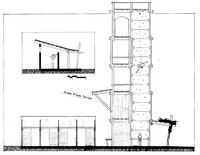
NOLS had established a base for sea kayaking and other water activities on the Baja California peninsula, in... Read more
News Analysis
Efforts to establish a National Institute for the Environment (NIE) are proceeding in Washington, and they may even pick up speed as a way to consolidate environmental research efforts that are being handled through many different agencies. A bill to establish the Institute is expected to be introduced in... Read more
News Brief
A four-month-old initiative within the U.S. Postal Service aims to revise design guidelines and material specifications to improve environmental performance. The Washington, D.C. office of HOK, Inc. was recently retained to help develop the proposed changes, which will be presented to senior Postal Service staff for review in late October. To... Read more
News Brief
The Wild Lawn Handbook: Alternatives to the Traditional Front LawnStevie Daniels, 1995. Macmillan, 15 Columbus Circle, New York, NY 10023; 800/858-7674. Hardcover, 223 pages, $20 ($27.95 Canada).
Written for homeowners who are questioning the ecological and financial cost of maintaining a traditional lawn... Read more
News Analysis
Fluorescent lighting was introduced in the 1920s as a more energy-efficient alternative to incandescent lighting. Over the past two decades, technology improvements have gradually increased the acceptability of fluorescent lamps for many more applications. Light quality was dramatically improved with triphosphor... Read more


