
News Analysis
Philips Lighting Company has announced a new line of T-8 fluorescent lamps using the company’s Alto II technology to replace its ten-year-old Alto technology. Each new lamp contains 1.7 mg of mercury, compared to 3.5 milligrams (mg) in each original Alto lamp. “Through some innovative approaches to mercury doses and retention in the lamp... Read more
Product Review
News Brief
The American Society of Heating, Air-Conditioning, and Refrigerating Engineers (ASHRAE), the U.S. Green Building Council, and the U.K.-based Chartered Institute of Building Services Engineers are working together to provide guidance for measuring and reporting building performance. After a literature review, due out on September 1, 2007, the... Read more
Product Review
Explainer

Ground-source heat pumps take advantage of stable temperatures just below the Earth's crust for energy-efficient heating and cooling.
Ground-source heat pumps (GSHPs), often called “geothermal heat pumps,” exploit the relatively stable temperatures found just 5 feet (1.5 m) or more below the surface, either depositing or extracting low-intensity heat. Heat pumps—whether ground-source or air-source—are basically air conditioners that can be run in reverse to provide heating as... Read more
News Brief
News Analysis
EBN
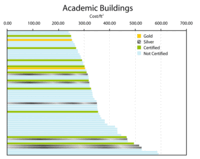
Vol. 13, No. 8] with new data, Lisa Fay Matthiessen and Peter Morris of Davis Langdon still come to the same conclusion. There are so many huge cost factors in construction that it is not possible to detect any statistically significant difference between... Read more
News Brief
The U.S. Green Building Council (USGBC) announced in July 2007 that it had reached a total of 10,000 member companies, signaling large growth in the previous year. The 2007 figure represents a growth of 2,800 members over 2006 numbers; USGBC gained a total of 4,800 members between 2002 and 2006. Member companies include architects,... Read more
Op-Ed
Thank you for your recent article on light bulb bans [see
EBN
Vol. 16, No. 4]. It was well documented and had good points about the value of improving incandescent lamps rather than banning them. Incandescent lamps still have their place in some situations, and it would make no sense to replace every incandescent bulb with a... Read more
Product Review

News Brief
News Brief
A study published in
Forest Products Journal in June 2007 found that wood treated with copper azole or alkaline copper quaternary compound (ACQ) to both above-ground and ground-contact levels is prone to damage from brown-rot fungi. Both chemicals were introduced to replace chromated copper arsenate for residential use several years ago... Read more
Product Review

Explainer

News Brief
One of the largest waste collection and recycling companies operating in the U.S., Waste Management, Inc., has acquired an existing business, LampTracker, which offers a mail-back recycling program for fluorescent lamps. The company sells special containers for collecting and shipping fluorescent tubes, compact fluorescent lamps, and other... Read more
News Brief
The Canada Green Building Council (CaGBC) and the Building Owners and Managers Association of Canada (BOMA Canada) have discontinued negotiations towards a cooperative relationship. According to Nancy Grenier, manager of communications for CaGBC, the two organizations had been pursuing a relationship in which they would promote each others’... Read more
News Analysis
In July 2007 the New Buildings Institute (NBI) released its Advanced Buildings
Core Performance Guide. The guide describes a series of energy-efficiency measures, selected by NBI using a comprehensive energy-modeling exercise, as the most cost-effective ways to achieve 20%–30% energy savings in buildings throughout the U.S. This guide... Read more
News Brief
Until recently, builders using structural insulated panels (SIPs) had to work with an architect or engineer to prove the technique was equivalent structurally to those spelled out in the International Residential Code. In May 2007, the International Code Council (ICC) adopted prescriptive specifications and installation details for SIPs into... Read more
News Brief
Six organizations have joined forces to create a design guide focused on indoor air quality (IAQ) in nonresidential buildings. The U.S. Environmental Protection Agency initially decided to fund a design guide and reached a cooperative agreement with the American Society of Heating, Refrigerating, and Air-Conditioning Engineers. A memorandum of... Read more
News Brief
A spokesperson for San Francisco’s Department of Environment confirmed that chances were very good that legislation would be enacted to formalize recommendations put forth in a June 2007 report by the Mayor’s Task Force on Green Building. Following the proposed recommendations, large commercial and high-rise residential buildings, both new and... Read more


