
News Brief
Product Review
EBN... Read more
News Analysis
Bisphenol-A (BPA), a chemical used to make polycarbonate and epoxy plastics, has come under fire recently for its status as an endocrine disruptor. The chemical is commonly used as an ingredient in consumer products, particularly reusable water bottles, baby bottles, plastic dishware, tooth fillings, and canned-food liners. It also appears in... Read more
News Brief
The socially responsible mutual fund company Calvert has released a study, conducted with the Boston College Institute for Responsible Investment, ranking the 13 largest homebuilders in the U.S. according to their green practices.
Calvert assessed the policies, programs, and performance of each in four areas: energy, water, materials, and... Read moreNews Brief
In November 2006, the U.S. Environmental Protection Agency (EPA) issued guidance for a washing machine that uses nanoparticles of silver, regulating the machine as a pesticide (see
EBN
Vol. 16, No. 1). At that time, EPA decided not to create broader rules governing nanosilver in general.
In response to what it sees as a... Read moreFeature
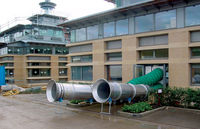
Incorporating a continuous air barrier into a building's design and construction can save energy and improve the indoor environment, among other benefits.
Air leaks may not be as dramatic as water leaks, but they cause plenty of problems. When a new LEED-certified building in New York formed icicles and ice dams, the owners brought in building-science consultant Terry Brennan of Camroden Associates to investigate. “The detailing of the air barrier was actually pretty good,” he says. The rafters... Read more
News Analysis
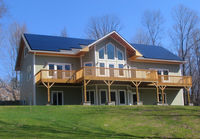
The HERS Index, an energy rating system based on a straightforward scale that puts a net-zero home at zero and a basic code-built home at 100, has been adopted by a variety of programs that evaluate the environmental performance of homes.
While the LEED for Homes rating system from the U.S. Green Building Council has garnered a lot of attention since its 2007 launch (see
EBN Vol. 16, No. 12), a less complex and comprehensive rating system, the HERS Index, has quietly been applied to hundreds of thousands of homes and is referenced by a growing number of programs.
... Read moreNews Analysis
Explainer
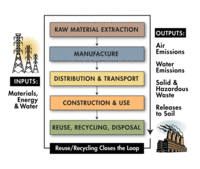
Life-cycle assessment—accounting for all of the environmental impacts of a product from its manufacture to its disposal—is a simple concept, but using it to compare products in practice can be difficult.
If you wanted to know about all the environmental impacts of a product, common sense suggests that you would have to trace that product from the origins of its raw materials, through its manufacture and use, and finally to its fate at the end of its useful life. That’s the premise behind environmental life-cycle assessment (LCA)—a science that... Read more
News Analysis
On May 19, 2008, the U.S. Green Building Council (USGBC) opened a public comment period for the most sweeping changes to its LEED Rating System since its original launch in 2000. The changes, which apply to all nonresidential LEED rating systems that have been formally released, are largely in line with the plan that USGBC laid out at the 2007... Read more
Blog Post
Blog Post
Does wind power increase carbon emissions? That was the question I asked in a recent post after seeing a analysis by Stanley Rhodes of Scientific Certification Systems, a major testing and certification agency for green building products, among other things. Stanley, who is a respected expert on life-cycle assessment, looked beyond the carbon... Read more
Blog Post
Blog Post
Blog Post
Blog Post
Twice each month, BuildingGreen publishes an email news bulletin with current news and product information briefs. Sign up here — it's free. We will never share or sell your email address, and you may unsubscribe at any time.
Read the current bulletinBlog Post
I love people that make, rather than assemble. The old-world built environment had a character of imperfection, a dose of wabi sabi, odd and lumpy bits that represent a connection that's both human and natural.
I have a huge amount of appreciation and respect for (and some jealousy of) people plying artisan trades, and had a couple good conversations with AIA'08 exhibitors offering that sort of thing. John Canning & Company goes beyond artisan; check out the featured projects on their website. In my capacity as poster boy for the A Little... Read more
Blog Post
Blog Post
Sunlight gives us light at no charge, which we can harness in our buildings to reduce our reliance on electrical lighting, while providing a more enjoyable indoor environment. Leave it to an engineer to tell us how much that sunlight actually costs us. Lumens per watt (lpw) is the measure of lighting efficacy, telling us how much light (lumens... Read more
Blog Post


