
Blog Post

For real this time?
For twenty years or so, companies like Pilkington (Spacia) have been cranking out R-5ish (center-of-glass) vacuum-insulated glazing (VIG). The attraction of glazing units with a very thin profile, relatively low weight, and a high level of performance is strong, particularly for retrofit applications.
But it sure seems as though we have... Read more
News Brief

The resilient design pilot credits were taken down temporarily but have returned—with a few changes.
Three newly revived pilot credits offer project teams the option of using resilient design to gain LEED points. Pilot credits are a way for users to test out new concepts and achieve points under the Innovation category of the LEED rating systems.
The basic structure of the suite of credits has not changed: the first credit involves an... Read more
Blog Post

The carbon that’s emitted when we produce materials and construct our buildings is finally getting the attention it deserves.
Shortly after the release of Paula Melton’s Spotlight Report on Embodied Carbon, which has been getting amazing reviews and kudos, I sat in on an update by Ryan Zizzo, Chair of the Embodied Carbon Network’s Buildings Taskforce. I was so inspired by the breadth of activities suddenly going on in this space, that I decided to lay them out in a... Read more
News Brief
California has committed to 100% “carbon-free” energy by 2045, illuminating the vision promoted by the Global Climate Action Summit.
On September 10, 2018 at the Global Climate Action Summit in San Francisco, Governor Jerry Brown signed bill SB 100 into law, committing the state to 100% carbon-free utility electricity by 2045. (California is the second state after Hawaii, in 2015, to commit to 100% renewable energy by 2045.) Two days later at the summit, Brown signed an... Read more
News Brief
Curbing the urban heat-island effect and managing rainwater are among the strategies that could help cities save big.
Solar power, cool roofs, and permeable pavement aren’t new ideas—but they’ve also never been deployed at scale. A new study looks at what might happen if they were.
“Cities mismanage their two great natural gifts of sunshine and rain,” states the report, “Delivering Urban Resilience,” which was supported by the Smart Surfaces Coalition... Read more
Product Review
SolarEdge’s photovoltaic inverter and electric vehicle charging station reduces the number of mechanical systems and simplifies installation.
Charging your electric vehicle (EV) at home using renewable energy is the future of transportation. But getting that power to the car typically requires two systems: an inverter and a charger. Photovoltaic (PV) panels use inverters to convert direct current (DC) to alternating current (AC), and a charger typically supplies energy pulled from... Read more
News Brief
A new partnership between the International Living Future Institute and Toxnot will help manufacturers provide better-quality health information.
The International Living Future Institute’s (ILFI) Declare label is supposed to be an easy-to-read “nutrition” label for products, showing the product’s ingredients and whether or not it contains any of ILFI’s banned Red List chemicals. This simple document belies the underlying complexity required for manufacturers to track chemicals used to... Read more
News Analysis
Health advocates worry that new review methods at EPA could cripple the updated Toxic Substances Control Act.
It wasn’t perfect, but it was promising. The Toxic Substances Control Act (TSCA), as amended in 2016, was designed to give the U.S. Environmental Protection Agency (EPA) new powers and obligations to study and regulate industrial chemicals.
But if current EPA actions are any guide, the limitations and outright bans that environmental... Read more
News Analysis
The AIA Code of Ethics now addresses specific environmental priorities like water, energy, and climate change.
Op-Ed
Getting stronger sustainability language into the code wasn’t easy, but only because AIA takes these things seriously.
David Pill, AIA, had an inspiration as we were planning the third annual AIA New England Committee on the Environment (COTE) Summit, which took place in Burlington, Vermont, in June 2017. He had recently noticed that the American Institute of Architects (AIA) has a Code of Ethics and was aghast at how little was being expected of AIA members,... Read more
Blog Post
Upgrading our basement dehumidifier
The basement of our well-insulated and air-sealed 100+-year-old home is dry, but enough moisture (as vapor) makes its way through our concrete walls and slab that dehumidification is a must from about April through October. Dehumidification comes with a pretty big energy penalty, so I am proactive in managing this load: when I see that... Read more
Feature

Building materials emit massive amounts of carbon long before the lights go on. Here’s how thoughtful design can reduce global warming impact.
Climate change is a rapidly escalating emergency, and we have a lot of hard work to do in order to mitigate its effects. For building professionals, that has typically meant increasing energy efficiency and pushing for renewable energy production, thus reducing the amount of carbon generated by the fossil fuels we burn in order to... Read more
News Brief
Step-by-step guidance helps design teams put healthier material selection into practice on every project.
Awareness of material transparency and hazardous chemical avoidance has increased dramatically over the past several years. But awareness is only half the battle. In practice, selecting building materials that are safer for people and the planet can still be a highly complex and difficult task.
In response to this issue, the American... Read more
Product Review
Integrating low-temperature hydronic distribution with air-to-water heat pumps provides a more comfortable and “future-proof” heating system for residential and light commercial applications.
Hydronic systems, which use water to move energy, are one of the most efficient ways to heat and cool buildings. Water carries far more energy than air, and does so in a small pipe rather than in leaky, bulky ductwork. It can also be engineered to deliver personalized heating or cooling to individual rooms. Many of the hydronic systems used in... Read more
News Brief
An exhaustive plant-by-plant study reveals the toxic impacts of producing chlorine for PVC, polyurethane, epoxy, and polycarbonate.
Chlorine is a problem. Used in many industrial processes, including the production of PVC and other plastics, it readily combines with other compounds to form persistent, bioaccumulative toxic chemicals (PBTs). These chemicals are not only toxic but also highly mobile in the environment and don’t break down readily.
The green building... Read more
News Analysis
Designers asked for transparency and got it. Now they need to follow through with specs, say producers.
Five years ago, about 40 prominent architecture firms issued a demand to manufacturers: tell us what’s in your products. They got transparency documents for thousands of product lines in return, according to 35 signatories to a recent letter, and now it’s time for those architecture firms to follow up with “demand” in the economic sense of the... Read more
News Brief
Energy, water, waste, and operating costs were all lower in buildings targeting higher performance, according to a new study.
Do good intentions actually result in lower energy and water use? The answer is decidedly yes in federal buildings, according to a new report from the U.S. General Services Administration (GSA).
The study compared 100 buildings that meet the Guiding Principles for Sustainable Federal Buildings with 100 “legacy stock” buildings. The... Read more
Product Review
Shaw is now offering biobased and recycled PET resilient flooring options for commercial and healthcare applications.
Editor’s note: PET Resilient was never fully rolled out to market, and the company’s explanations about why have been vague. However, Shaw has now introduced a polyolefin-based LVT replacement it claims is comparable in price to domestically sourced LVT.
If you want to avoid vinyl, there are plenty of resilient flooring options... Read more
News Analysis
Recent large-scale projects highlight the beneficial intersections between modular prefabrication, wood construction, and Passive House design.
The goals of sustainable design and construction have evolved to include an increasing focus on the embodied impacts of buildings in addition to the operational impacts. And although strategies that can achieve these goals have emerged—like net-zero design, onsite renewables, material reuse, and whole-building life-cycle analysis—many can... Read more
News Brief
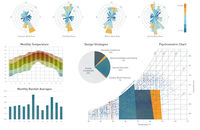
The criteria for the COTE Top Ten awards have been refashioned into a best-practice design guide for use on any project.
What can you do to make any project greener, even one with a small budget and an unmotivated client? A new guide helps designers focus on the strategies that have proven to be most effective.
The American Institute of Architects’ (AIA) Committee on the Environment (COTE) has released the phase one draft of the AIA COTE Top Ten Toolkit.... Read more


