
Blog Post
Blog Post
Although not as green as cellulose, batt insulation makes sense under certain conditions.
Last week's column addressed cellulose insulation, which is the greenest and one of the most effective insulation materials available. But it isn't always practical or affordable to install cellulose. To insulate walls with cellulose, it's usually necessary to hire an insulation contractor, and if the job is very small--bumping out and... Read more
Blog Post
Blog Post
Blog Post
Blog Post
Insulation is our number-one line of defense against high heating costs, and my favorite type of insulation is cellulose. Along with its effectiveness at slowing heat flow, cellulose insulation is a green product--made mostly out of an abundant waste product: old newspaper.
Most... Read more
Blog Post
Blog Post
There is no component of a home more important in minimizing energy costs than insulation. Insulation is the material used in walls, ceilings, roofs, and foundations that slows the flow of heat.
Most... Read more
Blog Post
Blog Post
News Brief

News Brief
Green building has a new voice in Washington: the High-Performance Buildings Congressional Caucus and Coalition. The caucus consists of members of Congress, led by cochairs Russ Carnahan of Missouri and Judy Biggert of Illinois, interested in green building legislative issues; the group hosts briefings and communicates its findings to other... Read more
News Analysis
Alpen Energy Group, the Colorado-based manufacturer of high-performing windows (see
EBN
Vol. 16, No. 10) and recipient of a 2007 BuildingGreen Top-10 Award, was acquired in June 2008 by Serious Materials, Inc., of Sunnyvale, California. Serious Materials, previously Quiet Solution, Inc., produces acoustic drywall and plywood... Read more
News Analysis
News Brief
San Francisco officials hope to lead the nation in the installation of rooftop photovoltaic systems by having 10,000 systems in place within a decade. (About 770 systems are currently installed.) The City’s Board of Supervisors has approved $3 million per year for ten years to provide taxable incentive payments to residents and businesses... Read more
Product Review
News Brief
The Green Communities Act, passed by the Massachusetts Legislature and signed into law on July 2, 2008, promises to “reduce electric bills, promote the development of renewable energy, and stimulate the clean energy industry that is taking root here in the Commonwealth,” according to Governor Deval Patrick.
The act includes a wide range of... Read moreNews Brief
In May 2008 the U.S. Green Building Council (USGBC) announced that it would be outsourcing LEED certification to the Green Building Certification Institute (GBCI) and, through GBCI, to independent certification bodies (see EBN Vol. 17, No. 6). USGBC has now named the ten companies that will be certifying LEED buildings beginning in January 2009... Read more
News Brief
News Analysis
EBN
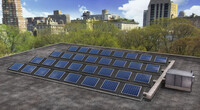
Vol. 5, No. 1), Conserval Engineering has created SolarDuct PV/T for rooftop applications. Like SolarWall, SolarDuct has a dark, perforated metal surface that heats air inside a passage. This heated air is then drawn... Read more


