
Explainer
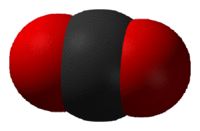
The family of greenhouse gases extends beyond CO2, with each gas contributing to global warming to some degree.
Carbon dioxide (CO2) is the most important of many human-generated “greenhouse gases”—gases that are contributing to a gradual warming of the planet. These gases, many of which have always existed in the atmosphere, contribute to a balance of heat flows that has given us a relatively stable climate. Since the beginning of the Industrial... Read more
Blog Post
Blog Post
Blog Post
Blog Post
Greasy Socks and Certifications Recently I was doing research for a brief item about green education for "real estate professionals," that is, real estate agents, appraisers, house inspectors, and loan officers. I read about a new course being offered, covering global climate issues, green building, indoor and outdoor air quality, and, last... Read more
Blog Post
Blog Post
So says the Urban Land Institute. The following grabs are from a couple slides in A Plan for Tomorrow: Creating Stronger and Healthier Communities Today and the nearly identical A Plan for Tomorrow: Creating Stronger and Healthier Cities Today, companion PowerPoint presentations to Higher Density Development: Myth and Fact.
"About... Read moreBlog Post
Jennifer Atlee has posted notes from the session she co-presented at USGBC Cascadia chapter's Living Future 'Unconference'. See them here.
Blog Post
Twice each month, BuildingGreen publishes an email news bulletin with current news and product information briefs. Sign up here — it's free. We will never share or sell your email address, and you may unsubscribe at any time.
Read the current bulletinNews Brief
While U.S. factory shipments were lower in 2007 than 2006 for nearly all residential appliances, according to the March 2008 issue of
Appliance magazine, factory shipments of unvented gas room heaters increased 43% during this period—from about 197,000 to 281,000 units. Dehumidifier shipments also increased significantly (38%), while... Read more
News Analysis

Product Review

News Brief

EBN
Vol. 15, No. 7). EPA now plans to extend the label to whole houses using specifications that will be finalized by the end of 2008. Draft... Read more
News Analysis
Bisphenol-A (BPA), a chemical used to make polycarbonate and epoxy plastics, has come under fire recently for its status as an endocrine disruptor. The chemical is commonly used as an ingredient in consumer products, particularly reusable water bottles, baby bottles, plastic dishware, tooth fillings, and canned-food liners. It also appears in... Read more
News Brief
In November 2006, the U.S. Environmental Protection Agency (EPA) issued guidance for a washing machine that uses nanoparticles of silver, regulating the machine as a pesticide (see
EBN
Vol. 16, No. 1). At that time, EPA decided not to create broader rules governing nanosilver in general.
In response to what it sees as a... Read moreNews Brief
In 2003, the European Union exempted the flame retardant deca polybrominated diphenyl ether (decaBDE), used in building materials as well as electronics and furnishings, from the RoHS (Restriction of Hazardous Substances in Electrical and Electronic Equipment) Directive, which restricts the use of brominated flame retardants (see
EBN... Read more
News Analysis
Forests in the U.S. are currently certified using one... Read more
News Brief
Recognizing the durability benefits of green buildings, insurance company Fireman’s Fund began offering green rebuilding policies for commercial properties in 2006. These policies cover the cost premium for adding green features when a building is repaired or replaced. Covered upgrades include efficient lighting and plumbing, vegetated roofs,... Read more
Product Review

EBN... Read more
News Brief


