
News Analysis
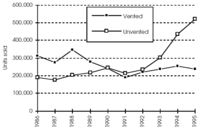
Manufacturers argue that, properly installed and operated, these heaters pose no threat, but the many warnings and cautions in the installation manuals suggest that... Read more
News Brief
ICI Paints of Cleveland, Ohio has expanded its Glidden line of zero-VOC paints with the recent availability of a full color line in the Lifemaster premium interior and Decra-Shield® exterior paints. With the introduction of solvent-free colorants, all colors are now available in VOC-free formulations. In the past, while VOCs had been eliminated... Read more
Feature

Are our buildings making us sick? Yes, say an increasing number of indoor air quality specialists in government agencies, academia, and the emerging industry working to solve these problems. By some estimates, direct medical costs associated with IAQ problems in the United States are as high as $15 billion per year, with indirect costs of $60... Read more
News Brief
A group of evangelical Christians is urging support of the Endangered Species Act (ESA), according to a January 31 article in
The New York Times. Dr. Calvin DeWitt, who helped found the Evangelical Environmental Network, said in the article that the Endangered Species Act is “the Noah’s Ark of our day” and that “Congress and special... Read more
Product Review

It was discovered in 1914 in Sweden that adding aluminum powder to cement, lime, water, and finely ground sand caused the mixture to expand dramatically. The Swedes allowed this “foamed” concrete to harden in a mold, and then they cured it in a pressurized steam chamber—an
autoclave.
Autoclaved aerated concrete (AAC, also called... Read moreNews Analysis
In a move that would appear to reinforce the National Association of Home Builders’ anti-environmental policies, the Association’s Committee on Energy was voted out of existence at the January 29 Board of Directors’ meeting. Ironically, the decision was made just a day after the First Annual Energy Value Housing Awards were presented, with the... Read more
News Brief
Motorists in Germany can now save on their auto insurance rates if they use public transportation. As reported in the February 23rd issue of
Global Environmental Change Report the German insurance company Rheinland (Neuss) has begun offering a 10% discount for policyowners who hold annual passes for the national railway system or for a... Read more
Op-Ed
You’re on the cutting edge again! We’ve been grumbling for the last couple of years about “Eco” homes carved out of the forest whose residents are forced to drive cars every day. Yours is the first article I’ve seen in green building literature that tackles transportation. Congratulations.
Paul HortonEnergy Outreach Center
Olympia... Read more
News Analysis
News Brief
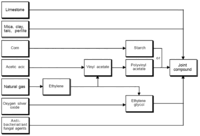
Joseph Demkin, editor. The American Institute of Architects. Published annually by John Wiley & Sons, 1996. Three-ring-bound. $150 + $2.50 for handling. Call 800/225-5945 to order.
The newEnvironmental Resource Guide (ERG) uses an effective combination of text and graphics to convey the environmental implications of building... Read more
News Brief
Willammette Industries, Inc. has just retooled a particleboard mill in Eugene, Oregon to produce a higher-quality medium-density fiberboard (MDF) using at least 50% recycled wood. The mill will use wood waste from construction sites, pallets, and packing crates.
Op-Ed
The January 22nd issue of
Newsweek—with a cover story suggesting that global warming might be responsible for the season’s intense blizzards—arrived about the same time as a letter from my father-in-law. “So much for global warming,” he noted with a jab, in response to the harsh weather we were enduring.
If you look hard enough, you... Read moreNews Analysis
Builders and designers committed to energy- and resource-efficient construction strategies have long struggled with building codes that mandate conventional practice, even when alternatives might be more sensible. A new addition to the Lake County, Illinois building code offers one solution to this problem—in a complete, take-it-or-leave-it... Read more
News Brief
100 pages; $5.00 covers postage & handling. Available from the American Forest & Paper Association, 1111 19th Street, NW, Suite 800, Washington, DC 20036.
This new, publication provides useful—though somewhat limited—information on where to recycle wood products. Organized on a state-by-state basis, the directory includes about 600... Read moreNews Brief
Wood and paper recycling could be used to achieve 10-20% of the U.S. carbon reduction goal, according to scientists at the USDA Forest Products Laboratory in Madison, Wisconsin. Recycling wood and paper reduces net carbon emissions by reducing timber harvesting, which in turn increases the amount of carbon sequestered by living trees, and by... Read more
News Brief
Tree Talk, Inc., PO Box 426, Burlington, Vermont 05402; 802/863-6789, 802/863-4344 (fax), wow@together.net (e-mail). CD-ROM Pro version: $99; CD-ROM standard version: $29.95; Compact (floppy disk) version: $19.95.
When we first reviewedWoods of the World (WoW) in July 1994, it had lots of useful information but also lots of gaps, and... Read more
News Brief
is cosponsor of the upcoming conference Use of Recycled Wood and Paper in Building Applications, which will be held on September 9-11, 1996 in Madison, Wisconsin. The conference should be the best forum to date for the exchange of information relating to use of recycled wood and paper in building applications. For information, see the... Read more
News Analysis

The Natural Step held the first of many planned one-day workshops this February in Denver, Colorado and in Marion, Massachusetts to acquaint business leaders with this innovative movement that is quickly gaining steam in Europe. The... Read more
News Brief
William McDonough Architects, of Charlottesville, Virginia was awarded a contract for design of a new environmental studies building at Oberlin College with extensive green design goals.
News Brief
Amoco/Enron Solar Power Development plans to build a four-megawatt photovoltaic (PV) generation plant in Hawaii in 1997 with a $1.14 million award from the Utility PhotoVoltaic Group (UPVG). The facility will use thin-film PV cells made by Solarex, which since January 1995 has been a subsidiary of the partnership between Amoco and Enron. Upon... Read more


