
Product Review
News Brief
Composite board decking and railing made by Louisiana-Pacific at the company’s Meridian, Idaho, plant between January 2005 and November 2007 may show premature deterioration and breakage, according to the company. Owners of the materials, sold under the Veranda,
WeatherBest, and ABTCo brands, should inspect their decks’ condition, stay... Read more
News Brief
Leaders in the Australian green building sector are promoting a cap-and-trade scheme for building energy efficiency to supplement greenhouse gas trading.
Maria Atkinson, global head of sustainability for property giant Lend Lease, and Che Wall, group director at Lincolne Scott consulting engineers and former head of the World Green Building... Read moreNews Brief
LEED Canada is being revised in concert with the U.S. 2009 revision to streamline LEED compliance for those who work on both sides of the border. The Canada Green Building Council (CaGBC) has chosen Enermodal Engineering to shepherd the revision process. According to Enermodal president Stephen Carpenter, a new version of LEED will be ready to... Read more
News Analysis
News Brief
The California Environmental Quality Act (CEQA), passed in 1970, is becoming an important tool in the state’s efforts to regulate greenhouse gas (GHG) emissions by controlling land-use decisions.
In August 2007, Attorney General Jerry Brown successfully sued San Bernardino County under the law for failing to address GHG emissions in its main... Read moreNews Brief
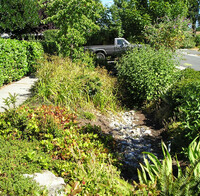
A recent study conducted by state agencies and the U.S. Environmental Protection Agency found that stormwater... Read more
News Brief
The renovation of a historic building in downtown Lansing was designed entirely by SmithGroup and... Read more
News Analysis
A law requiring annual energy-use reporting for all California’s nonresidential buildings takes effect in January 2009, and the state Department of General Services has been working closely with utilities to streamline the reporting process. Beginning in 2010 owners of commercial buildings must disclose their energy usage and Energy Star rating... Read more
Explainer
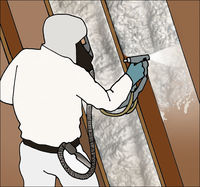
Among the many insulation materials we can choose from are foam-in-place products for filling cavities or creating a continuous layer on a wall or roof system. The most common of these is spray polyurethane foam, referred to in the industry as SPF.
There are two types of polyurethane foam: closed-cell and open-cell, both of which must... Read more
Feature
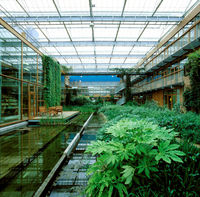
Some proponents of indoor plants promise that they will clean the air and promote occupant health and productivity. But will they? Scientific backing for these claims is still being developed, but some of the results are promising.
They maintain humidity, increase productivity, and reduce stress. They even scrub the air of dangerous chemicals. Whatever problems we create for ourselves in our buildings, plants are there to help cure them. Or are they? Although some promising studies have led to glowing accounts in the popular press, scientific study of the role of plants... Read more
News Analysis
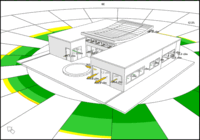
With a new plug-in for Google SketchUp, Integrated Environmental Solutions offers free energy simulations for projects in the early stages of design.
Integrated Environmental Solutions (IES) has launched a plug-in for Google SketchUp that delivers energy and carbon footprint simulations to inform early-stage design decisions. The free plug-in provides results without any additional software, although owners of IES’s Virtual Environment package or its VE-Toolkits can perform additional... Read more
Product Review
Vision Control sealed interpane louvers, available with any type of glazing, offer numerous benefits, including energy savings and reduced maintenance
Placement of blinds can be a dilemma—should they go on the inside or the outside of a window? The best place to put them, some argue, is within the glazing, where they are potentially maintenance-free, protected from dirt and possible damage. A handful of manufacturers offer this option, but the most versatile offerings come from Unicel... Read more
News Brief
win = window.open(URL, "win", "toolbar=no,location=no,directories=no,status=no,menubar=no,scrollbars=yes,resizable=yes,width=740,height=500");
win.focus();
}
Food Service Warehouse (FSW), an online retailer of commercial kitchen equipment, has announced a green commercial kitchen certification program. The... Read more
News Brief
The U.S. Green Building Council (USGBC) has announced the recipients of grants from its Green Building Research Fund. USGBC committed $2 million to the program, and the fund is generating over $1 million in matching funds and partnerships. Grants ranged from $90,000 to $250,000 and were awarded to 13 research teams.
The recipients of... Read more
Blog Post
Last week, I addressed some of the benefits of capturing waste heat from power plants and distributing it to buildings--a technology referred to as combined heat and power or CHP. This week we'll look at how this idea could be implemented in... Read more
Blog Post
Blog Post
Blog Post
Twice each month, BuildingGreen publishes an email news bulletin with current news and product information briefs. Sign up here — it's free. We will never share or sell your email address, and you may unsubscribe at any time.
Read the current bulletin

