
Feature

The economic collapse hit small and mid-sized design firms hard, but many with a green focus have adapted. We asked them to share their stories.
By Paula MeltonIt’s been five years since our super-sized housing market collided with the iceberg of reality and began its long descent, eventually pulling the global economy into the frigid depths along with it. The magnitude and origins of this collapse are making the recovery a slow one—and uniquely painful for those working in building... Read more
News Brief
The resulting education programs and building performance databases will help appraisers recognize and evaluate sustainability features within their own local real... Read more
News Brief

In exchange for the installation, which would typically cost tens of thousands of dollars, homeowners will agree to pay a set amount (lower than typical utility costs) for the power produced by the PV... Read more
News Brief
That’s where environmental product... Read more
Blog Post
Blog Post
[Editor's note: Robert Riversong, a Vermont builder, continues his 10-part series of articles taking design and... Read more
News Brief
The overall energy efficiency of domestic portland cement manufacture has increased 13% over a ten-year period, according to a report prepared for the U.S. Environmental Protection Agency (EPA) by economists at Duke University.
The decrease in total source energy, researchers wrote, is “equivalent to an annual reduction... Read more
Product Review
Conventional hot-water recirculation pumps—a standard appliance in hotels, multifamily residential buildings, and other commercial buildings with high demand for domestic hot water—were never supposed to save energy. These devices are installed to get hot water to the tap quickly to keep tenants and hotel guests happy. If they prevented some... Read more
News Brief
The Energy Lab at Hawai’i Preparatory Academy is the third building worldwide and the first K–12 school facility to achieve “Living” certification through the Living Building Challenge (LBC).
The science building, completed in January 2010, houses classroom and meeting spaces for a school curriculum focused on renewable energy.... Read more
News Brief
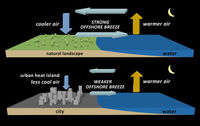
The urban heat island effect created by large areas of pavement and buildings can cause many problems, from increased energy use to reduced water quality. A new study from the National Center for Atmospheric Research (NCAR) suggests that expanses of paved surface may also worsen air quality in coastal cities like Houston, where... Read more
News Brief
The new standards, which will go into effect in 2013 for furnaces and 2015 for air conditioners and heat pumps, set regional equipment standards for the... Read more
Product Review
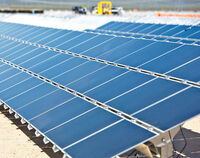
Manufacturers are improving photovoltaic (PV) module efficiency and bringing down costs, but the most efficient PV systems today use silicon crystal technology that is decades old. At the same time, thin-film technologies offer a cost-competitive solution with some advantages but with lower efficiency. With the hundreds of... Read more
News Brief
Through the program, Bank of America will distribute $50 million in low-interest loans as well as $5 million in grants to help community lenders administer... Read more
News Brief
The global recession caused a dip in energy-related carbon emissions in 2009, but IEA reports that infrastructure... Read more
Feature

Now you can get LEED, Energy Star, and other labels for designing or retrofitting high-performance multifamily buildings.
Multifamily buildings are inherently green, thanks to the way they support denser, transit-friendly communities. No one makes that point more strongly than developer Jonathan Rose, who refuses to build anything on a site that wasn’t previously developed. But, Rose argues, that’s not enough. “Climate issues, biodiversity issues, energy... Read more
Explainer
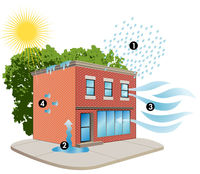
Water moves in, on, and through buildings in four ways, which we’ll discuss in order of the quantities involved; this order helps us set water management priorities.
1. Bulk water—rain, runoff, and other flows—is driven primarily by gravity but also by wind and pressure differences. Bulk water on the exterior of a building is managed by... Read more
Blog Post
I am going to go out on a limb here, but I would bet that sometime in the last 24 hours you have received a marketing message centered around how "green," how "environmentally friendly," or (if it's really serious), how "sustainable... Read more
Blog Post


