
News Brief
At a workshop sponsored by Environment Canada’s Winnipeg, Manitoba office, participants decided to establish the Used Building Materials Association as a networking forum and common voice for the salvage and reuse industry. With a core group of twelve American and Canadian nonprofit and for-profit salvage and reuse organizations, the... Read more
News Analysis

A government program to promote high-performance commercial buildings in Canada now has three buildings under construction. In two of these cases, program administrators were surprised to discover that their stringent criteria are being met using only conventional technologies, with little or no increase in building costs. They credit this... Read more
Feature
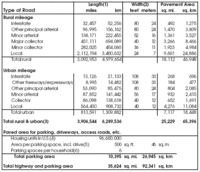
If our goal is to reduce the overall environmental impact of our building projects, we must begin paying more attention to the role automobiles play in these projects. Even the most environmentally responsible house—for example, an energy-independent, passive-solar house, built of salvaged and recycled materials, with graywater separation—will... Read more
Product Review
For years polystyrene has been just about the only game in town for exterior foundation insulation. The problem is that
extruded polystyrene—the type of polystyrene most commonly used on foundations—is produced with HCFCs that deplete ozone, and
all polystyrene (both extruded and... Read more
News Brief
Environmental Committee, Denver Chapter, AIA, and Colorado Chapter, ADPSR. 1995. Loose-leaf (without binder) or diskette (PC or Macintosh), $29.95. Order from: AIA Denver/SDRG, 1562 15th Street, Denver, CO, 80202; 303/446-2266, 303/446-0066 (fax).
Greatly improved from last year’s first edition, this... Read more
News Brief
The Woodworker’s Alliance for Rainforest Protection (WARP), a leading promoter of lesser-known species and other lumber from environmentally preferable sources, is changing its name to the “Good Wood Alliance.” Reasons for the change included a recognition that the environmental issues addressed are not limited to rainforests and that not all... Read more
News Analysis
Choosing an environmentally friendly siding material has never been easy. Often the more “natural” products, such as wood clapboards, are associated with depletion of sensitive forest resources, while materials that are highly manufactured—such as vinyl—raise questions about chlorine and petrochemicals as... Read more
News Brief
The Rainforest Action Network (RAN) has a new “Wood Reduction Clearinghouse” to disseminate information on ways to reduce waste and find environmentally sound alternatives to wood. Reducing wood use in construction is a primary goal of the service. Contact Dana Harmon at RAN, 450 Sansome Suite 700, San Francisco, CA 94111; 415/398-4404, 415/... Read more
Op-Ed
AS debate heats up on a new Endangered Species Act, revisions to the Clean Water Act, and dozens of other pieces of legislation affecting the environment, it appears as if the primary endangered species is objective information. Congressional opponents of regulation, trade associations, corporations, and... Read more
News Brief
Steven Winter Associates, Inc., of Norwalk, Connecticut, has been awarded a grant through the U.S. Department of Energy’s 1995 Small Business Innovative Research program to design advanced modular townhouses for urban infill sites. The company has been charged with designing townhouses that employ renewable energy and energy conservation... Read more
Product Review
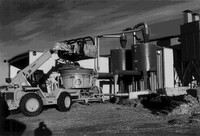
The company uses Norwegian manufacturing equipment to produce 4’ x 8’ (1200 mm x 2400 mm) panels in 1⁄4” (6 mm) and 1⁄8” (3 mm) thicknesses. Thicker, 1⁄2” (13 mm) panels were initially produced as well, but... Read more
News Brief
Environmental Building Consultants, 312 A Jefferson Ave., Cheltenham, PA 19012-2021; 215/663-1611, 215/663-1637 (fax), ehouse@omni.voicenet.com (e-mail); $50 for PC or Macintosh diskette containing database and software to run it.
This initial release of an IAQ products database contains about 450 listings... Read more
News Brief
Building Industry Professionals for Environmental Responsibility (BIPER) is a new lobbying group founded to counter the frequently anti-environmental message governments receive from mainstream industry organizations. Annual membership is $35. Three levels of membership allow members to choose the frequency of contacts from the... Read more
Product Review
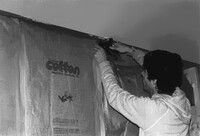
As you might imagine, information about new building products comes into the
EBN office all the time. When a new product strikes our fancy, we extract what information we can from manufacturers, we play with samples (often mutilating them in the process), we talk with any users we can track... Read more
News Analysis
With the Internet distribution this past August of a draft synthesis report by the three Working Groups of the Intergovernmental Panel on Climate Change (IPCC), suddenly global warming is back in the news. The report concludes that “the observed increase [in global temperature] over the last century (0.3°C–0.6°C... Read more
Explainer
now being manufactured in Perrytown, Texas, can be used in place of both framing and drywall in partition walls. At $19 each for 4’ by 8’ (1200 mm by 2400 mm) panels, they are very competitive with conventional stud framing within a reasonable shipping distance from the plant. The panels... Read more
News Brief
The DuPont Benedictus Awards for Innovation in Architectural Laminated Glass may have a significant environmental flavor in 1996 with the inclusion of two prominent “green” architects on the jury. Bob Berkebile of BNIM Architects in Kansas City, Missouri and Randolph Croxton, Croxton Collaborative Architects, New York City, have both been... Read more
News Analysis
How can we be confident that a particular manufacturer or company is committed to environmental improvements? There are certification systems for specific environmental claims, or for particular products, but as the best management practices and environmental goals evolve, how do we know that the... Read more
News Brief
Voluntary certification of product environmental claims is a useful option, but it does little to prevent bogus claims by other manufacturers. A 1990 California law attempts to address this problem by establishing legal definitions for the terms “ozone friendly,” “biodegradable,” “photodegradable,” “recyclable,” and “recycled.” Companies are... Read more
Product Review
... Read more


