
News Brief
Submissions are being accepted until February 15 for the 1996 Quality Building Conference Design Competition. New to this year’s competition is an Unbuilt Projects/Proposals category. Contact JoAnn Lawrence at the Northeast Sustainable Energy Association (NESEA), 50 Miles Street, Greenfield, Massachusetts 01301, 413/774-6051, 413/774-6053 (fax... Read more
News Analysis
A workshop on the linking and prioritizing of environmental criteria in building assessments was held this past November in Toronto. Workshop organizers had hoped that the participants would help figure out ways to prioritize environmental criteria so that practitioners in the building industry can focus the most energy and attention where they... Read more
News Brief
Real Goods has decided that it will no longer sponsor the National Tour of Independent Homes and is looking for another organization to take over the event. During its first three years, the Tour has been a big success, with 25,000 people having visited hundreds of homes and seeing first-hand the potential of renewables. Organizations... Read more
Op-Ed
Thanks for your article on “Establishing Priorities.”
Under saving energy, the first item: “In buildings with skin dominated loads,” incorporate high R-values. What about buildings with greater internal loads? Does it follow to use less insulation? Make it less airtight? I have a high school where the general contractor is saying, “How come... Read moreFeature
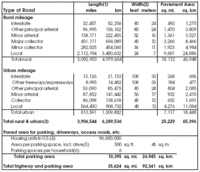
If our goal is to reduce the overall environmental impact of our building projects, we must begin paying more attention to the role automobiles play in these projects. Even the most environmentally responsible house—for example, an energy-independent, passive-solar house, built of salvaged and recycled materials, with graywater separation—will... Read more
News Brief
The DuPont Benedictus Awards for Innovation in Architectural Laminated Glass may have a significant environmental flavor in 1996 with the inclusion of two prominent “green” architects on the jury. Bob Berkebile of BNIM Architects in Kansas City, Missouri and Randolph Croxton, Croxton Collaborative Architects, New York City, have both been... Read more
News Analysis
How can we be confident that a particular manufacturer or company is committed to environmental improvements? There are certification systems for specific environmental claims, or for particular products, but as the best management practices and environmental goals evolve, how do we know that the... Read more
News Brief
Voluntary certification of product environmental claims is a useful option, but it does little to prevent bogus claims by other manufacturers. A 1990 California law attempts to address this problem by establishing legal definitions for the terms “ozone friendly,” “biodegradable,” “photodegradable,” “recyclable,” and “recycled.” Companies are... Read more
Product Review

The company uses Norwegian manufacturing equipment to produce 4’ x 8’ (1200 mm x 2400 mm) panels in 1⁄4” (6 mm) and 1⁄8” (3 mm) thicknesses. Thicker, 1⁄2” (13 mm) panels were initially produced as well, but... Read more
News Brief
published by Thousand Words, P.O. Box 9034, Berkeley, CA 94709; 510/883-0433, otg@ontheground.com (e-mail). $32 per year for four issues. Length varies: 32-36 pages.
On the Ground is a large-format, quarterly journal on community, landscape design, and the environment that premiered in the Fall of... Read more
Op-Ed
I very much appreciate your recognition of the need for and efforts to identify priorities for “green building” (whatever that is). Such priorities can either be defined implicitly by the buildings a “green designer” creates or by some systematic process based on a hierarchy of environmental problems. Your... Read more
Product Review
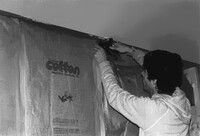
As you might imagine, information about new building products comes into the
EBN office all the time. When a new product strikes our fancy, we extract what information we can from manufacturers, we play with samples (often mutilating them in the process), we talk with any users we can track... Read more
News Brief
Environmental Committee, Denver Chapter, AIA, and Colorado Chapter, ADPSR. 1995. Loose-leaf (without binder) or diskette (PC or Macintosh), $29.95. Order from: AIA Denver/SDRG, 1562 15th Street, Denver, CO, 80202; 303/446-2266, 303/446-0066 (fax).
Greatly improved from last year’s first edition, this... Read more
Explainer
now being manufactured in Perrytown, Texas, can be used in place of both framing and drywall in partition walls. At $19 each for 4’ by 8’ (1200 mm by 2400 mm) panels, they are very competitive with conventional stud framing within a reasonable shipping distance from the plant. The panels... Read more
News Brief
The Woodworker’s Alliance for Rainforest Protection (WARP), a leading promoter of lesser-known species and other lumber from environmentally preferable sources, is changing its name to the “Good Wood Alliance.” Reasons for the change included a recognition that the environmental issues addressed are not limited to rainforests and that not all... Read more
News Analysis
Choosing an environmentally friendly siding material has never been easy. Often the more “natural” products, such as wood clapboards, are associated with depletion of sensitive forest resources, while materials that are highly manufactured—such as vinyl—raise questions about chlorine and petrochemicals as... Read more
News Brief
The Rainforest Action Network (RAN) has a new “Wood Reduction Clearinghouse” to disseminate information on ways to reduce waste and find environmentally sound alternatives to wood. Reducing wood use in construction is a primary goal of the service. Contact Dana Harmon at RAN, 450 Sansome Suite 700, San Francisco, CA 94111; 415/398-4404, 415/... Read more
Product Review
... Read more
News Brief
Steven Winter Associates, Inc., of Norwalk, Connecticut, has been awarded a grant through the U.S. Department of Energy’s 1995 Small Business Innovative Research program to design advanced modular townhouses for urban infill sites. The company has been charged with designing townhouses that employ renewable energy and energy conservation... Read more
Op-Ed
AS debate heats up on a new Endangered Species Act, revisions to the Clean Water Act, and dozens of other pieces of legislation affecting the environment, it appears as if the primary endangered species is objective information. Congressional opponents of regulation, trade associations, corporations, and... Read more


