
Blog Post
Blog Post
Over the past few... Read more
Blog Post
Blog Post
Twice each month, BuildingGreen publishes an email news bulletin with current news and product information briefs. Sign up here — it's free. We will never share or sell your email address, and you may unsubscribe at any time.
Read the current bulletinBlog Post
Blog Post
Last week I described why some environmentalists have shifted their position and now support nuclear power, and I described how we might be able to store nuclear waste more safely and cheaply than in the Yucca Mountain facility. So what's wrong with nuclear power? Why not move full-steam-ahead with this much more climate-friendly power... Read more
Op-Ed
There are a lot of problems with our existing food production system. Consider: the average mouthful of food has traveled 1,500 miles before reaching our plate, losing nutrition and flavor while consuming an incredible amount of energy. Agribusiness has created vast monocultures of grains, corn, and soybeans that, directly or indirectly deliver... Read more
News Brief
Responding to growing international requirements for suppliers to document that their wood comes from legal sources, the American Hardwood Export Council (AHEC) released a report claiming to validate the legality of North American hardwood sources as a whole. While a trade association promoting hardwood exports might not be the most objective... Read more
News Brief
The American Society of Heating, Refrigerating, and Air-Conditioning Engineers (ASHRAE) has proposed six addenda to Standard 90.1-2007 that would expand its scope and change how lighting efficiencies are calculated.
One addendum would add operations and maintenance as well as renewable energy to the scope of the standard, which currently... Read moreNews Analysis
GE Consumer and Industrial is seeking approval from the U.S. Environmental Protection Agency (EPA) to use the hydrocarbon isobutane in household refrigerators, according to a recent report in
Appliance magazine. Isobutane is neither an ozone-depleting compound nor a greenhouse gas, which sets it apart from the HCFCs and HFCs used in... Read more
News Brief
To achieve the rating, Gottfried renovated a... Read more
News Analysis

EBN
Vol. 15, No. 12) was recently chosen to provide heating and cooling at 2,000 housing units at Fort Dix/McGuire Air Force Base in New Jersey. About 600 units are in operation now, with new homes being completed at a rate of 40 each month.
Jack Gafford,... Read more
News Brief
Recent research published in the journal
Psychological Science gives a boost to the
biophilia hypothesis, which suggests that humans have an innate affinity for nature and that we benefit from exposure to nature—even through images (see
EBN
Vol. 15, No. 7).
Subjects in a University of Michigan study were... Read more
News Analysis
Icynene, maker of the widely used and first open-cell polyurethane spray foam insulation of the same name, has launched a new product with some rapidly renewable content. Icynene LD-R-50 is formulated with a polyol derived from the castor plant—a shrub with two annual growing cycles that thrives on marginal land.
Although the company hasn’t... Read moreNews Analysis
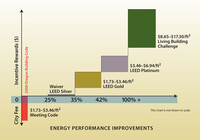
Officials in Portland, Oregon, have proposed a far-reaching green building program that would be the first of its kind in the country.
For new commercial buildings 20,000 ft2 (1,900 m2) or larger, the proposal sets up a “feebate” program in which developers constructing buildings that merely meet the Oregon state building code will be... Read moreNews Brief
Can the presence of porches and stoops affect people’s health? Numerous designers, researchers, and authors have explored the connection; Jane Jacobs famously wrote about the benefits of “eyes on the street” and the architectural features that support them. A team led by Scott Brown of the Miami Miller School of Medicine recently published... Read more
News Analysis
Serious Materials, Inc., the California-based manufacturer of environmental drywall products (see
EBN
Vol. 17, No. 12) and high-performing windows (see
EBN
Vol. 17, No. 8), has expanded its window-manufacturing capacity tenfold while rescuing a pair of troubled factories.
Pending results of a bankruptcy... Read moreNews Brief
The potential environmental benefits of nanomaterials may be significantly offset by the intensive demands of their manufacturing processes, according to research recently published in the
Journal of Industrial Ecology.
Nanotechnology has attracted attention within the green building industry (seeEBN
Vol. 17, No. 3) for... Read more
News Brief
In a recent ruling, the U.S. Department of Energy (DOE) updated the energy code used by states in crafting their own codes for commercial buildings. All states now must have codes equal to or more stringent than ASHRAE/IESNA Standard 90.1-2004 or apply for an exemption; the previous requirement referenced the 1999 version of the standard. The... Read more
News Analysis
Panasonic has introduced what may be the first vacuum-panel-insulated refrigerator in the world. The 17.7 ft3 (501 l) NR-F503TE refrigerator-freezer, introduced in late 2008 in Japan, is insulated with Panasonic’s U-VacuaIV vacuum panels that consist of multiple layers of glass fibers and aluminum films sealed into a vacuum panel. The... Read more


