
News Brief
Continuing a trend of rapid growth, the
U.S. Green Building Council announced in early February that it had accepted its 4,000th member. USGBC membership—which is open only to companies and organizations, not to individuals—hit 2,000 in September of 2002 and 3,000 in May of 2003.
News Analysis
At the beginning of March 2004, the U.S. Green Building Council released a draft of the LEED
® for Existing Buildings (LEED-EB) Rating System for review by Council members during a 30-day comment period. LEED-EB is designed to certify the ongoing operations and maintenance of facilities, including upgrades to building systems. It is not... Read more
News Brief
A recent design team solicitation from the Architect of the Capitol placed a whopping
25% of its selection criteria on the teams’ green design capabilities. “We believe this level of emphasis is a new high-water mark for the federal government,” said Terrel Emmons, FAIA, director of Planning and Programming. The project, being procured... Read more
News Analysis
The
Hayward Corporation, which produces FSC-certified wood products and other green building materials (see
EBN
Vol. 9, No. 6 and
Vol. 10, No. 4), has achieved a LEED
® v2 Gold rating for its Hayward Building Systems plant in Santa Maria, California. The 55,000 ft
2 (5,100 m
2) facility... Read more
News Brief
™ vapor retarder, which changes permeability according to relative humidity, has been awarded an Innovative Housing Technology Award in the energy category from the NAHB Research Center and EH Publishing. CertainTeed is online at www.certainteed.com. See
EBN
Vol. 12, No. 11 for a review of MemBrain.
... Read moreOp-Ed
Please explain what makes “polyester yarn … impregnated with an acrylic-based material” fire resistant, as claimed in the article “PVC-Free Interior Shade Screening from Nysan” (
Vol. 12, No. 12). As far as we know, polyester and acrylics are both flammable.
Tim Burns, President
The Vinyl Institute
Arlington,... Read more
News Brief
A new program is making it easier for Puget Sound residents to make their homes more efficient. Through a partnership with Efficiency Services Group (a division of Portland General Electric), HomeStreet Bank has started the
Mortgage Options for Resource Efficiency (MORE™) program. Participants in the program receive custom home energy... Read more
News Analysis
® landscape timbers, fencing, and pavers made from 100% post-consumer plastics, closed its doors in February. The Stamford, Connecticut company survived perennial capital shortages over its 15 years until an accident last April left owner Celeste Johnson unable to maintain sales streams, which plummeted more... Read more
News Brief
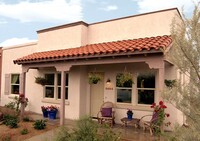
Civano, in southeast Tucson, Arizona, was named Best New Community in
Sunset Magazine’s annual Best Places to Live story. The 818-acre (330 ha), mixed-use community was designed around New Urbanist ideals, with a strong sense of community and place (see
EBN
Vol. 9, No. 7). The homes use 50% less energy... Read more
News Brief
The
Home Builders Association of Metro Denver, which recently trademarked the name Built Green
® for its residential green building program (the largest in the nation), has issued a cease and desist request against Vermont’s
Building for Social Responsibility (BSR) over its use of the name Vermont Built Green for its own... Read more
News Analysis
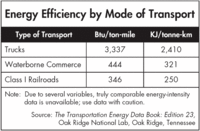
11 liters) of diesel fuel each year, emitting over 350 million metric tons of carbon dioxide. Facing a predicted 25% increase in these numbers by 2012, EPA launched a new program in February focused on making America’s... Read more
News Analysis
EBN... Read more
News Brief
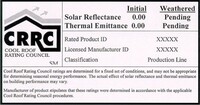
Cool Roof Rating Council (CRRC) has begun the aged-testing component of its product rating program. CRRC has been providing third-party verification of both initial solar reflectance and initial thermal emittance of roofing products since September 2002 (see
EBN
Vol. 12, No. 7), and this aged-testing component adds another... Read more
Op-Ed
Last October’s issue of
EBN (
Vol. 12, No. 10) was another great one. My non-expert two cents on the filtration issue is that the best way to do HVAC in buildings (at least buildings other than single-family homes) is to separate space conditioning, which is an intermittent load, from ventilation, which is always present during... Read more
News Brief
A recent study that compared development patterns to the health of over 200,000 people in 448 counties in major metropolitan areas around the U.S. found that
car-dependent suburbanites suffer from obesity and high blood pressure at a greater rate than city-dwellers. The report, “Relationship between Urban Sprawl and Physical Activity,... Read more
News Analysis
The Second Circuit Court of Appeals in New York City has rejected a Bush Administration plan to lower energy-efficiency standards for air-conditioners. The lawsuit,
Natural Resources Defense Council v. Abraham, was brought by NRDC, consumer groups, and attorneys general from ten states. Clinton Administration standards, which mandate... Read more
News Brief
The Boston Society of Architects has approved the Institution Recycling Network (IRN) to offer American Institute of Architects
Learning Units in construction waste management. IRN, based in Concord, New Hampshire, is a cooperative organization that works to improve the financial and operating performance of recycling programs at... Read more
News Brief
Global climate change will prompt
widespread extinction within decades, according to an international group of 19 scientists. The group studied more than 1,000 species representing roughly 20% of the Earth’s terrestrial surface and found that, if current warming trends continue, 15–37% of them will be “committed to extinction” by 2050.... Read more
News Brief
David L. Grumman, editor. American Society of Heating, Refrigeration and Air-Conditioning Engineers, Inc., 2004, paperback, 170 pages, $99 ($79 for ASHRAE members). Contact ASHRAE Customer Service at 1-800-527-4723 or 404-636-8400, or visit the ASHRAE.org Bookstore.
Engineers can be a literal bunch. A chapter in the
ASHRAE... Read more
News Brief
Traces of fluoxetine hydrochloride, the active ingredient in the drug
Prozac, have been found in fish in central Texas, according to a Baylor University study led by toxicologist Dr. Bryan Brooks. “Maybe it makes you a happy fish and you’re kind of hanging out,” said Brooks, but he questions the drug’s effect on the ability of fish to... Read more


