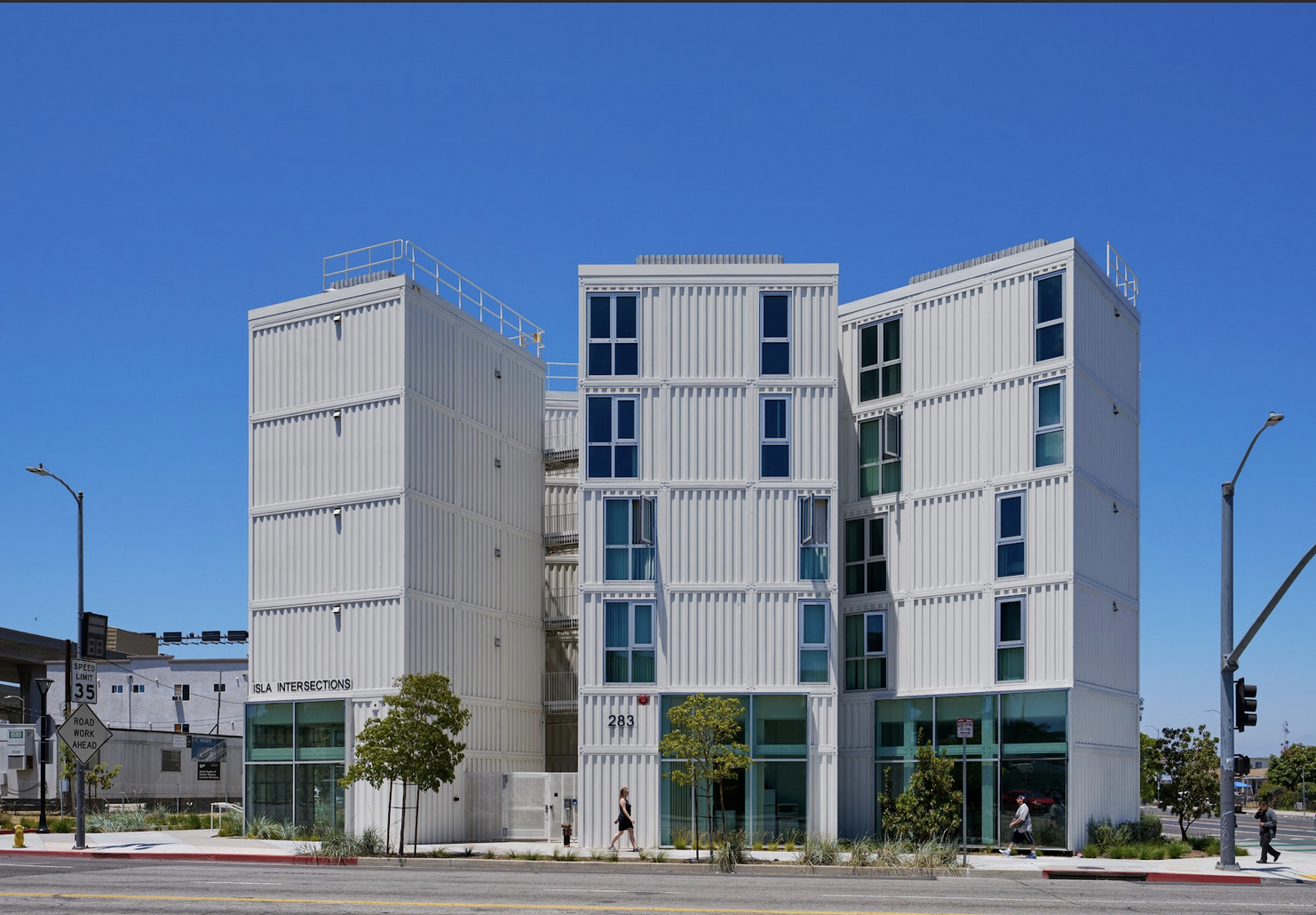
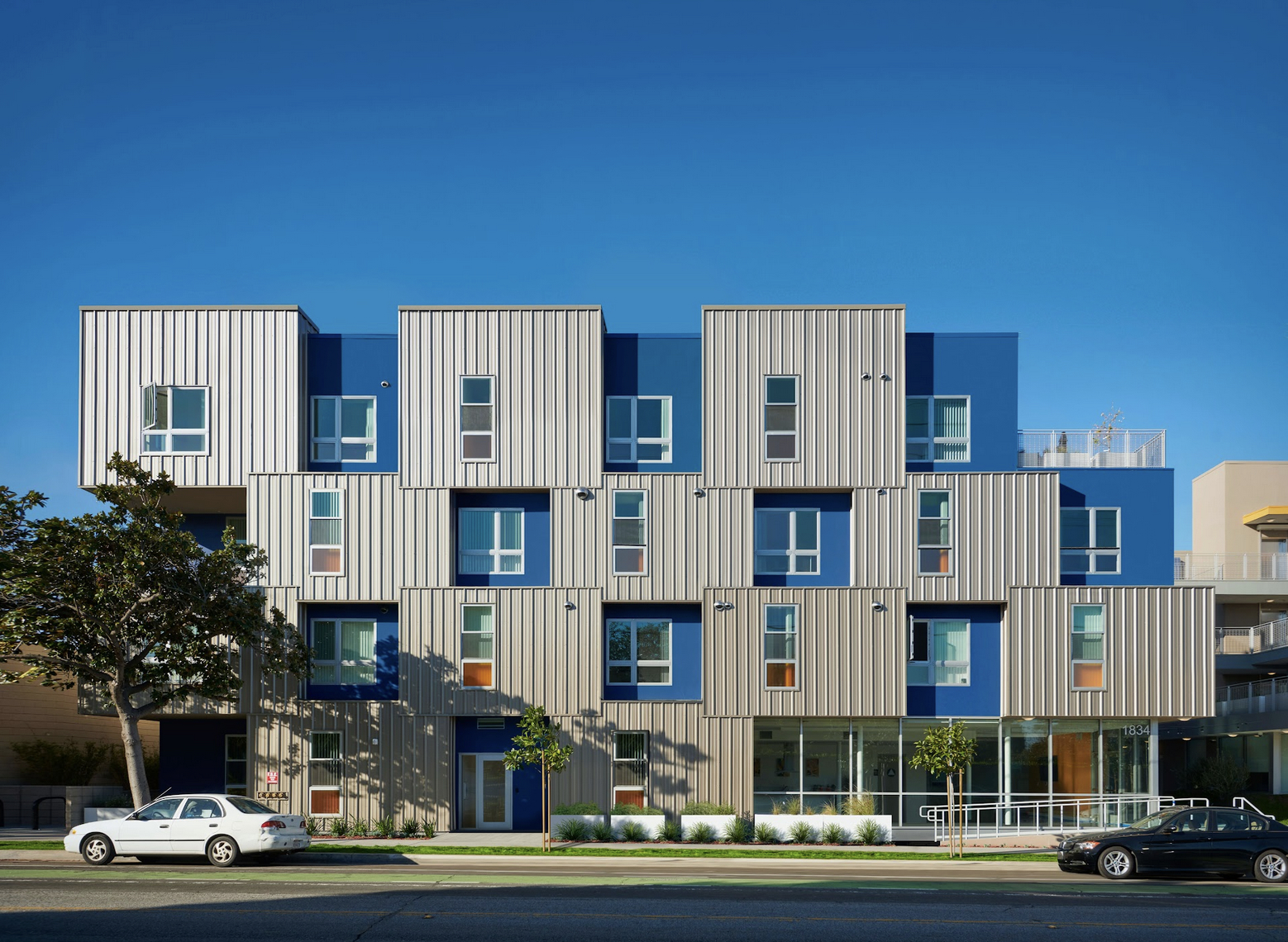
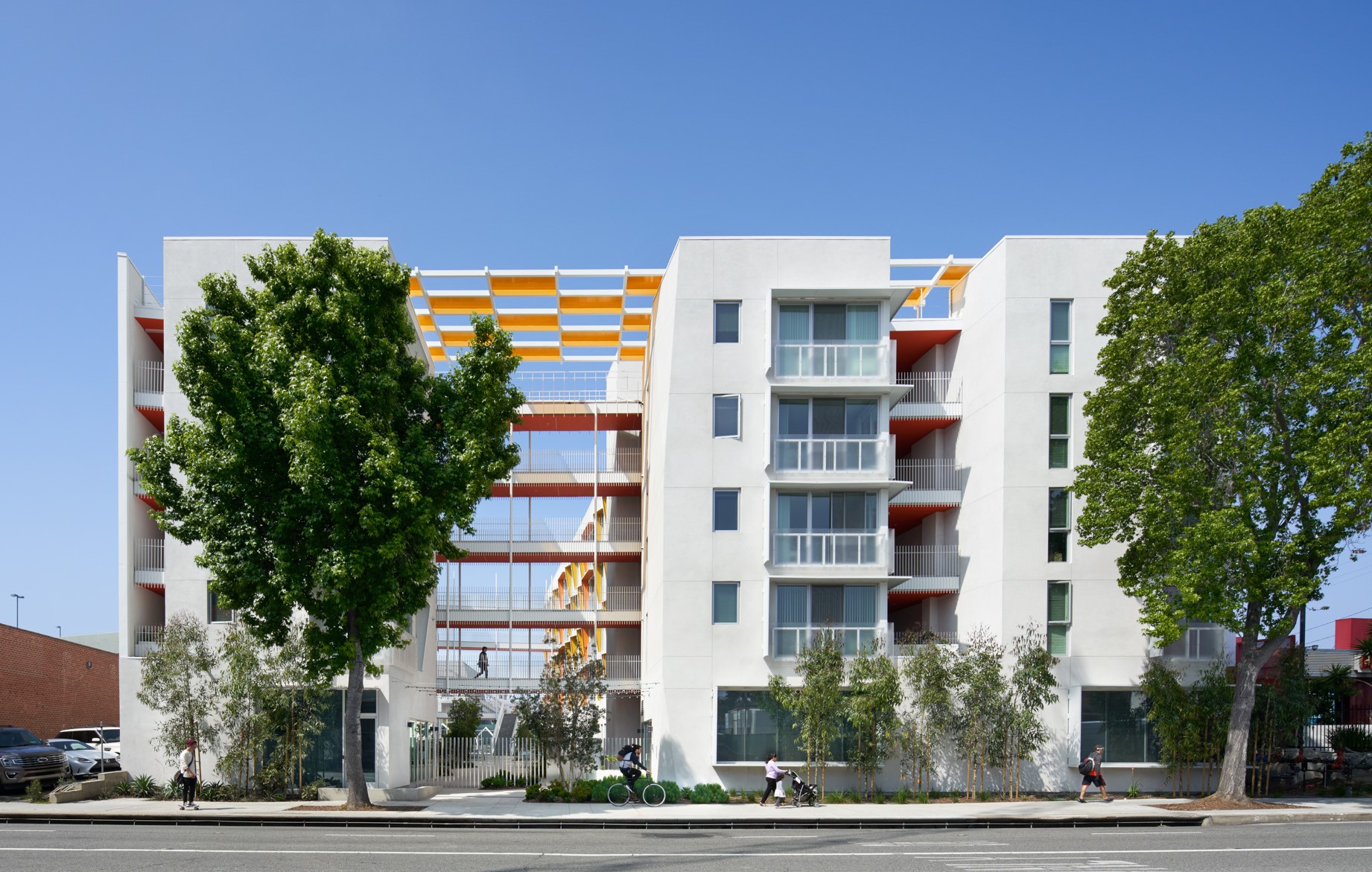
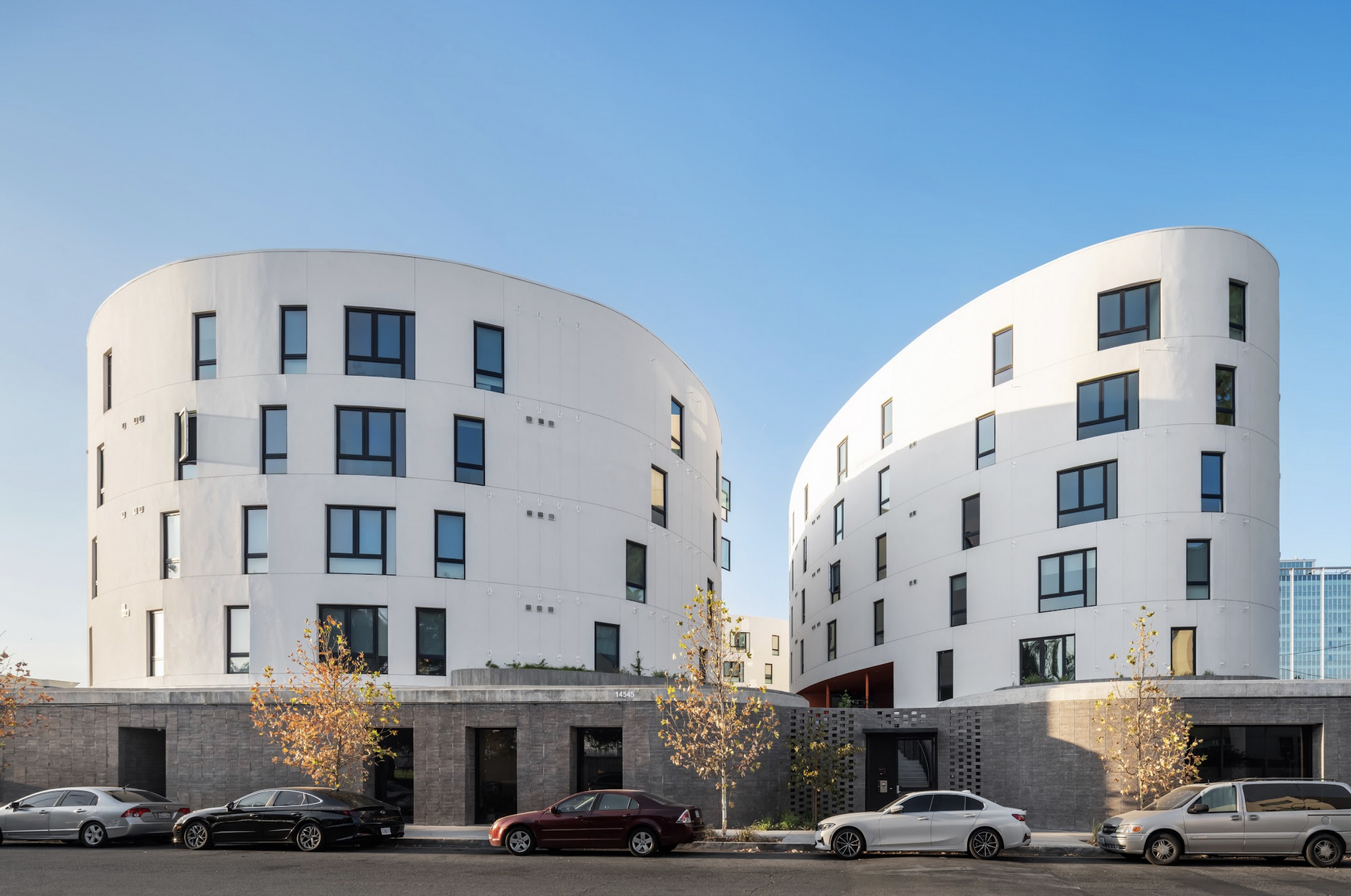
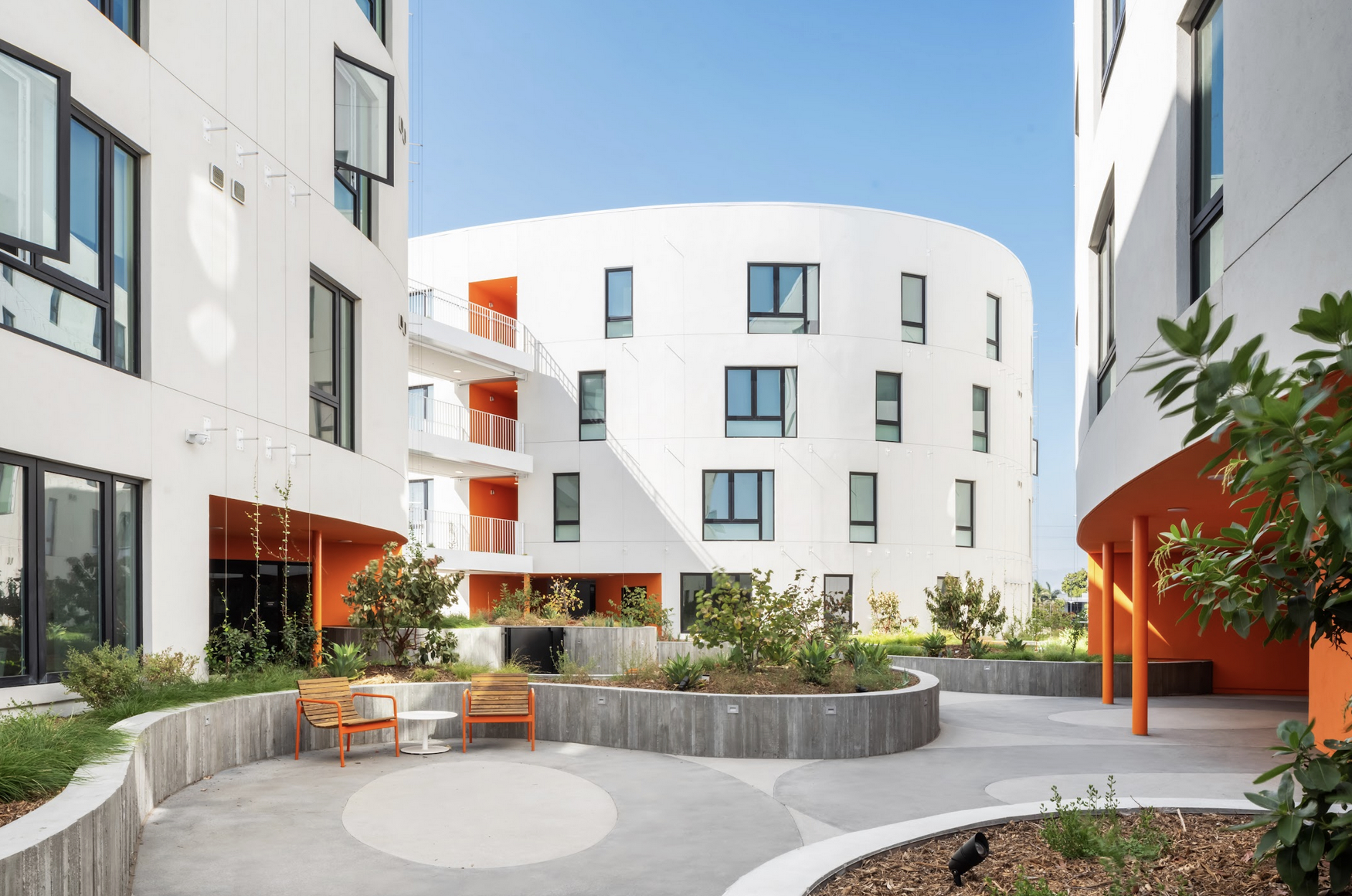
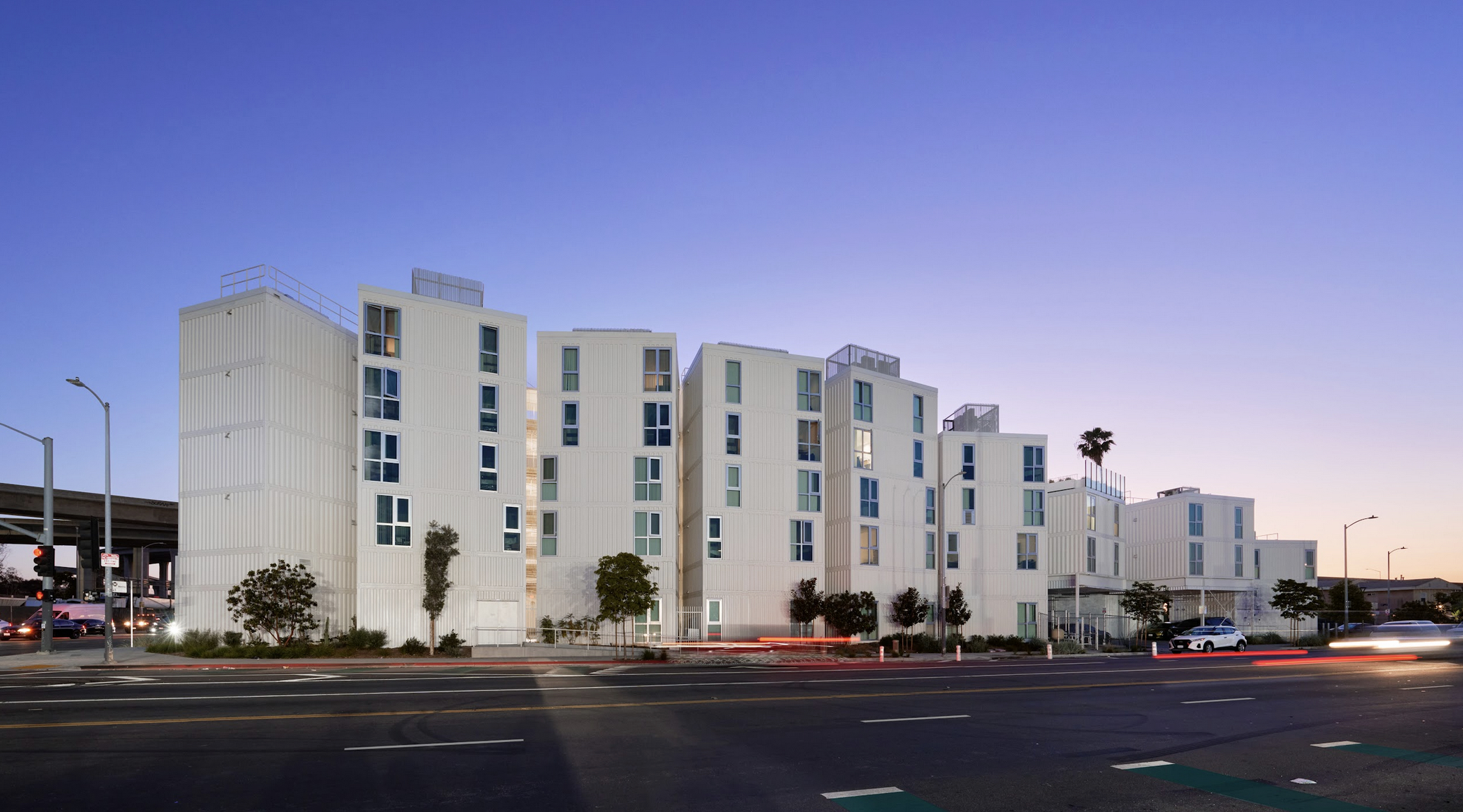
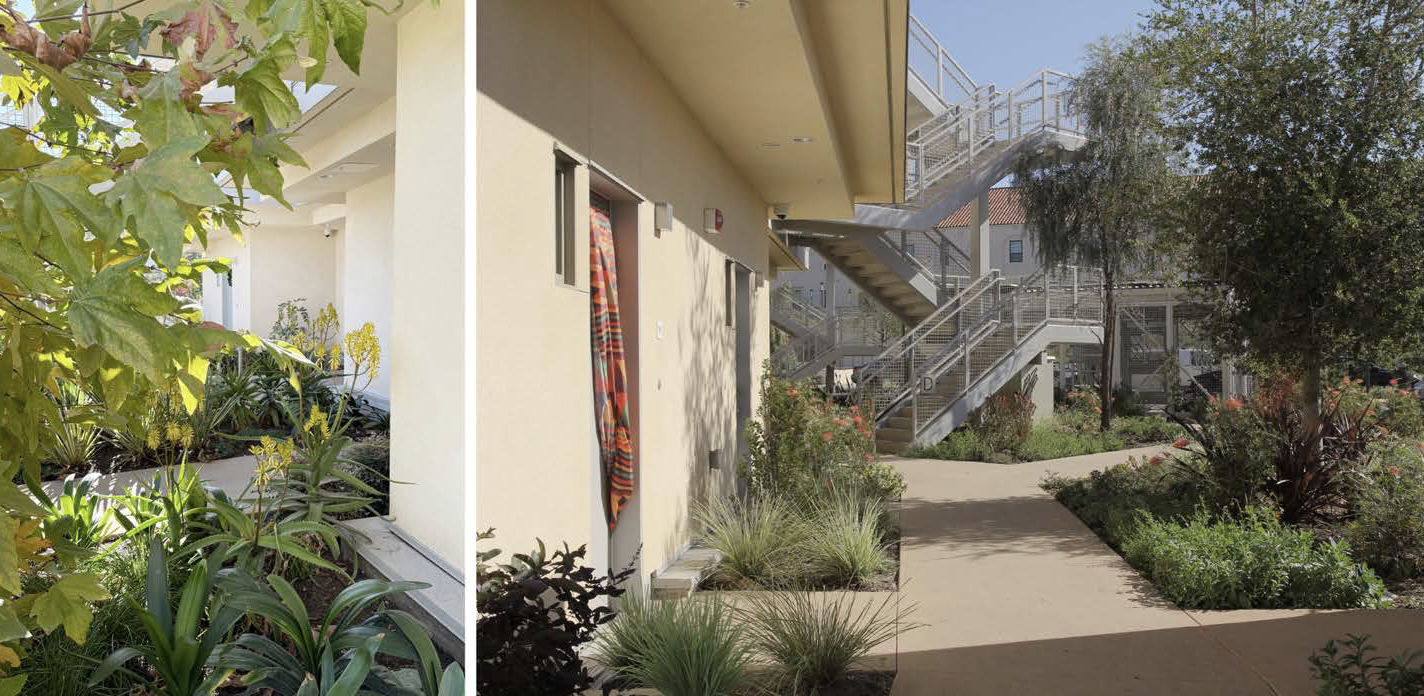
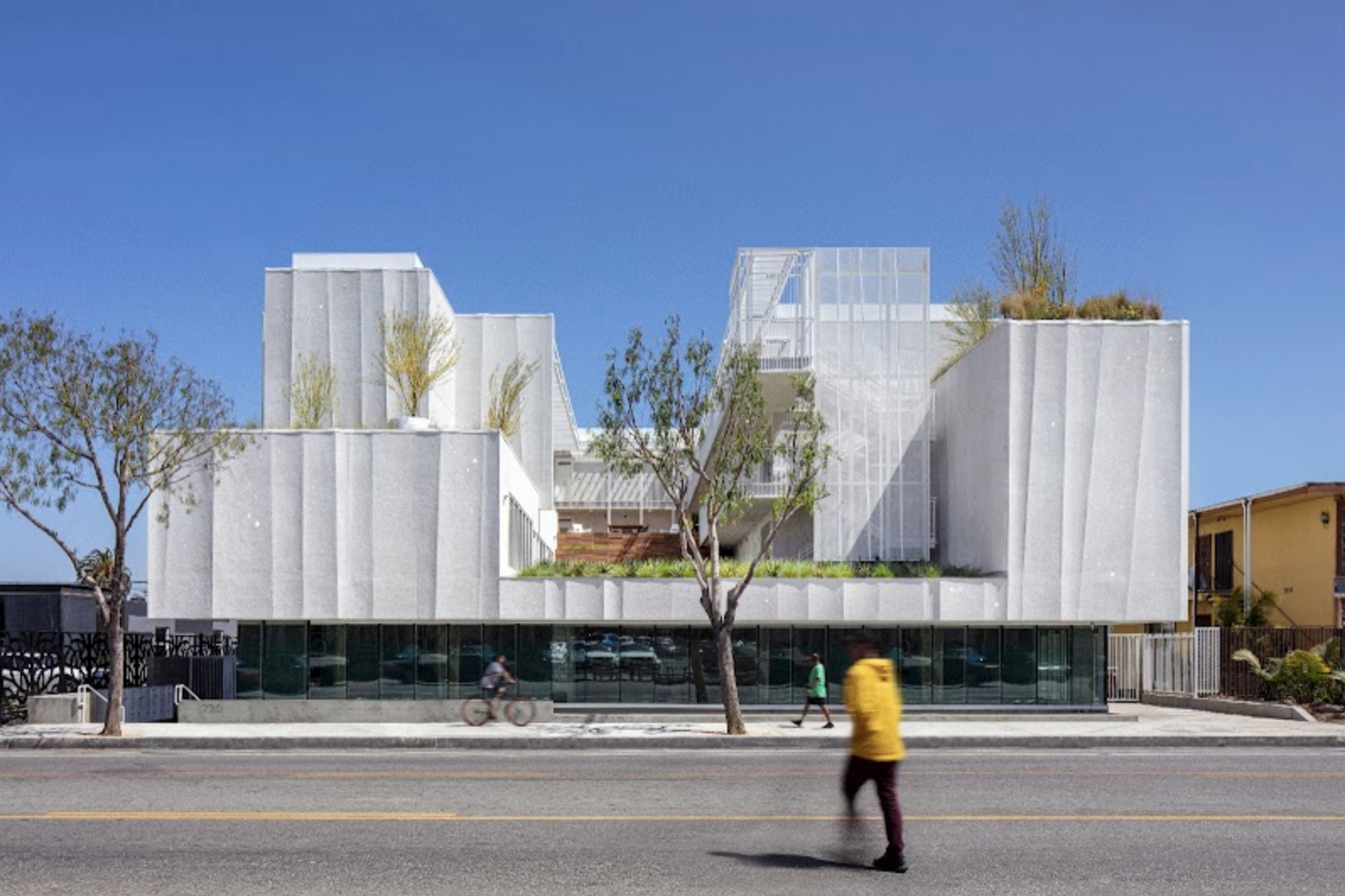
Isla Intersections by Lorcan O’Herlihy Architects, located in South Los Angeles, includes 53 one-bedroom permanent supportive housing units built around a breeze-cooled central courtyard. Photo by Eric Staudenmaier.
Here is a thought experiment: What would California’s great cities be like if they had built housing at density levels commensurate with the state’s economic trajectory over the past 50 years? According to Eduardo Mendoza, a senior researcher at the pro-housing group California YIMBY, San Francisco would be the Manhattan of our time. Los Angeles might be a towering megalopolis on a par with Asian behemoths like Tokyo or Shanghai. As for Palo Alto, well, instead of being a quaint Spanish-style town, it could have morphed into a dizzying city as future-forward as the town’s tech industry. Instead, that future was put on hold, exiled to video games and cinematic fantasylands like Bladerunner or Her, while in real life, voters on the West Coast have sought to maintain a lifestyle more akin to The Brady Bunch, maintaining the suburban domestic ideal, constraining infill development, pushing cheaper housing to the exurbs, causing house prices in jobs-rich centers to escalate (median house price in Los Angeles: almost $1 million; in Palo Alto: $3.5 million), and regular workers to flee California cities and the state in search of cheaper homes. The result has been disastrous both for economic, community and environmental sustainability, as ceaseless sprawl compounds commutes, workers’ wellbeing and pollution along with reducing habitat and biodiversity.
Within this picture, however, you find a sector of housing production that has attempted to alleviate these conditions: “Capital A” Affordable Housing—low-income, government-subsidized multifamily rental housing, built by mission-driven developers with high social and design ideals, and modeling sustainability in terms of proximity to mass transit and jobs, durability and energy conservation, as well as providing economic and emotional well-being for residents. What follows is the story of this movement and how it produced a legacy of housing that is quite different from the bungalow in the garden that defines the California Dream—and arguably a lot greener.
Starting in the 1960s, voters and their elected officials in the powerhouse cities of San Francisco and Los Angeles, as well as many other municipalities, put the brakes on the production of housing. They downzoned entire neighborhoods and commercial thoroughfares. They used seemingly well-intentioned environmental laws like CEQA (California Environmental Quality Act), the Coastal Commission and tools like historic preservation overlay zones to thwart the development of new homes in economic centers like L.A.’s Westside. Numerous other factors have also reduced affordable residential options, including, over several decades, historic exclusionary zoning and disinvestment in public housing; Proposition 13, “locking in” older homeowners in large houses better suited to young families; the razing of Single Room Occupancy (SRO) dwellings, the phasing out of boarding houses; the 2008 recession, which saw hundreds of thousands of foreclosed houses bought by real estate investors; and the advent of Airbnb, causing the loss of thousands of rental units. Then there is the growing gulf between wage levels and housing costs, high priced materials and labor, and a highly regulated and time-consuming construction approvals process.
The result of all this is that up to three-fourths of renters in L.A. County are “rent-burdened,” as in paying 30 percent or more of their income on rent or mortgage payments. Young people increasingly cannot live in the neighborhood they grew up in. Those who are rent-burdened include the working poor—hotel and restaurant workers, care staff, shop assistants, preschool teachers—and the workforce in the “missing middle:” teachers, bus drivers, firefighters, cultural workers, hospital orderlies and more. Then there are those squeezed out through various circumstances into living on the streets, and now numbering some 72,000 in L.A. County.
So a growing cohort of elected officials and young housing activists are pushing for laws and incentives to speed up housing production in cities. They are believers in a brave new state in which cities become more pedestrian and mass transit–based with denser, taller buildings. Manifestos like Abundance by Ezra Klein and Derek Thompson are book club favorites that have galvanized and split Democratic factions.
To achieve these outcomes, officials favor a combination of approaches to solve for affordability: Some simply want to increase the supply of housing at all income levels, on the trickle-down theory of housing economics, through zoning and other changes. These include, most recently, and dramatically, the passage of SB 79, upzoning areas close to mass transit; and the overhaul of CEQA, making it no longer possible to use the environmental law to stop infill housing. Many want to stabilize rents in existing affordable rentals. Some dream of large-scale social housing, akin to that of Vienna, Austria (and once tested in public housing in America in the New Deal years), while many strategize ways to create more achievable home ownership options, from community land trusts to greater availability of condos.
While this plays out, voters have tried to solve the problem, not with runaway private development, but by intervening in the market to create subsidized, “Capital A” Affordable housing developments. This started in the 1960s, with the drop in Federal investment in public housing, picked up steam in the Reagan 1980s and has gone full-bore in the last few years, with the advent of new laws and taxes aimed at providing funding streams or incentives for Affordable Housing (including the City of L.A.’s ED1 and Measure ULA, L.A. County’s Measure HHH, as well as Transit Oriented Community incentives and inclusionary zoning with density bonuses).
For several decades this type of housing was largely produced by nonprofit developers, a good number of which are deeply mission-driven; some religious in origin, others secular progressives. They typically use Low-Income Housing Tax Credits (LIHTC) and other funding streams to provide dwellings that are then “deed-restricted,” at subsidized rents for some 55 years (in California). Nonprofit developers earn a “development fee” rather than paying themselves through profits. They are typically not answerable to shareholders. The homes have long been aimed at households earning between 30 and 80 percent of Area Median Income (AMI), though that range has increased in some expensive cities up to 120 percent. Typically they are in complexes containing 100 percent affordable homes. Sometimes they are the “affordable,” or “inclusionary,” piece of a market-rate development, in which you might find from 10 to 30 percent of units set aside for low-income tenants. They can be aimed at specific demographics, like veterans or seniors or the unhoused. Sometimes these developments come with wraparound “supportive services,” for people with mental or physical disabilities or other needs.
The tax credits and other funding streams come with constraints and conditions—on unit size and type of household, accessibility, prevailing wages for labor, energy performance and more. Plus, most new affordable housing structures are built using a construction typology known as Type V or 4- or 5-over-1: several stories of wood or “stick” frame over a “podium” of concrete, containing parking and other uses. This “podium and wrap” typology can result in expediently built, formulaic designs. Yet what could have been a worthy but architecturally uninspired branch of housing in a region denoted by the experimental single-family home, became a canvas for architectural aspiration, producing a legacy of multifamily housing with design flair and social ambition.
Los Angeles has arguably been a leader in the Affordable Housing movement. Starting in the early 1980s, scrappy, grassroots organizations came into being in the basin’s costly Westside: Community Corporation of Santa Monica (Community Corp), in the newly incorporated city of West Hollywood, West Hollywood Community Housing Corporation (WHCHC), Venice Community Housing (VCH), Hollywood Community Housing Corporation (HCHC), and many others. Their managers teamed up with a young generation of Los Angeles architects who had cut their teeth in the formally experimental ’80s, some even working in the offices of Frank Gehry and Morphosis. A good number were connected to the UCLA School of Architecture and Urban Design that was advancing social ideals. The outcome is buildings that are eclectic in style but united in core values: architecturally aspirational dwellings close to jobs, with a free flow of light and air, and a strong sense of community; in sum, buildings that are “sustainable” by many metrics.
Sustainability Without Compromise
“Sustainability” can be broadly defined. For some it is to model a more urban land use, reviving arterial routes and bringing homes closer to transit and workplaces. Many projects emphasize community and social well-being through the provision of shared spaces, especially gardens. But it certainly means energy efficiency. Many of the stellar examples of affordable housing come with high energy saving outcomes and, often, high LEED ratings. A growing number are all-electric.
This is due not only to the virtue of the design and development teams. It is a condition of doing business. Tax credits are administered by each state and they determine criteria for qualifying projects that often incentivize certain principles, such as high levels of sustainability. For example, the California Tax Credit Allocation Committee (CTCAC) has for many years awarded extra credits if applicants go over and above Title 24/California energy code standards. To achieve that, they offer up a checklist of options that includes going all-electric, but also irrigating only with reclaimed water, gray water or rainwater; providing community gardens; and installing bamboo, salvaged or FSC-Certified wood, natural linoleum and other approved materials in dwelling spaces. Built into the regulations is a competition around performance.
For some developers, such incentives align with principles already long pursued. In the early 2000s, Community Corporation of Santa Monica worked with Brooks Scarpa Huber (previously Brooks + Scarpa) on a groundbreaking design for 502 Colorado, with a striking facade made of vertical solar panels adorning the exterior frontage of the building. It was one of the first LEED Gold–certified affordable housing buildings in the country. Tara Barauskas, Executive Director of Community Corp, a Santa Monica Certified Green Business, says, “Since then, we have deepened our sustainability principles by not only surpassing code and funding requirements, but moving to all-electric affordable housing, as well as sustainability practices that extend to every corner of our work.”
Las Flores, designed by Don Empakeris Architects (DEA) is a 73-unit, 100 percent affordable complex located near downtown Santa Monica. Photo by John Linden.
Las Flores
You can see this play out in most of Community Corp’s buildings. Take for example Las Flores, designed by Don Empakeris Architects (DEA), a firm skilled at cleverly massing multiple units with interlocking spaces, setbacks and receding and projecting forms to break down density while creating opportunities for outdoor space.
This 73-unit, 100 percent affordable, all-electric complex of family-sized dwellings, located near downtown Santa Monica and half a mile from a light rail station, is built around a central courtyard with bioswale planting over a rain-capture cistern. A landscaped entry plaza creates a publicly accessible pocket park with visual connection into the courtyard, and the building is terraced, creating five decks that provide numerous open-space opportunities, while outdoor staircases and walkways provide lively views onto the multitiered community.
Arroyo, designed by Koning Eizenberg Architecture, is a 64-unit, 100 percent affordable housing project near downtown Santa Monica. Photo by Eric Staudenmaier.
Arroyo
Consider also Arroyo, designed by Koning Eizenberg Architecture, in the vanguard of affordable housing since the mid-1980s. This 64-unit, 100 percent affordable housing project is located at the edge of transit and jobs-rich downtown Santa Monica. The design is organized around what the firm calls a “sticky space” concept of connecting home to street—in this case, a multilane thoroughfare, Lincoln Boulevard. Vine-covered fencing keeps tenants safe from the busy thoroughfare while offering views in and out.
The design team attained a LEED Platinum rating for its high level of sustainability using passive and active systems: High albedo roofs to reduce heat island effect, rooftop photovoltaics and solar hot water panels, enhanced air filtration and low-VOC materials. Sunshades reduce solar gain and high-efficiency artificial lighting fixtures. The list goes on. Outdoor access hallways are not conditioned, reducing energy costs in ways that benefit the CTCAC application. Nathan Bishop, Partner and Design Principle at Koning Eizenberg, points out that the environmental design is a fully integrated system. For example, the cheerful, colored angular metal shades on the windows are not simply an aesthetic choice. They control “how much solar gain you’re getting, and therefore how much cooling you need. And so it’s not something easily removed, because it’s tied to the performance of the building, and it’s connected to your base energy performance.”
Social Sustainability
Moreover, that outdoor access is designed to be more than mere circulation. It has built-in social sustainability. The housing is organized around a courtyard, which serves as a big backyard for young families, with open bridges and staircases, allowing for both natural ventilation and light, and visual connection.
The airy, shared open spaces have a transformative effect. One resident, a teenage boy named Mark, told me that Arroyo changed his life. He and other children there play all the time in the courtyard, while their mother can keep an eye on them from her living room facing the courtyard. “Where we used to live, me and my brother wouldn’t really do anything. We would just sit down and watch TV, and usually get headaches,” Mark says. Moving to a place with a courtyard, he says, “just really made me and my brother happy.”
Santa Monica Vermont by Koning Eizenberg houses 187 affordable units, ranging from studios to three bedroom apartments. Phot by Paul Vu.
Santa Monica Vermont
The community sustaining aspects of housing like Arroyo cannot be overstated. After all, we live in an era where isolation has become a public health issue. At the turn of the 20th century, roughly two percent of Americans lived alone, explained Gillian Morris in a New York Times Op-Ed. “We were, in large part, a nation of boardinghouses, multigenerational homes, tenements and apartment hotels, where urbanites ate in communal dining rooms.” Today, nearly 30 percent of U.S. households are occupied by people living alone. In many parts of L.A., not only do people live by themselves, but they also do not live near welcoming shared spaces.
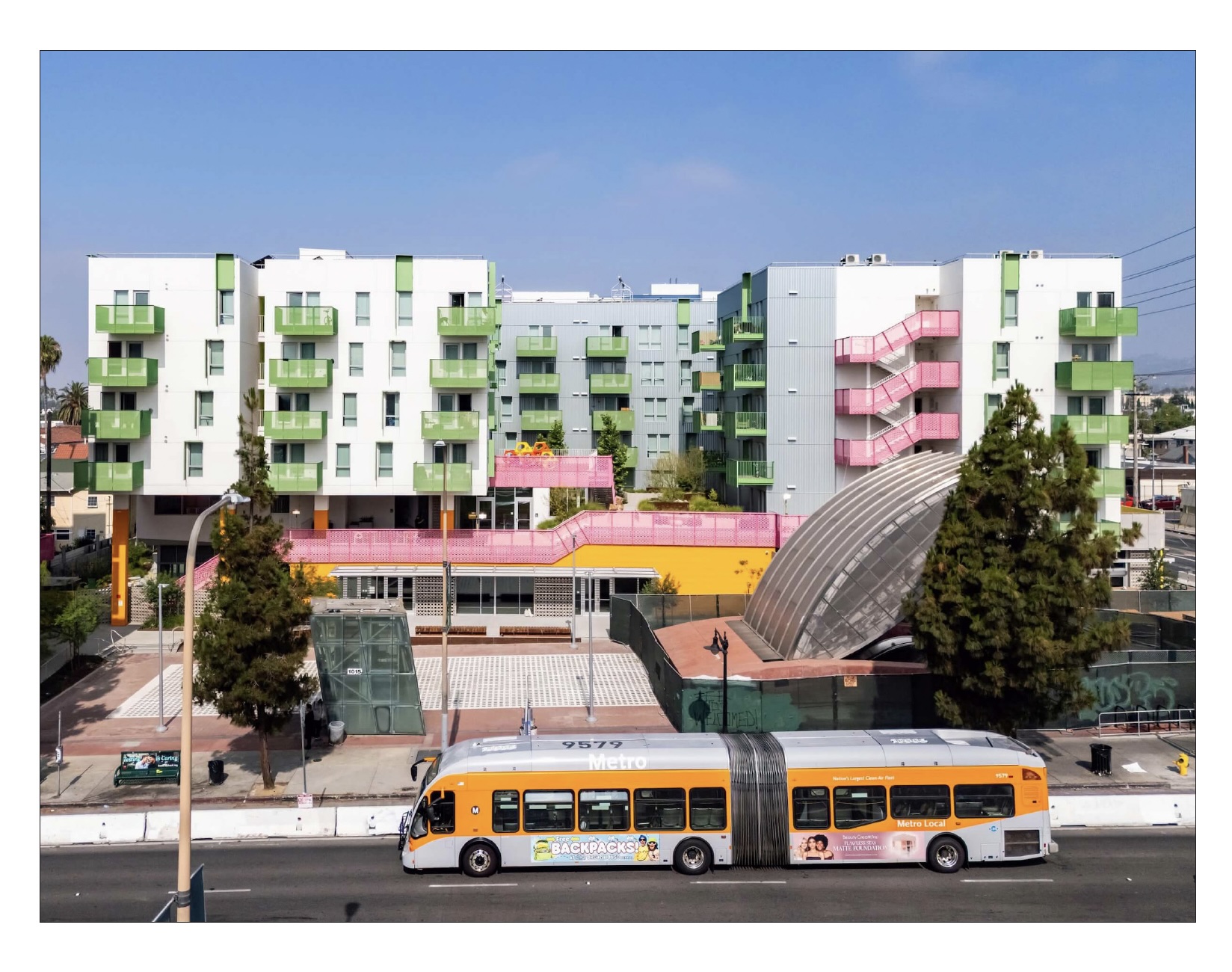
At some affordable housing projects, the social dividends can ripple out even further than the boundaries of the self-contained community of neighbors, to the wider community around them. Koning Eizenberg’s most recent affordable housing project is Santa Monica Vermont (2025). The complex of 187 affordable studios and one-, two- and three-bedroom units on five levels, unmissable in their vivid color palette of pink, green, orange and yellow, is built on land owned by the nonprofit Little Tokyo Service Center (LTSC), surrounding the Santa Monica/Vermont subway. It resulted from a deal between a housing nonprofit and L.A. Metro, the huge regional Los Angeles County Metropolitan Transportation Authority, which has embarked on an effort to build as much affordable housing beside its mammoth network of trains and bus lines currently being built out.
Koning Eizenberg aimed to create a high-quality domestic space while energizing the public space, with its pink granite plaza and elliptical portal. They created court-centered structures and amenities for the new residents, including play areas and community rooms spread throughout the complex, along with outdoor stairs and bridges that connect the social life of the housing to the public life below. They specifically avoided surrounding the courtyard with a continuous wall of residences, carving instead “a bite out of the donut.” The goal was twofold: get air and light to all the units, but also allow the flow through of more light and visibility onto the plaza, creating an “eyes on the street” sense of security.
“It has a mutual benefit to both,” Bishop says. “There are things we’re doing typologically and massing wise that are not just around sustainability in that narrow way. They’re in the more expansive way you create a space that has mutual benefit to the public and the plaza and the residents in the courtyard.”
Designed by Studio One Eleven for Venice Community Housing, a housing nonprofit, The Journey in Venice, California, is a 100 percent affordable development. Photo by Paul Vu (HANA.)
The Journey
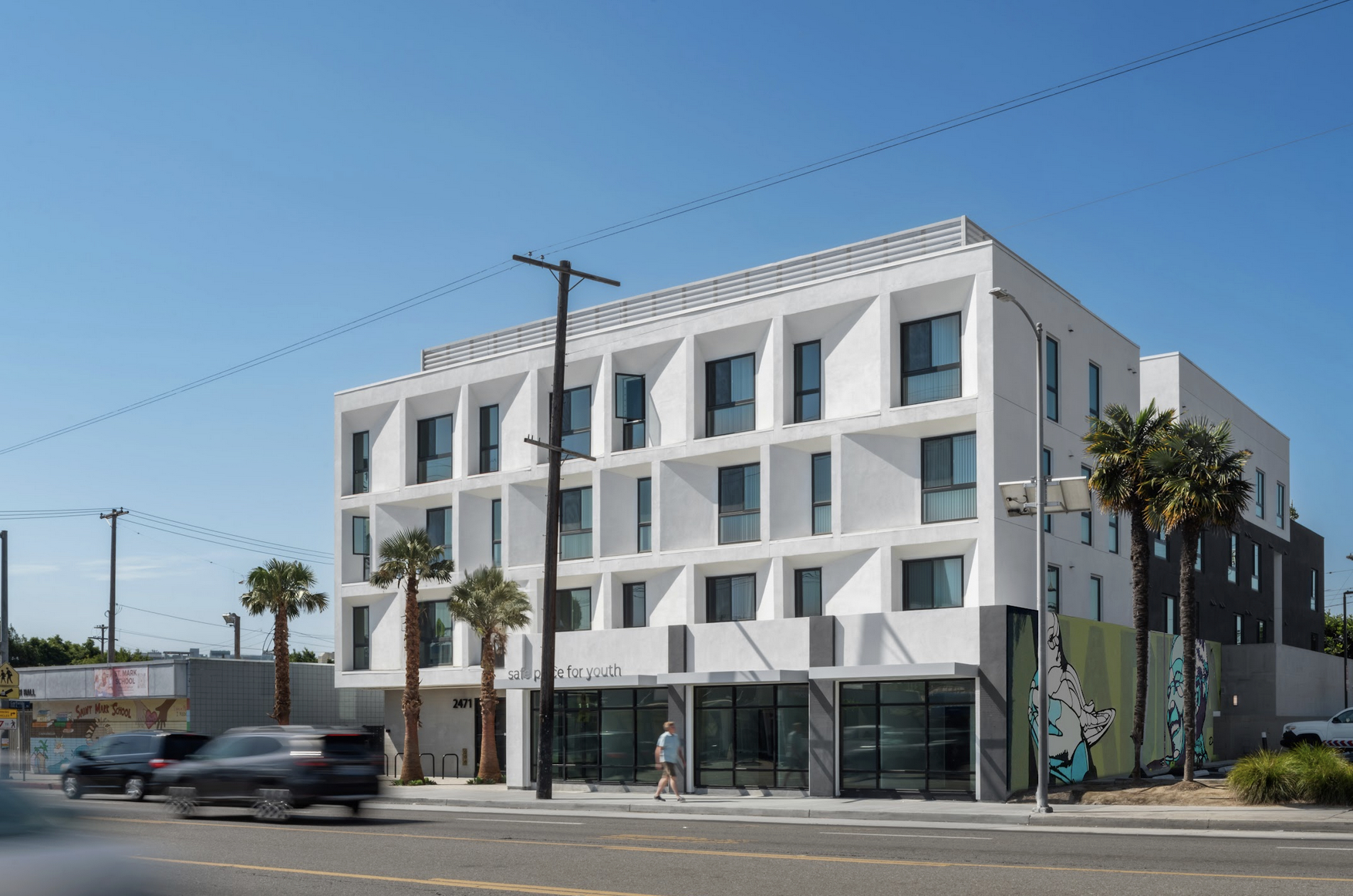
Building bonds is true too of The Journey (2024), in Venice, California. This 100 percent affordable development with wraparound supportive services was designed by Studio One Eleven for Venice Community Housing, a housing nonprofit that works intensively with people who face great challenges in getting housed, including those with mental and/or physical disabilities, and young people moving out of foster care who might also be experiencing homelessness.
The Journey’s name bespeaks its goal—to provide a path to a better life for its community of adults and young people who may have suffered from instability and lack of support. It is echoed metaphorically and literally in the design of the building. Its mostly young residents embark on a “journey,” starting at Safe Place for Youth (SPY), a drop-in service center on the ground floor, and then, on entering through a side door, climb an open staircase, with each rise in level opening up bigger views of the sky, from where they can access studios and open terraces, the uppermost of which has a panoramic view westward to the palm tree-silhouetted, purple sunsets of L.A.
One resident told me that he would sometimes come up to the 4th floor “to catch a vibe,” and ended up chatting with a neighbor for hours. “I think all apartments should have some sort of a space for everyone to share,” he says. “But especially a place like this, it’s especially important because you need a community after going through a tough time. It’s hard to go through things by yourself, and a place to share with others that are in the same boat as you, it’s priceless.”
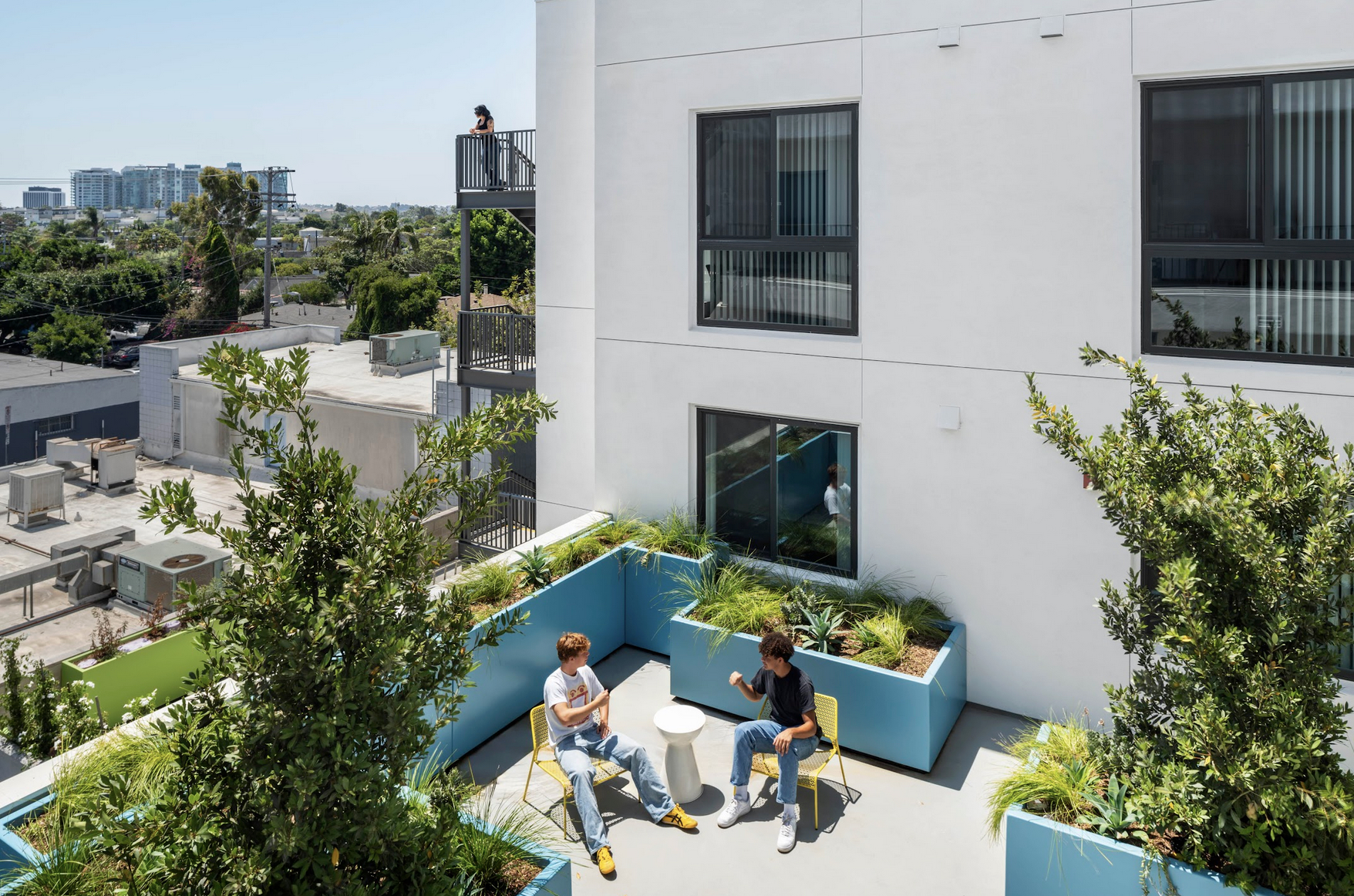
The Journey, designed by Studio One Eleven for Venice Community Housing, includes box planters and spaces for residents to gather outside at each level. Photo by Paul Vu (HANA.)
Reshaping the City
The Journey is one of several examples of affordable housing that have modeled sustainability in regard to land use. Kept out of low-rise and single-family residential neighborhoods by costs and opposition, low-income housing is often built near highly trafficked arterial roads and mass transit stops. Designers must figure out ways to provide places of respite from noisy and polluted streets, while massing buildings in ways that harmonize as best as possible with the adjacent low-density residences. So design and development teams have figured out ways of making lemonade out of lemons, along the way creating acupuncture points in distressed areas, that can help revive them.
The Journey’s site is on Lincoln Boulevard, a multi-lane thoroughfare. So the rooms were oriented, as much as possible, away from the street; to the west. It was next to a church, whose congregation did not extend the compassion of the Good Samaritan. Rather, they fought bitterly to stop the project, and expressed concern at having residents look onto the congregants’ children at play. This led to the stepped back massing and the terraces onto which they now put planters, bringing greenery and shoots of life into this arid arterial. “Even though you’re in this hustle and bustle of L.A., you have a further connection to nature, with rooftop community gardens and views of the ocean and Santa Monica Mountains,” says Michael Bohn, partner-in-charge at Studio One Eleven. By elevating this dismal stretch of Lincoln, the building also played a role that has often fallen to low-income housing: to model denser living close to commerce and mass transit and, ideally, attract more of it. The church community eventually came around to embrace the project.
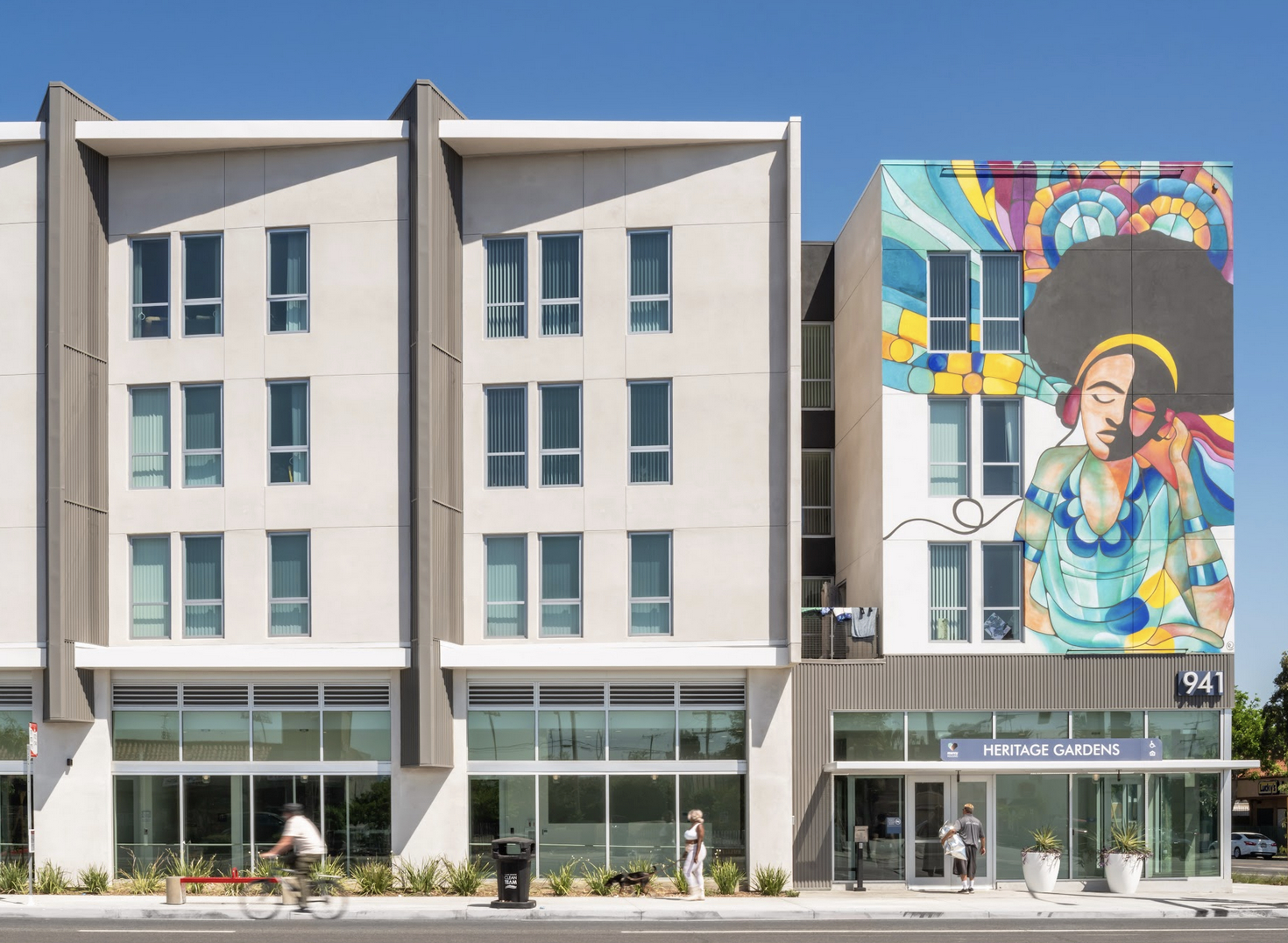
Also designed by Studio One Eleven, Heritage Gardens is Affordable senior housing for formerly homeless and veterans. Photo by Paul Vu (HANA).
Heritage Gardens
Studio One Eleven also designed Heritage Gardens Affordable Senior Housing for Formerly Homeless and Veterans. This is in Long Beach, where the firm itself is based, and deeply engaged with local land-use issues. Heritage consists of 67 affordable senior housing units, including 34 for formerly homeless seniors, alongside services on the first floor, on two underutilized commercial lots on the busy Pacific Coast Highway alongside L.A. Metro’s A Line and a bus route. For Bohn, this project offered the opportunity to deepen cultural and social sustainability along with conventional “greening” (the building garnered a LEED Gold certification.)
The two parcels that made up the site contained a liquor store and an auto body shop; these, notes Bohn, “are probably the least health-related sustainable businesses for this part of town.” Then locals expressed concern at the height, so, as at The Journey, they terraced the building, with the greatest height toward Pacific Coast Highway (PCH) and most of the back area, adjacent to single family homes, becoming a one-story podium. They then put in community gardens, which have proven to be a magnet for the seniors who have time and energy to grow flowers and vegetables, in the company of their neighbors. Inside, the community room hosts regular events, creating a vibrant hub for interaction.
At ground level, facing PCH, they also created a lounge area, with a view of the bus stop so residents don’t need to boil in the sun while they wait for transit. The team planted trees on the sidewalk, and put canopies on the ground levels to shade the building. This makes life more pleasant for the residents and the people in the community. “We’re bringing pedestrians back to the street and making it more attractive,” says Bohn, pointing out that this could be applied across the region. “We probably have hundreds of miles of these corridors that have just become limbo land throughout L.A. and Long Beach and L.A. County and Orange County. And so it is a great place to bring density.”
Corazon del Valle, or Heart of the Valley, designed by the L.A. office of Perkins&Will for the developer Holos Communities. Photos by Paul Vu.
Breaking Out of the Box
Corazon del Valle is situated in the San Fernando Valley, with 180 studios to three-bedroom units for previously homeless people and low-income families designed by the L.A. office of Perkins&Will for the developer Holos Communities. Photos by Paul Vu.
Corazon del Valle
Such corridors criss-cross Panorama City, in the heart of the San Fernando Valley, a sprawling grid of subdivisions and wide arterials lined with auto showrooms, big box stores and takeout chains. There, at the meeting of a giant thoroughfare and a low-rise residential neighborhood rises a surprising, curvaceous white building. This is Corazon del Valle or Heart of the Valley: 180 dwellings containing studios, one-, two-, and three-bedroom units for previously homeless people and low-income families. It was designed by the L.A. office of Perkins&Will for the developer Holos Communities, which, under the directorship of Cristian Ahumada, has produced several new standout affordable housing buildings in the L.A. region, each one offering specific site solutions and inventive approaches to sustainability. Perhaps this is because, says Ahumada, when he approaches a new project, he tells his design team not to start by designing, but rather by figuring out “the conditions that are there.” In the case of this site, that meant an expansive heat island with summer temperatures routinely reaching 110 degrees and above.
So cooling became a driver of the design, and the team delivered an unusual response: two reflective white, curving structures configured to create a narrow, winding courtyard that functions as a funnel, sucking in the wind flowing from the southwest and bringing down temperatures by some 7-10 degrees. That refreshing current also helps passively cool the interiors, so AC is not necessary all the time.
As the Perkins&Will team describes it, “Negative space drives the project’s design—shaping the landscape into organic, canyon-like voids filled with life, community and greenery.” On visiting recently, my partner Robin Bennett Stein waxed eloquent, describing it as a “modernist redo of Castle Carcassonne in the South of France” (the inspiration for Sleeping Beauty’s fortress bedchamber in the Walt Disney movie). It also reminded him of Scandinavian housing, which is a high compliment.
They have also brought community uses into the complex. Following a collaboration with the San Fernando Community Health Center (SFCHC), they transformed a commercial space on the ground level of Corazon into a satellite clinic for the group, open to both residents and neighbors and offering primary and pediatric care through to the management of mental health and chronic medical conditions. As with many affordable housing projects, Corazon del Valle tries to solve several societal problems at once, in ways that are highly inspiring.
Another angle of Isla Intersections by Lorcan O’Herlihy Architects, located in South Los Angeles, all permanent supportive housing units. Photo by Eric Staudenmaier.
Isla Intersections
It is possible that Holos Community’s buildings are as expansive in their goals and as original as they are because Ahumada is less interested in earning high green ratings, such as LEED—which he finds “limiting”—but rather through holistic solutions (hence the company’s name change from Clifford Beers Housing to Holos Communities). He says he looks for guidance to Maslow’s Hierarchy of Needs. Abraham Maslow was a psychologist who conceived a pyramid of human needs starting with physiological (air, water, food and clothing), through safety (job security), love and belonging (friendship), community esteem, and, finally, self-actualization. This translates into projects that encompass cleaning the air, recycling water, generating food and more, with the goal of modeling projects of the future that enable a better life for residents and a transformative impact on the neighborhood. At Corazon, for example, he discovered that the gray water they installed generated far more water than their project needed, so he has set about trying to make it available to a nearby high school. He hopes to make this a reality.
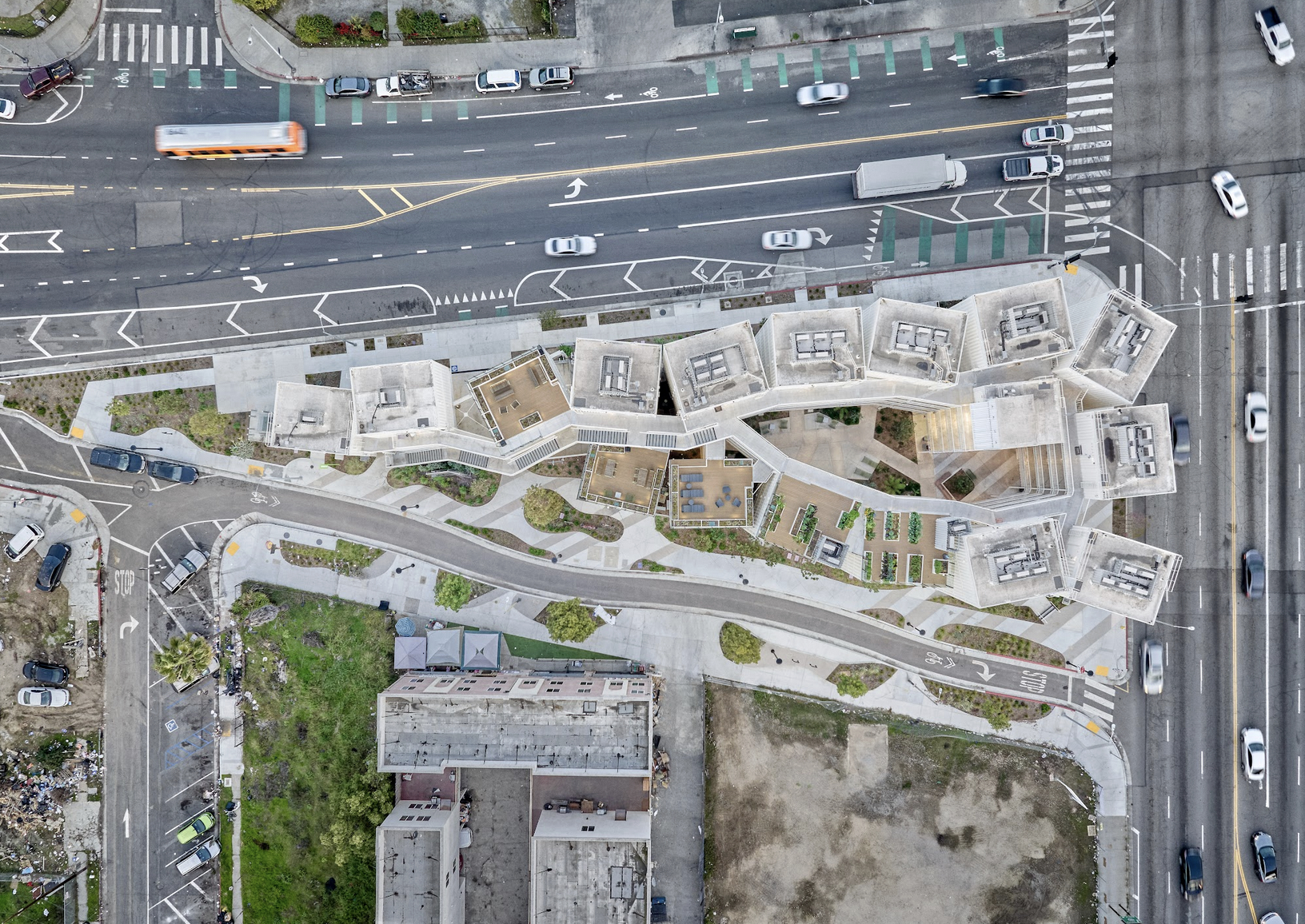
The aerial view of Isla Intersections reveals the courtyard and “green lung” concept in an area of Los Angeles dominated by busy streets and freeways. Photo by Eric Staudenmaier.
Meanwhile, at another recent project of theirs, Isla Intersections (2024), designed by Lorcan O’Herlihy Architects, known for a bold architectural voice and an emphasis on social interaction, the team took on an extremely challenging site, groundleased by the City of Los Angeles, as a way of expediting more housing. It sits beside one of the world’s busiest freeway interchanges, the meeting of the 110 and 105 freeways at the intersection of Broadway and Imperial Highway.
Here at this horrendously polluted and noisy site, the team boldly embarked on creating a “green lung;” incorporated into a triangular stacked building, containing 53 one-bedroom permanent supportive housing units, is a breeze-cooled central courtyard, stepped rooftop gardens and a landscaped paseo at street level, funded by the Annenberg Foundation and landscaped by Agency Artifact.
The building simultaneously tests design possibilities. It is made of repurposed shipping containers, which are stacked, arranged into towers, and oriented at angles to minimize noise and air pollution from the nearby traffic. These towers are connected by a series of walkways to create a sequence of pocket parks, or terraces, some with planters filled with vegetables, and offering a range of activities, and dramatic views onto the cars gliding past and the endless cityscape of L.A.
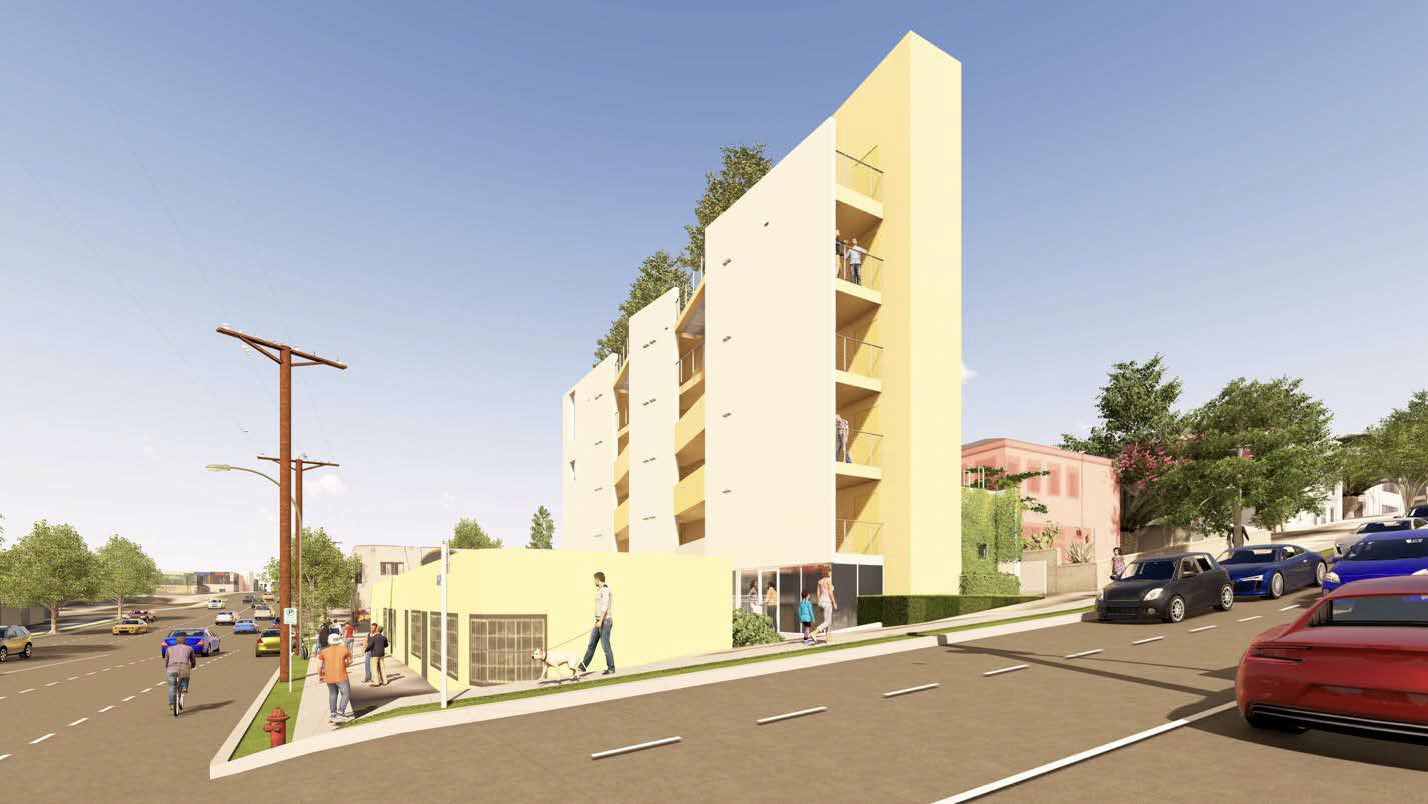
Loma Verde, in the historic Filipinotown enclave of Los Angeles, was designed by architect Michael Lehrer on a slender, 4,500-square-foot single-family lot, where he found space to create a five-story building containing 19 studios for chronically homeless people.
Loma Verde
Another Holos project is Loma Verde, in Historic Filipinotown, designed by architect Michael Lehrer, whose firm is known for an astonishing addition to Hollywood Forever cemetery along with many thoughtful residential and civic projects.
Together they have transformed another tricky site, a very slender, 4,500-square-foot single-family lot, into a five-story building containing 19 270-square-foot studios for chronically homeless people, with supportive services. Given the tight nature of the site, hillside conditions and the need for open space, Loma Verde is topped by a roof terrace with expansive views of the city. “Loma Verde is a testament to solving the housing and homelessness crisis by maximizing what can be achieved in a very small lot,” says Ahumada, adding, “This is the way we solve it—through sophistication and efficiency.”
Natural light and ventilation are also a key drivers of the design. The narrow site necessitated a single-loaded corridor, but this also enabled access to light at both ends of the units. Lehrer explains that they put the main windows on the north elevation to minimize heat gain, but they also added south-facing sidelights next to the entry door, bringing in sunlight. “Natural light is both free, and more importantly, happy and uplifting,” says Lehrer, adding that in his view, “natural light, fresh air, gracious and ennobling procession and meaningful outdoor places (such as the circulation and roof garden) are essences of social well-being.”
701 MacArthur Avenue is located on the West Los Angeles VA North Campus, adjacent to Westwood Village. Designed by the late Frank Gehry and his partners and the noted designers Elysian Landscapes, in collaboration with Thomas Safran & Associates, the development houses veterans.
701 MacArthur Avenue
Ahumada’s choice of Maslow’s Hierarchy of Needs (from the basics—food and clothing— through, finally, self-actualization) as a means to understand sustainability is provocative. It goes far beyond meeting basic needs to the fullest realization of human potential. And it is in that realm that affordable housing meets an inherent limitation. The best of it provides for most of Maslow’s needs, starting with shelter; some developers even tackle food insecurity, through donations and through community gardens where residents grow their own food. But it is by definition paternalistic—well-intentioned but institutional—and managers can impose rules like banning pets or limits on how much a resident can decorate their own environment (just as happens in the private sector, and usually due to maintenance costs). This adds up to a loss of personal autonomy—and it is the desire for personal autonomy that is part of the appeal of home ownership. Designers conducting post-occupancy surveys in affordable housing complexes have, however, found that seemingly small measures like providing residents with their own door key make a large difference in personal well-being.
So the team behind 701 MacArthur Avenue endeavored to address this. The complex consists of 11 one-, two- and three-story apartment buildings containing some 120 permanent studio and two-bedroom units, located on the West Los Angeles VA North Campus adjacent to Westwood Village. Residents share a laundry, fitness center, computer lab, library and lounge (including piano and billiard table) and a lush garden and outdoor barbecue area. It was designed by the late Frank Gehry and his partners and the noted designers Elysian Landscapes, in collaboration with Thomas Safran & Associates, a prominent developer of affordable housing in Los Angeles, whose Veterans Collective is building or retrofitting 1,200 homes for veterans.
The team set about creating a habitat that is “green” in the conventional sense, but also tries to imbue a sense of personal control.
The project was especially meaningful for Gehry, himself a vet. After all, this is a group that falls, lamentably, between the cracks in housing. At least seven percent of people experiencing homelessness are veterans, a number that has thankfully fallen from past heights but is still too high.
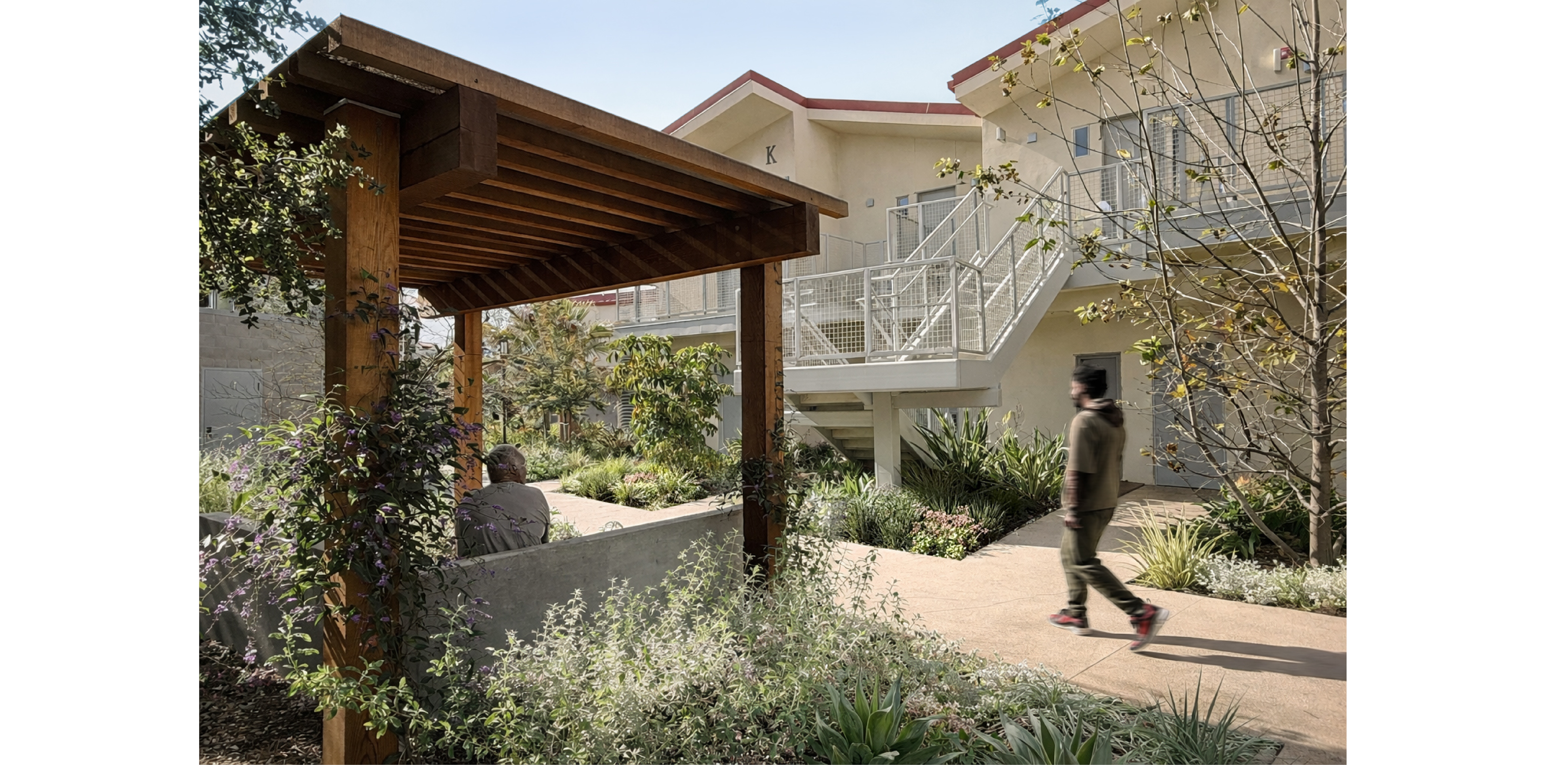
701 MacArthur Avenue, which provides housing for veterans, is dominated by lush gardens designed by Elysian Landscapes, led by Judy Kameon.
Many of the dwellings at the VA campus are in 1920s–1940s buildings in an imposing if somewhat institutional Mission Revival style. MacArthur Avenue is instead a complex of low-rise, cream-colored apartment buildings, simple in design though incorporating “my house” signifiers like personal front doors with projecting overhangs, and a garden path to each building. Dana Bauer, partner at Elysian Landscapes, explains that the team worked together to translate “ideas about autonomy and dignity and pride” into basic design elements. The path connects to outdoor staircases and walkways—in place of dismal, enclosed, double-loaded corridors—amplifying the sense of connection and outdoor living. “Gehry Partners envisioned buildings that were human scale, domestic, and approachable, embedded in an unexpected park-like setting,” says Bauer.
To that end, garden paths lead into a flowing courtyard that blends through landscaping into a shared garden, which is no second thought. It is expansive and lush, with some 11,000 plants and 160 trees, planted over many months of work. They are a mix of natives and non-natives close to the buildings—providing year-round interest—and become all native at a distance, where the land merges with the arroyo. The vets can make their own mark on the landscape, growing their own plants and eventually, hope the designers, further develop the “horticultural therapy” provided by the landscape to include programming where residents learn about gardening, perhaps even leading to a career path. In sum, says Judy Kameon, founder of Elysian Landscapes, the design contains “this idea of restoration, both of the ecology and within a community that is also looking for restoration of humanity.”
Much of this narrative has focused on Southern California. However, the affordable housing movement is shaping cities and states on the rest of the West Coast and beyond. Take, for example, a newly opened complex in the state of Oregon that pushes the limits in all the ways outlined above, but also breaks ground technologically.
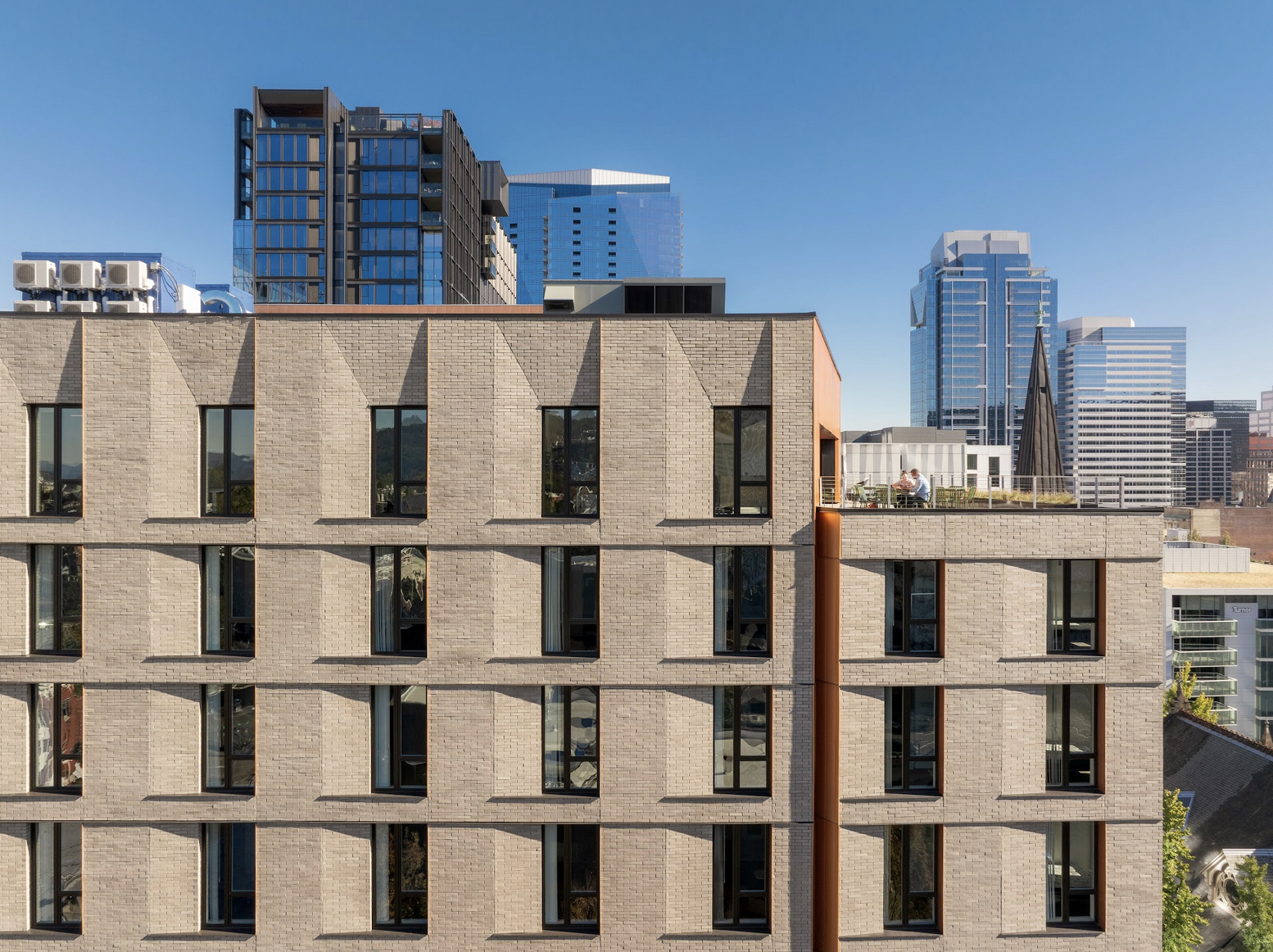
Julia West House, designed by Holst Architecture, at 580 SW 13th Avenue in downtown Portland, is a 12-story complex providing 90 units of permanent supportive housing for formerly homeless, BIPOC elders and very low-income individuals. It is centrally located in downtown Portland’s West End, close to shops, parks, grocery stores and other businesses. Residents can walk, take public transit and enjoy nearby greenery.
Most significantly, the building is currently Oregon’s tallest mass timber structure, and yields, say the design and development team, a lower carbon footprint than concrete or steel. Exposed wood ceilings and glulam columns also create a sense of warmth, and natural light fills the dwellings.
Community Development Partners (CDP) and the Julia West House project team have argued that rather than add extra costs, this strategy would be the quickest and most economical way to build. “We did pay a small premium for the mass timber material itself,” Mai Huynh-Carnes, CDP’s Senior Development Manager explained in Woodworks’ case study. “But overall, from both scheduling and financing perspectives—not just hard costs but overall costs—it was a wash because we projected a faster construction schedule. Plus, mass timber met our sustainability and carbon goals.”
Costs and Benefits
The high sustainability goals outlined in this article often cause eye rolls among opponents of tax-subsidized affordable housing. Yes, the sector has critics, typically private sector developers who argue that if the state simply eased the numerous constraints on construction, housing production would be much cheaper, adding that if supply could be increased, older rentals would fall in price, producing what is known as “Naturally Occurring Affordable Housing” (NOAH). Nonprofit developers of affordable housing themselves point out that their tax credit–based system—often entailing several funding streams that each have their own timeliness and conditions—is inefficient and adds costs. In a column in The New York Times, Abundance co-author Ezra Klein cited a RAND study finding that per square foot, affordable housing cost more than 1.5 times as much to build in California as market-rate housing. “One reason we don’t build enough affordable housing is we’ve made affordable housing unaffordable to build.”
It is however very hard, if not impossible, for the private sector to produce housing in pricey cities that can be maintained at stable rents long-term, for extremely low-income households, families (studios and one-bedroom units are cheaper to build) and people with physical or mental disabilities. Furthermore, the high quality of the affordable housing projects also helps “sell” them to nervous neighbors, who can stall affordable housing projects with objections, contributing to ever-rising costs.
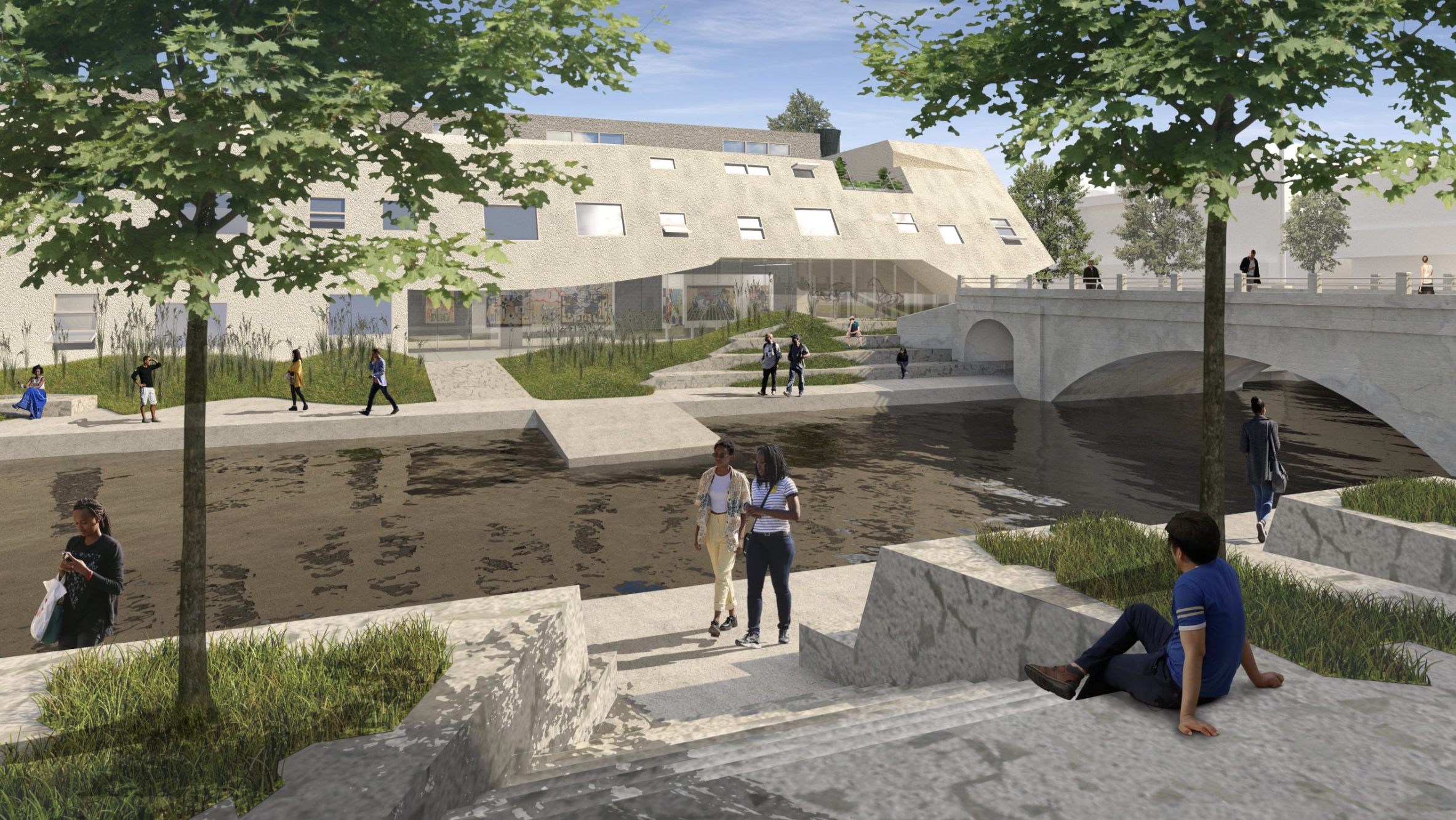
Venice Dell was designed by Eric Owen Moss a decade ago to be sited on the Venice canals as an affordable and supportive housing complex in Venice, California, for low-income artists, families and people who had been living on the streets. Despite majority neighborhood support for the project, opponents have delayed the three-story complex with a ceaseless opposition campaign. Rendering
courtesy Eric Owen Moss Architects.
Venice Dell
Despite voter support for all sorts of measures to produce more affordable housing, residents adjacent to proposed projects often put up a fight. Take Venice Dell, an affordable and supportive housing complex in Venice, California, for 140 low-income artists, families and people who had been living on the streets. This project commenced in 2016, when the city offered up a parking lot at 200 N. Venice Blvd as an Affordable Housing Opportunity Site. Venice Community Housing (VCH) and Hollywood Community Housing Corporation (HCHC) won the project and tapped the maverick Los Angeles architect Eric Owen Moss. Ten years later, the development has still not even broken ground. Despite extensive neighborhood outreach and majority support for the project, opponents have maintained a ceaseless war to stop the three-story complex, using every legal tool in the book. VCH and HCHC have spent enormous amounts of time and money to move the project forward, even changing architects, to Brooks Scarpa Huber Architects (formerly Brooks + Scarpa).
After a seven-year fight, Angela Brooks and Lawrence Scarpa got the Rose Apartments built. The 100 percent affordable dwellings house a mix of young people who have transitioned out of foster care, and people who had been living on the streets. Photo by Jeff Durkin, courtesy Brooks + Scarpa.
Rose Apartments
Angela Brooks and Lawrence Scarpa are A-list designers who have long experience in affordable housing design. They ran through a gauntlet of community opposition to another complex for Venice Community Housing, Apartments on Rose Avenue, also bitterly contested by some locals (in over 50 meetings).
After a fight that went on for seven years, they finally were able to complete a very distinctive, four-story building containing 35 100 percent affordable dwellings for a mix of young people who have transitioned out of foster care, and people who had been living on the streets. Three wings of studio apartments hug two courtyards, which are connected by deep steps that serve as seating. There are landscaped terraces and a flying bridge and, most delightfully, glitter steeped in the stucco on the facade that truly makes the building shimmer.
It turned out that good design was able to change hearts and minds. Brooks recalls an encounter with a neighbor, who told her, “I didn’t want this project to be built. And now that it’s here, it’s really beautiful.” Yes, the bells and whistles and the conditions attached to affordable housing do increase costs, but perhaps you get what you pay for. The affordable housing projects that deliver sustainability by all the metrics discussed above arguably create better lives, better neighborhoods and better cities, demonstrating a quite different way to live “green” in California and beyond.
Disclosure: the author is a board member of Community Corporation of Santa Monica, which she joined after many years reporting on their work and that of other nonprofit housing developers.