
News Brief
J.D. Ned Nisson Leaving EDU
Halogen Torchieres:
Not a Bright Idea
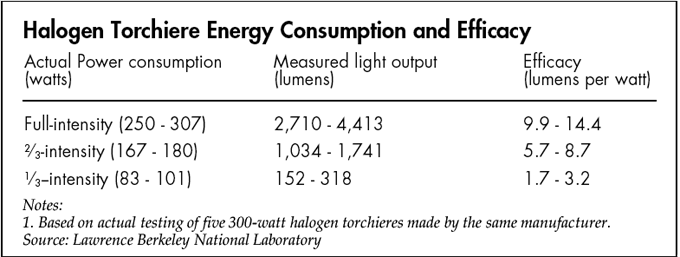
E Source, the Boulder, Colorado-based energy information service, estimates that halogen torchieres sold in the last two or three years are now using more energy in the U.S. than the combined surveys of all the compact fluorescent lights sold in the past ten years! Some 18 million torchieres were sold in 1996, bringing the total number in use in the U.S. to about 40 million. Assuming typical usage patterns, these lights consume about 16 billion kWh per year, according to Christopher Granda of Ecos Consulting, in Arlington, Massachusetts, or roughly the annual output of two 1,000-MW power plants. They represent 20 to 40 percent of all sales at many lighting retail stores, according to Granda.
Halogen torchiere manufactured by Cheyenne Lamps of Little Rock, Arkansas, purchased by EBN at Wal-Mart for $14.97. Along with many warnings about fire safety, the information packet in the box noted that “halogen lighting is the most efficient available light source today.”
Compounding the problem of very low efficacy is the fact that torchieres provide indirect uplighting, but are often used for task lighting applications. Among the least expensive of any fixtures to buy (as low as $15 at large chain retailers), and they are commonly purchased as reading lights.
Because of the very low cost of halogen torchieres they are very popular at college campuses. A survey at Harvard University found that 75% of on-campus students were using these fixtures, with average electricity consumption of 13.4 kWh per week per fixture. Granda told
EBN of anecdotal information that these fixtures may actually be converting some college dormitories to electric heat. Here’s how: A student living in the end room of a dorm that has just one thermostat per floor buys a halogen torchiere; the torchiere is plugged into the wall near the thermostat, raising the air temperature; the other rooms on the floor get too cold, so those students go out and buy halogen torchieres as well. Voilà—electric resistance heat!
Fire Risks
While the energy performance of halogen torchieres is atrocious, the real Achilles heel of these lighting fixtures is risk of fire. According to Granda, there have been so many fires caused by halogen torchieres that the U.S. Consumer Product Safety Commission took the unusual step of pressing Underwriters Laboratory (U.L.) to revise the test used to determine fire safety. Under the new testing procedure, which becomes effective in February, cheesecloth is draped over the top of the fixture and it must survive for seven hours without combusting or developing holes. In a recent edition of the television news programDateline, none of the torchieres tested passed this test, and the average time before combustion was a mere 30 seconds! This intense heat is especially problematic because the short power cords often result in placement near walls. After the new U.L. testing procedure becomes effective, lamps that fail the test will not be able to carry the U.L. label; many large retailers will not carry them without a U.L. label, according to Granda.
What’s Ahead for Torchieres?
To address both the high energy consumption and fire concerns with halogen torchieres, a number of research groups and companies are currently working to design torchiere fixtures that can use compact fluorescent lamps (CFLs). The efficacy of CFLs is about six times as high as a halogen torchiere at full intensity, and as much as 30 times higher than the halogen torchieres dimmed to one-third intensity. Both Law-rence Berkeley National Laboratory and the Florida Solar Energy Center have developed prototypes of such products. Several fixture manufacturers are expected to introduce electronically ballasted CFL torchieres using the three-way-dimmable General Electric 38-watt 2D™ lamp this year. The GE 2D lamp produces 2850 lumens initially (2395 averaged over its lifetime), which is lower than 300-watt halogen lamp output. At two-thirds and one-third dimming, however, the lumen output of the 38-watt CFL is higher than the 300-watt halogen. GE plans to introduce a 55-watt 2D CFL early this year, which will enable fixture manufacturers to exceed light output of the 300-watt halogen torchieres. CFL retrofits for torchieres may eventually be introduced, at least for torchiere fixtures with three-way—rather than continuous—dimming.
For more information:
E Source
303/440-8500; 303/440-8502 (fax)
esource@esource.com (e-mail)
Chris GrandaEcos Consulting
617/643-1144; 617/643-1155 (fax)
granda@ecosconsulting.com (e-mail)
Michael Siminovitch
Lawrence Berkeley National Laboratory
510/486-5863; 510/486-6940 (fax)
MJSiminovitch@lbl.gov (e-mail)
http://eande.lbl.gov/CBS/NEWSLETTER/NL12/torchieres.htmlDanny Parker
Florida Solar Energy Center
407/638-1405; 407/638-1439 (fax)
dparker@fsec.ucf.edu (e-mail)
Published January 1, 1997 Permalink Citation
(1997, January 1). J.D. Ned Nisson Leaving EDU. Retrieved from https://www.buildinggreen.com/newsbrief/jd-ned-nisson-leaving-edu



Add new comment
To post a comment, you need to register for a BuildingGreen Basic membership (free) or login to your existing profile.