
News Brief
Climate Considerations in Building and Urban Design
by Baruch Givoni, 1998. John Wiley & Sons, New York. Hardcover, 496 pages, $64.95
Graphic from Climate Considerations in Building and Urban Design illustrating the increased wind speed caused by a high-rise building helping to dilute street-level air pollution.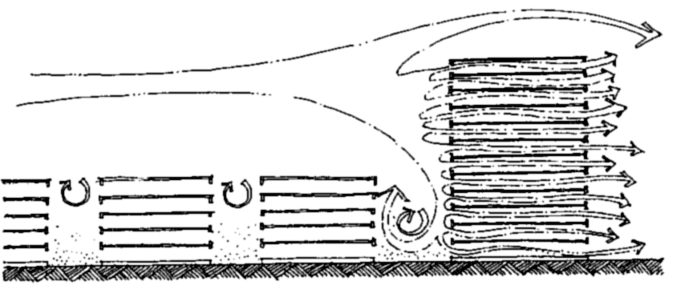
Givoni uses detailed analyses and examples from around the world to make the case that people can be comfortable in conditions well outside the range typically prescribed in engineering texts. He then presents strategies for keeping buildings within this expanded comfort range using window orientation, ventilation, shading, surface colors, thermal mass, appropriate materials, and insulation. Passive solar heating and cooling is covered, drawing heavily on examples of houses built in the 1970s in the U.S. Southwest. Givoni’s review includes some systems that he acknowledges are theoretically interesting but technically unrealistic, such as the use of water-filled bags on a roof to radiate heat into the night sky.
Part II, on urban climatology, focuses more on broader issues than building design, including urban density, orientation of streets, and the integration of green spaces.
Givoni notes the impacts various design choices have on the urban climate, particularly in relation to the temperature rise known as the “urban heat island” effect.
Part III provides a more juicy nuts-and-bolts analysis of design ideas suitable for use in buildings and urban areas in four different climate zones: hot-dry, hot-humid, cold, and cold winters/hot-humid summers, though attention to the latter is limited. There is considerable focus on low-cost housing in developing countries.
The somewhat technical, quantitative approach taken by Givoni lends credence to concepts that might otherwise be discounted. While Climate Considerations is not perfect, it serves a valuable purpose in promoting simple design approaches, rather than energy-intensive mechanical systems, for making buildings comfortable.
Published October 1, 1998 Permalink Citation
(1998, October 1). Climate Considerations in Building and Urban Design. Retrieved from https://www.buildinggreen.com/newsbrief/climate-considerations-building-and-urban-design



Add new comment
To post a comment, you need to register for a BuildingGreen Basic membership (free) or login to your existing profile.