
News Brief
Trees and Development: A Technical Guide to Preservation of Trees During Land Development
by Nelda Matheny and James R. Clark, 1998. International Society of Arboriculture, P.O. Box 3129, Champaign, IL 61826; 217/355-9411,
www.ag.uiuc.edu/~isa. Paperback, 184 pages, $45 plus $7 shipping & handling
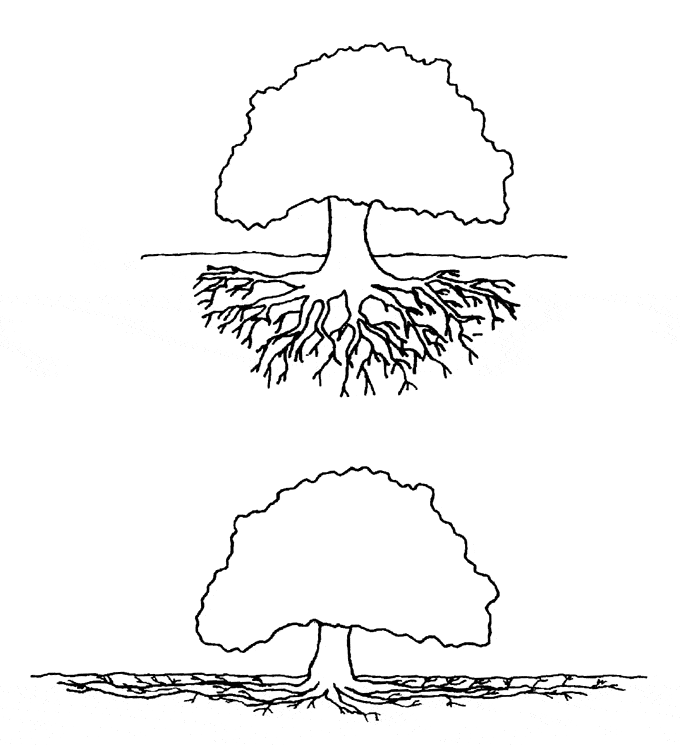
A simple illustration in the book shows the difference between our common perception of tree roots (top) and reality (bottom).
Trees and Development is an important reference book for developers, builders, architects, landscape architects, and civil engineers—anyone regularly dealing with site design for building projects. After making the case that preservation of trees is important, the authors address how to assess the trees on a site, how to protect those trees during development, and how to increase the likelihood of their survival after development.
Tree biology is fairly well covered, with important clarifications about the root structure of trees (see figure at right)—most roots remain very close to the surface of the ground and spread well beyond the “drip edge” of the crown, as shown in the bottom illustration, rather than our more common image of tree roots, shown in the upper illustration. Common injuries and diseases of trees are described and illustrated, as is the aging process—the point is made that trees do not live forever, and an accompanying table shows typical and maximum lifespans of various common species.
One chapter reviews the typical development process and describes how and where arborists should get involved. Another explains the various types of maps and plans used in development, focusing on those that affect trees most directly, such as drainage and utility plans. The chapters “Designing for Tree Preservation,” “Evaluation of Impacts to Trees,” “Minimizing Impacts and Preparing Specifications,” and “The Construction Phase” will probably prove most valuable to
EBN readers. A half-dozen two-page case studies describe tree protection efforts with various development projects around the country, but they are not specific enough to be very useful.
Trees and Development takes a mainstream approach at tree protection, covering use of pesticides, irrigation, and fertilizer. (Interestingly, the prevailing wisdom in arboriculture today is to minimize use of fertilizers to help trees recover from construction damage.) We were disappointed not to find more information about some of the innovative ways to minimize tree damage—there was relatively little in the way of specifics on machine tunneling beneath root systems, for example. And we found the absence of an index to be a major limitation in a book that will largely be used as a reference. But on the whole, this will be a valuable addition to the libraries of most developers and building professionals who regularly build on wooded sites.
Published April 1, 1999 Permalink Citation
(1999, April 1). Trees and Development: A Technical Guide to Preservation of Trees During Land Development. Retrieved from https://www.buildinggreen.com/newsbrief/trees-and-development-technical-guide-preservation-trees-during-land-development



Add new comment
To post a comment, you need to register for a BuildingGreen Basic membership (free) or login to your existing profile.