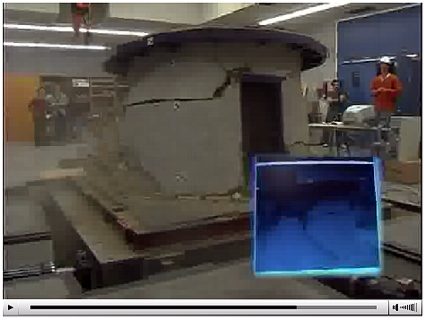
The model was of a circular structure with a shed roof, described as "about 6 ft diameter and 5 ft high"... not representative of houses in the developed world, but a start for more research. There was a small window on the rear, which is easy to miss in the video. (Fenestrations normally weaken a structure, so they're important to include.) There also doesn't appear to be a stemwall — highly recommended for cob buildings, and another likely point of seismic catastrophe.
A larger or other-shaped structure would have performed differently — which is not to say that cob wouldn't outperform many other building methods. But a person needs to know how the same structure, built from other materials, performs before any comparisons can be made. In the video, Carlos Ventura, director of the research facility, said that the impacts generated in the first part of the test "usually will destroy a structure that's not properly done." Which means that a structure — of any sort, presumably — that is "properly done" would also have survived. He goes on to describe it as a "satisfactory performance."
None of which is meant to denigrate the research and findings. Just showing (beyond anecdote) that cob can perform at least as well as proven materials and methods under seismic conditions is an excellent victory. When we in the developed world hear about loss of life in earthquakes due to collapsing houses in places where earth building is common, we tend to think that earth building plus earthquakes automatically equals death. But there's more than one way to build with earth, just like there's more than one way to build with anything else.
This excerpt from the proceedings of The 1855 Wairarapa Earthquake Symposium in New Zealand isn't surprising:
Within the highest intensity areas, many brick, cob, and stone buildings were seriously damaged, some collapsing during the earthquake and many requiring demolition after. However, there were a few brick buildings that suffered little damage. Some wooden structures were also seriously damaged and several collapsed. Most wooden buildings, however, seemed to have remained standing although many were damaged by falling chimneys.
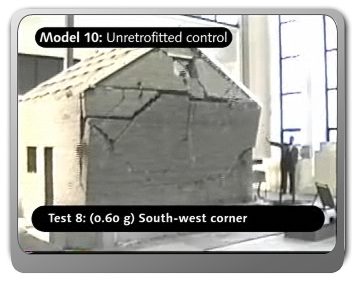
In the Vancouver test, the first point of failure appeared to be typical: diagonal cracks radiating from the corners of the door. I suspect the window at the rear of the structure had similar behavior. At the end of the final test (culminating in a massive 9.0 Richter), the building was breaking apart into large pieces, mostly diagonally — as would be expected under these forces on this kind of shape. But there was also horizontal failure between lifts, suggesting that cob building may not always be quite as monolithic as generally suggested — though clearly far more so than typical unreinforced, unstabilized adobe:




Add new comment
To post a comment, you need to register for a BuildingGreen Basic membership (free) or login to your existing profile.