
Wow, that photo of Lake Mead is disturbing. Very scary to think about.
Blog Post
Lost in Las Vegas: A Search of Irony in the City of Excess

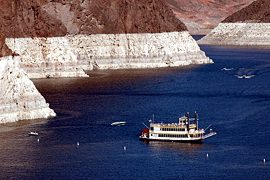
Photo: Ken Dewey. Click for bigger.
So here I was watching a film about how there isn't enough water to go around. And I was sitting in a Las Vegas casino theater watching it. Las Vegas is America's driest city. In an average year, the city receives four inches of rain. So far in 2008 they were still not up to the one-inch mark for the year. It's dry! The city gets 90% of its water from Lake Mead, the nation's largest man-made reservoir. One of the Colorado River reservoirs, Lake Mead is running dry. There's a white "bathtub ring" around the reservoir walls that's now ten stories high — showing how much the water level has dropped in the last couple decades. Now at 48% of capacity, a study came out last year from Scripps Institute saying that there's a 50% chance that the reservoir will be functionally empty by 2021 — a scant 13 years from now. And meanwhile, Las Vegas keeps growing; the city's population has doubled just since 1995!


Click for bigger.
Sobered by the film and worn out from conferencing, the next morning (my last in the city), I woke early and went out for a long walk, leaving the South Point Casino and Hotel behind and exploring the sprawling subdivisions of the south end of Las Vegas where the South Point is located. The photos here are a few that I took that morning. It was refreshing to be outdoors, but sobering to see and experience the absolute dryness. We talk about xeriscaping (low-water landscaping), but any place I saw a sprig of green I knew that I could look a little harder and see an emitter from an irrigation system. Though the Southern Nevada Water Authority, with one of the most aggressive water conservation programs in the country, offers $1.50 per square foot to homeowners or business owners to replace irrigated turf with water-efficient landscaping (with no limits on the conversion area and payment!), I still saw lots and lots of bright green turf. For more on our water crisis and what to do about it, take a look at the three-part series we've run this year in EBN. The first article addresses demand-side solutions (reducing the amount of water we use in and around buildings), the second covers alternative water sources (including graywater, rainwater, and air conditioner condensate), and the third covers policies and what we need to do to effectively reduce our water consumption. These three articles are all free on our site. —Alex WilsonPublished October 30, 2008 Permalink Citation
(2008, October 30). Lost in Las Vegas: A Search of Irony in the City of Excess. Retrieved from https://www.buildinggreen.com/blog/lost-las-vegas-search-irony-city-excess
Comments
By coincidence, last night I

By coincidence, last night I saw the movie Mr. Wilson discusses. The Springs Preserve of Las Vegas is the backdrop for the sustainable built environment suggestions the film makes. Sadly, he did not make it to the Springs Preserve - this is probably because the preserve doesn't really advertise; thus the people at the conference had no idea that the movie of which they are so supportive, was (partially) shot at a location not more than 15 miles away - right up I-15 from the Gold Coast.
In case you don't go to the website, Springs Preserve is a collection of 5 LEED Platinum buildings that serves as an example, model and teaching resource for the arid west. It is open to the public 7 days a week and holds classes in green design, desert xeriscaping, and hosts meetings. It is situated on the original spring at Las Vegas, and should have been the site of WaterSmart '09 Innovations. Maybe next time.
While the mass of the populace out here is ignorant, if not hostile, to sustainable ideas, the cutting edge of thought (and action) is way ahead of the curve. There's a lot of irony here; it's highlighted by this blog entry.



Add new comment
To post a comment, you need to register for a BuildingGreen Basic membership (free) or login to your existing profile.