
Blog Post
Saving Energy by Saving Water
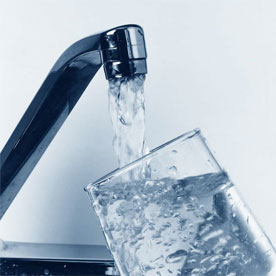
Whenever we reduce water use, we also save energy. In fact, several of the most cost-effective energy saving strategies -- projects with the quickest "payback" -- are water conservation improvements that reduce hot water use. I'll cover some of these strategies here, but first I want to explain why even reducing our cold water use saves energy.
If you have your own water system with a deep-well pump and pressure tank, the less water you use, the less electricity you will consume pumping that water out of the ground and pressurizing your water tank. The deeper the well, the more energy is needed. In some houses with really deep wells and large water demand, this is one of the three or four largest energy users in the home.
If you're on municipal water and sewer, water consumption is also responsible for significant energy use. It takes energy to pump water from reservoirs or wells, and to filter and purify that water. It takes even more energy to treat wastewater in sewage treatment plants. In fact, for many municipalities, wastewater treatment is the single largest energy expense. Nationally, water and wastewater account for about 35% of municipal energy budgets, according to a recent report by the New York State Energy Research and Development Authority. The average "energy intensity" of municipal water in the U.S. is 2.6 kilowatt-hours per thousand gallons, including all of the energy associated with fresh water delivery and wastewater treatment. This energy cost is factored into municipal water and sewer rates.
While we pay a little bit for every gallon of water we use, we pay a lot more when it's hot water we're using. In a typical American home, water heating accounts for about 12% of total energy use, according to the U.S. Department of Energy -- more than lighting, half-again as much as refrigeration, and about the same as air conditioning. That's a significant amount of energy. Fortunately, there are some easy ways to reduce our hot water use. A few of these are described below:
- Install low-flow showerheads. Older showerheads use as much as five or six gallons of water per minute (gpm). New models, by law, cannot use more than 2.5 gpm, and there are some very good models that use as little as 1.5 gpm. At home, we've been using a 1.6 gpm showerhead made by Delta Faucet (H2Okinetic line) for several years with great results, even with our fairly low water pressure. The payback on a low-flow showerhead can be as little as a few months.
- Install low-flow faucet aerators. The federal standard for faucets is 2.2 gpm, but for bathroom faucets, I think a half-gallon per minute is adequate, though many people will want at least a gallon per minute; in either case the savings can be dramatic. (Note that with a lower flow rate, it will take longer for hot water to reach your bathroom, and if you have a tankless water heater, a flow rate of less than 0.5 gpm may not be enough to get the water heater to turn on.) With kitchen faucets, going much lower than 2.2 gpm may not make sense, because it will take longer to fill cooking pots.
- Repair leaky faucets or showerheads promptly. A leak of two drips per second wastes over 17 gallons per day and over 6,000 gallons per year. At five drips per second (about the minimum flow to produce a steady stream) the waste totals 43 gallons per day and over 15,000 gallons per year. (To calculate waste from a dripping faucet, search online for "WaterWiser drip calculator.")
- Insulate hot water pipes. If the water sitting in your hot water pipes stays warm after you run the tap, there's greater likelihood that you won't waste water the next time you turn on the hot water. Waiting for hot water to reach a faucet or shower results in a lot of wasted water (and energy). In new construction, all hot water pipes should be insulated; in existing houses insulating pipes can be quite difficult and may not be worth the effort--but insulate any accessible pipes.
- Replace your clothes washer with a horizontal-axis, Energy Star model. The water savings will be significant and if you wash in hot water, so will the energy savings.
- Replace your dishwasher with a top-efficiency, Energy Star model (see last week's column).
Over the next few weeks, I'll cover different options for water heating. But as I've said with space heating, always start with reducing demand. If you're thinking of buying a new, more efficient water heater -- or a solar water heater -- great! But before you do, invest in water conservation where the payback will be the quickest.
Published May 25, 2009 Permalink Citation
(2009, May 25). Saving Energy by Saving Water. Retrieved from https://www.buildinggreen.com/blog/saving-energy-saving-water



Add new comment
To post a comment, you need to register for a BuildingGreen Basic membership (free) or login to your existing profile.