Posted from Greenbuild '08.
As my colleague Nadav Malin has written, attempts to achieve LEED credits, particularly in the materials and resources category, sometimes involve "magical," that is, wishful, thinking.
At a session this morning on green blogging, a guy popped out of the audience who wields a much more interesting and perhaps even more audacious type of magic toward achieving LEED credits... sculpture.
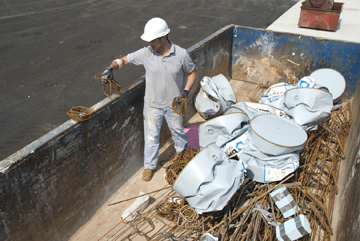
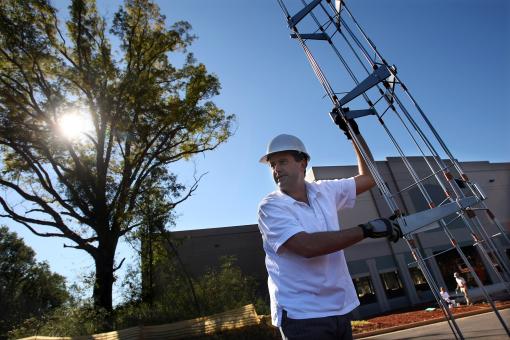
Dwayne Bass of Twovital takes on-site construction waste and turns it into permanent on-site sculpture. I didn't catch which LEED credits he has successfully achieved, but this kind of work would clearly contribute to MR Credit 2: Construction Waste Management (although more durable materials that could be sculptural, like rebar, are likely to be recycled anyway), and particularly if a project leaned on the educational angle, could earn a point for Innovation in Design.
In Dwayne's words (from his website):
In 2007, Dwayne Bass, a seasoned sculptor, had contacted Dave Radlmann, a green builder/developer, to discuss opportunities that there may be in any of Dave's projects for a sculpture. After hours of discussion, they came to the conclusion that there is a need in green building and development for sculpture and art. Thus, the birth of Twovital's pioneering sculpture out of construction waste.
Dwayne worked with Dave to receive a green credit under the UGGBC's LEED program and has the first sculpture placed at Commonwealth Braselton in Braselton, GA. Successful completion of the project yielded both approved LEED credit and an engaging sculpture to greet building visitors.
The majority of construction projects do not recycle waste that is accumulated while building. Twovital provides a positive alternative solution to simply hauling off waste to landfills. Even the construction of our sculptures takes the sensitivity of the environment into account. Environmentally sensitive adhesives are used in all sculptures rather than using welded joints. The end result is a synergy of artistic value, environmental stewardship, and recreational functionality.
Green or greenwash? You be the judge. I would be careful to not overstate the environmental benefit, but this seems like a win for art and education, and a win for the environment.
More press and photos are here.





Add new comment
To post a comment, you need to register for a BuildingGreen Basic membership (free) or login to your existing profile.