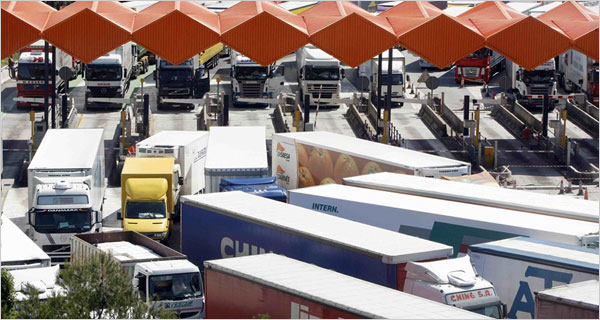
A friend of mine near Barcelona wrote me that truckers in Spain are on strike and are blocking roads. They demand the government set a 35% haulage tariff, which would be in proportion to the increase in fuel costs in the past year. Anticipating the stores will soon be empty, my friend made a trip into town, by train, to get a 50-pound bag of rice and some butane cylinders to run his family's kitchen stove. News reports say perishables are expected to run out within a week. Of course, if people make a run on the stores, perishables and non-perishables alike could be scarce faster.
Is this how famine starts?
Europe isn't suffering crop failures or drought. There's food. But if it doesn't get where it is needed, hunger can set in quickly, especially in places where people are accustomed to shopping frequently and tend not tend to store much in their homes.
The truckers say that they're better off not working than losing money on every delivery due to fuel prices. The interruption in food shipments is unlikely to last long, this time. A political solution will be devised. But I can't help seeing in this strike a foreshadowing of things to come. Where a society depends on moving food long distances--especially when it depends on relatively inefficient means, like trucks--it is vulnerable. Food that isn't shipped because it isn't profitable to do so, or that is shipped but becomes unaffordable because its price, reflecting the cost transport, is too high, is food that might as well not exist.
Famines caused can be caused by high prices, not just outright shortages. When the potato crop failed in Ireland in 1879, there was other food, but not that poor Irish could afford. And in the Bengal famine of 1943, during which at least 1.5 million died, while rice supplies were down, that was not sufficient to account for the widespread starvation. It was rising prices and many workers' falling wages that put rice out of reach for multitudes of Bengalis.
The fragility of our food system and the consequent danger of famine is yet another reason (beyond reducing energy consumption, decentralizing power and developing more distinctive, place-based cultures) to guide development, and re-development, toward compact settlements situated amid productive countryside capable of supporting them, and to keep our supply chains short and comprehensible. Green buildings, as EBN explained in this article on the transportation energy intensity of buildings, can be wonderful in themselves, but involve high costs when they can only be reached by driving. In the same vein, transportation and access to essential supplies needs to be taken into account across the board in planning of towns and regions.
Perhaps vegetated, or green roofs should in some cases be growing produce rather than sedums (though it would require deeper soil as with intensive green roofs); as valuable as parks are, perhaps urban green space should more frequently be set aside for garden plots; perhaps town-dwellers should be encouraged, rather than forbidden, to keep a few chickens; and perhaps lawns should largely give way to fruit trees and vegetable patches. (On the problems with lawns, check out "Reconsidering the American Lawn" in EBN.) To move toward resilience, buildings and settlements need to be more often thought of not as isolated entities but as parts of a complex survival system in which they need to be productive assets and not merely loci of consumption.
There seems to be a trend toward speaking of "resilience" rather than sustainability. It may be that terms simply go in and out of fashion, but to me "resilience" emphasizes the ability, not just to get along without undermining one's own foundations, but to bounce back when things go badly. It means taking into account passive survivability in order to be able to endure a long power outage or an interruption in fuel delivery. It acknowledges that sooner or later trouble comes, often in unpredictable ways, and that getting through hard times requires ample margins. To be resilient is to have flexibility and toughness, not the strength of sheer force but the ability to change course when necessary, before it is too late to do so with some grace.
I would love to have a couple of milk goats and a few chickens on my city lot. I live on a quarter acre in a "nice" area of town where we are not allowed to do anything that might be disturbing to the neighbours. With my 2 border collies, I am often in trouble already, since ANY barking warrants arrest by thy bylaws authorities. What a waste of land it is just to be manicured! If we were faced with the situation that Barcelona is enduring, wouldn't it be great to know that my little vegetable garden, chickens and goats would sustain my family? I sure think so. Do you?





Add new comment
To post a comment, you need to register for a BuildingGreen Basic membership (free) or login to your existing profile.