

Blog Post

What do you do when a good product has PVC in it?

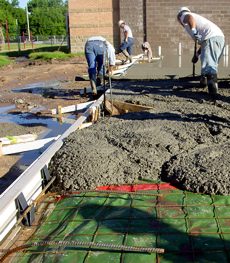
There are still people on both sides of the PVC issue, but let's go ahead and assume that most green builders don't like the stuff — mostly because of its upstream and downstream environmental burdens. PVC taken in isolation from its birth and death enters murkier territory. There's a product available that decreases a building's heat loss, doesn't increase materials costs, decreases installation time, provides a termite shield, prevents damage commonly inflicted by the landscaping crew and ongoing grounds maintenance... and contains a fair amount of PVC. It's a stay-in-place form for slab-on-grade construction called EnergyEdge that insulates, finishes, and protects a slab's exterior face. Dan Morrison wrote a blog post about it over on GreenBuildingAdvisor.com that sets the stage:
"Slab on grade construction is extremely common in the southeast and southwest US because it's a fast, affordable way to get out of the ground and into the house. Slabs are also a great way to incorporate hydronic heating into a house."
But (he goes on)...
"Slab foundations can be energy sieves if not insulated on the outside with rigid foam. Both heat and cold can penetrate deep into a house through an un-insulated slab edge in summer and winter."
The product was also given a brief presentation in the first issue of Insider, the print newsletter distributed to GBA Pro members (where it's got a Michael Chandler byline), which notes:
"EnergyEdge saves labor costs because you don't have to add foam later or strip the forms. And the product is comparable in price to 2x8 forms or modified insulated concrete forms."
(As a bit of an aside, both GBA pieces mention that the PVC is recycled from post-industrial sources [i.e., pre-consumer], which in the scheme of things is usually a baby-step or less removed from virgin PVC. However, something is askew somewhere. A company representative told me on the phone that they're "looking into" using recycled PVC with only a thin virgin wear layer. It could be that the company is investigating the use of post-consumer PVC as the bulk, which would be great... though using a recycled PE, rather than PVC, would probably be better.) So where's the line? The GreenSpec research crew has had quite some discussion about it. The product has a lot going for it... but as a general rule, GreenSpec doesn't include PVC products. This one, though, can contribute to significant energy savings, which translates into better environmental health. What would you do?

Published February 10, 2009

(2009, February 10). What do you do when a good product has PVC in it?. Retrieved from https://www.buildinggreen.com/blog/what-do-you-do-when-good-product-has-pvc-it

Add new comment

To post a comment, you need to register for a BuildingGreen Basic membership (free) or login to your existing profile.

Comments

March 2, 2009 - 4:06 am

We ended up listing this product in GreenSpec, and not surprisingly, we got some pushback in the member comments. I thought I'd share BuildingGreen's response:

This one was a tough call for the GreenSpec team. PVC, of course, isn't green - generally, PVC components are enough to knock a product out of the running. With this product, the question was (in the absence of other products that provide the same qualities) whether its use of PVC as a component - with the awareness of the consequences of PVC's upstream and downstream burdens - was outweighed by the product's lifespan contribution to the reduction of human and environmental health burdens. See "The Challenges in Defining What is Green" at http://www.buildinggreen.com/auth/article.cfm/2000/1/1/Building-Material...

Also see our blog post, "What do you do when a good product has PVC in it?" at http://www.buildinggreen.com/live/index.cfm/2009/2/10/What-do-you-do-whe...

In the case of this product, it was determined that the human and environmental health burdens eliminated over its service life due to energy use reduction outweighs the harmfulness of the PVC component during its manufacture and eventual disposal. GreenSpec is a constantly evolving resource, and when a similar product comes to light that achieves the same qualities without the use of PVC, this product will be removed and replaced with the other. But for now, to our knowledge there's no alternative that competes with it.

There's a similar difficulty in the case of plumbing waste pipes. We used to list cast iron as an alternative to the ubiquitous PVC pipes, but ended up delisting cast iron when it came to light in lifecycle studies that cast iron had even more harmful human and environmental health effects than PVC. Fortunately, in that category there are alternatives to both cast iron and PVC. In this application, as far as we know, there isn't - so far. If there is, we want to hear about it.


March 4, 2009 - 10:59 am

The best resource I have found for understanding the issues around PVC is Joe Thornton's book, Pandora's Poison. It goes into carefully researched detail on each stage of the life cycle. For me it was a painful read, and I came away with a resolve to avoid PVC wherever possible. You might draw different conclusions, but at least you will be better informed.

Another resource about PVC is Judith Helfand's documentary film, Blue Vinyl. The film makes it easier to learn the issues because it is leavened with humor.

March 4, 2009 - 4:59 pm

There's a follow-up post to this one: "Redux: What do you do when a good product has bad stuff in it?" Pick up the conversation at
http://www.buildinggreen.com/live/index.cfm/2009/3/2/Redux-What-do-you-d...

March 4, 2009 - 4:26 pm

See our review of the great film Blue Vinyl at
http://www.buildinggreen.com/auth/article.cfm?filename=110414a.xml
(It was a real treat for me to finally get to meet Judith a couple years back.)

Also check out the Environmental Building News article from 1994, Should We Phase Out PVC?, for hard basics:
http://www.buildinggreen.com/auth/article.cfm/1994/1/1/Should-We-Phase-O...

For the full breadth of reporting on PVC in EBN, see
http://www.buildinggreen.com/search/index.cfm?q=pvc&num=100&f=Article
(which does include letters to the editor from pro-PVC sources)

February 19, 2009 - 4:59 am

I have been watching the PVC debate for 2 years and the same old arguments are used, but the facts are never clear. One fact neglected in the use of PVC is the life of the product is extremely long and it outlasts many others. That explains how so little reaches the recycling plants.

cPVC pipe used in the fire industry uses far less energy to produce, lowest maintenance against comparable steel systems and lowest friction for pumping costs, yet LEED losses points on the credit calculation. In a fire, cPVC and PVC behaves better and burns less than PE and XLPE. PE based pipes become liquid hydrocarbon with no resistance to fire and are an accelerant in a fire. It burns very fast and is toxic to humans and will incapacitate far quicker than PVC.

The Green Councils of the US and the world loose sight that building products in a fire contribute massive CO, CO2 and toxic products that are ignored in the credit schemes and its short sighted to think these new "Green" products are not harmful. My fire experience says they are far more dangerous. Go do the research and find out for yourselves and act on them responsibly. Environmental credits for adding a sprinkler system to a building preventing massive fire product discharges should gain a large credit to any building.

February 18, 2009 - 9:18 am

I've visited a jobsite within the last 6 months that used a plastic self-insulated formwork (don't know if it was the same product or not) for the pour of a basement slab. A significant amount of this form work was busted up in the process of all the construction activity and the damage appeared to be enough that it would effect the insulative properties it was supposed to add to the slab. (Note that the pour of the slab itself seemed to be successful.) The contractor I spoke with expressed he probably would not bother with the product again.
I am a bike commuter and am often frustrated by the plastic accessories I need to buy for my bike because there are no more durable alternates (fenders and blinking lights for the most part). My experience with plastics is that UV light eventually takes its toll on them and they don't hold up well to outdoor conditions and activities. I'm not convinced that the PVC slab edging noted in the article will hold up over time and will eventually end up as debris.
While my lack of understanding of the differences between different plastics and their different uses may make my opinion overly simplisitic, at the very least the durability of the product should be scrutinized in a forum such as this, especially considering the environmental and health problems associated with the making and disposing of PVC.

February 18, 2009 - 12:52 am

Only a very small amount of PVC is recycled. In Europe the PVC industry has developed a 'green' policy called Vinyl 2010 which claims that 59,000 tonnes of PVC were recycled in 2007. Compare that to the 5.5 million tonnes of PVC resin that the European Council of PVC Manufacturers claim to have produced in the early 2000s and the recycling rate seems very small.

Having said that, I agree with the viewpoint that BuildingGreen seems to put forth in that while PVC isn't by any means an inherently green product I tend to think that its been overly villified compared to a lot of other mainstream building products. Given that a lot of a building's impact is still in the in use phase then I wouldn't be adverse to using a PVC product is it was the only option and it performed very well in other areas.

Tom Hill, LCA and Materials Analyst,

February 10, 2009 - 9:06 am

I also believe that Hydronic Heated surfaces of a slab need to be treated to reduce moisture vapor emmissions transfer in and out of a slab. The most common reason for a concrete floor covering failure [epoxy, VCT's and mastics] is water vapor condensing at the surface. This moisture causes bond loss fo adhesives, bubbles under epoxies and water to pond under a rubber flooring system.
The type of material for radiant heat is important, But manipulating a slab temperature, inviting transfer of vapors without waterproofing the concrete floor, seems foolish. Doesn't that fly in the face of Longevity we strive to obtain by building Green?
How Green will it be to scarify a slab surface to get it right the next time?

February 12, 2009 - 8:59 am

It is a known fact that most consumers and builders reject many green/sustainable building applications because of a lack of "common sense" in dealing with the process. PVC because of its cost effectiveness and applications in affordable housing production, will be with us for a long time. Instead of fighting it and making many turn away from Energy Efficient/Sustainable Building, we should figure out to cost effectively recycle it and the practical applications were it can be used. It reminds me of Asbestos roofing. It was a good product, outside of a building envelope, where not breathable, not the same as a pipe wrap inside of a building. When we stop using common sense, we lose more people, who are waiting to embrace the cost effective, sustainable building movement and end up attributing the problems to "Tree Huggers" with no budgets or knowledge.

February 13, 2009 - 2:34 am

As a green builder, I use slab on grade construction with hydronic radiant heat, and I know the benefits of a well insulated slab. A product such as this that provides the necessary insulating value (which translates to energy savings) and streamlines the construction process (by not having to strip forms, and by not having to add insulation later) is a win/win. Even if it does contain PVC, the sustainability factor and the and energy savings, to me, offset the negative impact of the other issues.
