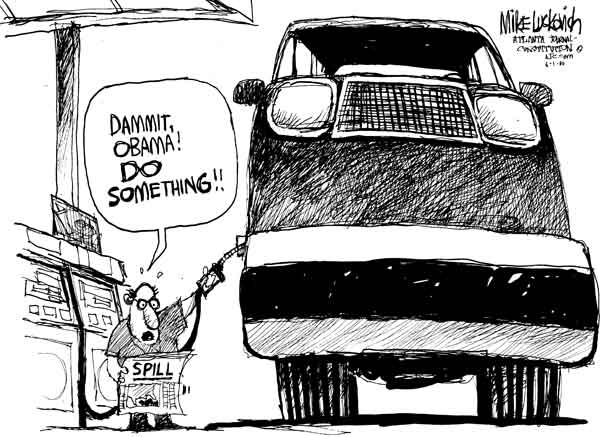
I'm sorry, but the irony is just too thick these days. We Americans are rightly upset with BP for the devastating spill in the Gulf that is wreaking ecological devastation on a mammoth scale. But as I watch the television news and read the daily coverage, I'm not hearing enough outrage at our petroleum-dependent lifestyles and the gas-guzzling vehicles we hop into at a moment's notice to drive to the store for a pint of ice cream. We need to hold a mirror up to ourselves at those protest rallies. Oil spills are tragic on multiple levels: to the affected ecosystems; to those who depend on the region's bounty for their livelihoods; to the tourism industry in the region; and even to employees at the oil companies and public agencies whom we have to assume are trying hard to do the right thing. Residents of the Gulf Coast and ecosystems are being--or will soon be--devastated by the spill that continues to hemorrhage tens of thousands of barrels of oil into the Gulf daily. We must redouble efforts to protect coastal wetlands while workers with their undersea robotic vehicles continue trying to stem the leak. And we certainly should hold the companies that caused the leak liable for the costs of cleanup, as well as for the economic damage both the oil and its cleanup are causing. Those impacts will likely be measurable for years, if not decades. But at the same time, we too--consumers of the oil and gas we are going to ever-greater effort to harvest--must share some of that blame. Every once-in-a-while we are reminded in a very dramatic way of the larger impacts of our profligate consumption of oil. The Santa Barbara oil spill in January 1969 spilled 200,000 gallons of crude oil, despoiling a 35-mile stretch of the California coastline and resulting in a ban on offshore drilling. Twenty years later in March, 1989, the Exxon Valdez oil tanker spilled 10.8 million gallons of crude oil, ravaging the rich biodiversity along a 1,300-mile span of Prince William Sound coastline and leading to tighter regulations on shipping oil, including the requirement for double hulls in the oil tankers that haul billions of gallons of oil around the world each year. Now, after two more decades, another oil spill is dominating the news. As with the other two described, this one is far larger than the previous one. By government estimates, the BP spill has already spewed 22-35 million gallons (at least twice as much oil as the Exxon Valdez), and some experts say the rate of flow from the disabled blowout valve is significantly greater. While progress appears to have been made in capturing some of the gushing oil, we are told that it will be months before the well is permanently capped and the spill fully contained. These spills are horrible, of course, but so too are the spills that occur when the oil pans in our cars drip oil. Each year in the U.S. roughly 180 million gallons of motor oil is either dumped down the drain during oil changes or is leaked from engine crankcases, according to the Massachusetts Department of Environmental Protection. The few drops of gasoline that most of us spill each time we fuel up our cars add up to hundreds of thousands of gallons per year nationally. Leaks from our outboard motors leave that familiar iridescent sheen on the water. The lubricating oil we use in our chainsaws is deposited directly onto the ground as we cut our cordwood (as it's intended to do). These smaller incremental leaks each year add up to many times as much oil contamination as the BP spill to date. This is not at all meant to trivialize the BP spill, but rather to point out the significance of oil spills that we consumers can do something about. We can repair our cars so that they don't drip motor oil. We can be more careful when fueling up. We can use biobased lubricating oil for chainsaws. And, of course, we can use less energy--by driving less and better insulating our houses. If we're serious about our anger at the BP oil spill in the Gulf, we should direct a large share of that anger at our own consumption of petroleum in our cars and our homes. As Pogo said in Walt Kelly's famous comic strip: "We have met the enemy and he is us." Interested in your thoughts. Alex Wilson is the executive editor of Environmental Building News and founder of BuildingGreen, LLC. To keep up with his latest articles and musings, you can sign up for his Twitter feeds. Cartoon by Mike Luckovich for the Atlanta Journal-Constitution. Used with permission.
Well put, Alex. It seems as a country have a dependency issue — as if hooked on a drug, in this case dependency on oil ... and it's a habit we can't kick. And not only does this result in great environmental cost (including climate change), but we also justify wars and international intervention at great cost to protect this "habit".
In an earlier post "mom" expressed concern that reduce our oil habit, we had to give up conveniences (SUV's due to family size, etc.). Not so! We just have to change the choices we make — we don't have to "give up" anything - and we do have choices. For me personally, this point was demonstrated many years ago when visiting Europe. I shared a long trip with a family in a then new Peugeot 505 wagon. The vehicle was exceptionally quiet, comfortable, spacious (it's a large station wagon) and it averaged 34 MPG on a long journey. At that point in my life, I realised that I could live a more energy efficient life style, and not give up anything if I did not want to.
My best friend just purchased a new clean diesel VW Jetta (EPA rated 42 MPG) here in the States, and he has not given up anything either.
Very good point about Nigeria, Brent. Another under-represented entity that suffers due to our push for greater amounts of fossil fuels is the ocean itself. While concern about the economies and environment of the coastline are up-front-and-center, the big, blue, "silent" ocean is reeling. In the same way we expect it to flush away (and hide) the garbage we dump there, we assume it will dissolve this oil plume eventually or push it all to shore, where it is a major inconvenience to us. Oil on the beaches and on coastal wildlife puts a face to the danger of our assumed "entitlement" to cheap oil. The real danger is that after the plume is controlled complacency returns with our "out of sight, out of mind" mentality.
To Brent's point, our messes are not more important than those in Nigeria, or under the ocean surface, no matter how much more vocal we are about it. Will we ever start to work with the "inconveniences" of reducing fossil fuel usage on a large scale to lessen our impact at the source? Will we change our habits ourselves instead of waiting for the government to mandate it? We have the benefit of a tremendous amount of information at our fingertips, such as this blog, to lead the way.
As part of her testimony to congress regarding the Deepwater Horizon Spill, Sylvia Earle, ocean explorer and advocate said, "Fossil fuels took us to the moon and to the universe beyond, and made it possible for us to see ourselves in ways that no generation before this time could fathom. They have provided the backbone of the extraordinary progress we enjoyed in the 20th century and now into the 21st. We now know that those of us now alive have participated in the greatest era of discovery and technological achievement in the history of humankind, largely owing to the capacity to draw on what seemed to be a cheap but by no means endless source of energy.
At the same time we have learned more, we have lost more.
Cheap energy, it turns out, is costing the Earth...so to speak."
I live on the Mississippi Gulf Coast. Oil is washing ashore on the beach less than a mile from my home. My husband and I have 3 children and a dog. We drive a car. We don't drive a huge gas-guzzling SUV. Sure, it would be more comfortable to have an SUV. However, we have made a conscious choice that we don't "need" an SUV. Things will only change when we all make a choice about our consumption of oil. Is being "comfortable and having a cool SUV" worth the damage it is causing? I don't think it should be a battle between those who do and do not drive SUV's. It is hard to drive a small vehicle and we don't make trips all the time. My family lives a 1000 miles away and we have only visited them once this year. Maybe we need gas rationing. That would definitely help people understand the difference between "wants" and "needs". I did not feel this strongly until it began affecting my community. So, please do not rationalize your "need" for a "comfortable" SUV" if you do not live in the affected area.
I'm going to repeat what I said when this article was posted in the blog:
What is happening in the Gulf of Mexico is horrible. But let us not lose sight of the fact that far worse is regularly inflicted on the people and ecosystems of disadvantaged countries, for example Nigeria (http://tinyurl.com/3a3by6m), as the developed world feeds its endless appetite for energy.
I apologize for repeating myself, but I think it's important that we have a sense of perspective on the impacts of our energy use. The reality is that, without an easy, visceral point of reference like the BP spill, most people simply cannot imagine the destruction that each of us (indirectly) wreaks on a daily basis through our use of fossil energy. I am hoping that the attention focused on the BP spill will allow people to begin to understand the true size and impact of the developed world's footprint.
Thanks Alex for the well-thought out piece. Unfortunately, in this hyper-partisan environment, it seems next to impossible to achieve any meaningful relief from our fossil fuel addiction in this country. Even many folks in the south, because their livelihood depends on the fossil fuel industry, are still in favor of additional drilling even as they walk along the beaches picking up tar balls and washing off brown pelicans. Both sides are not right on this issue; fossil fuels are hurting this country with their myriad of externalities. Our national "energy" must be refocused to change the situation.
I agree we all have to do our part. But, I am looking for a eco-friendly solution for a family of 6 with 2 dogs? We live far from family and have to frequently travel, so our large SUV has become an actual necessity. Could I pay huge amounts of money to fly to our destination and board our dogs? Absolutely! But, I don't have the extra cash. We drive our small car to and from work, or anytime we aren't traveling with the whole family.
Bottom line, someone should build an effective hybrid or other alternate fuel "SUV" or large vehicle for large families. We shouldn't be judging people who drive SUVs - not all of us have another option. Until there is a viable alternative (and by viable, I mean comfortable and safe - this is my children we're talking about), I'm going to continue to drive my huge SUV - To compensate, I'm doing my best to drive it as little as possible & trying to save energy and water in other ways.





Add new comment
To post a comment, you need to register for a BuildingGreen Basic membership (free) or login to your existing profile.