Years ago a friend and I borrowed my mother's minivan, left our small college, and drove west in search of the Great American Wilderness. For months we steered clear of cities in favor of National Parks and Forests, but as we passed through the Sierras we couldn't help but notice how close Death Valley is to that other American extreme: Las Vegas.
We drove out of Death Valley around midnight, and soon the artificial sun of Sin City was glowing on the eastern horizon. Stepping out onto the Strip, all I could see was the waste: the blazing lights, the miles upon miles of climate-controlled real estate, the networks of fountains spewing billions of gallons of water into the dry desert air. With all the maturity and nuanced perspective of my 20 years, I thought: We're all going to die, and this is what will kill us.
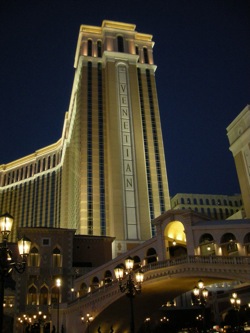
I left Vegas less than 12 hours later and I've never been back, but I think of it often, especially when I'm feeling less hopeful that we will ever un-supersize the American lifestyle, because it's so clear from examples like Las Vegas that excess—waste—still sells. But something I saw this week might have me looking for a new scapegoat: the Las Vegas Sands Corp. (of the Venetian, Palazzo, and Sands Expo complex) has a plan to turn the three-casino complex into the "world's greenest building"—all 17.9 million square feet of it.
When I saw the headline I had to laugh, remembering my apocalyptic Vegas moment and wondering what superficial half-measures and meaningless "green bling" I could expect to read about in the article. On the other hand, I had to admit: the potential for energy and water savings might be greater in Las Vegas than it is anywhere else in the world. If this was a legitimate effort, the results—and the ripple effect—could be incredibly positive.
According to the Las Vegas Review-Journal report, the Sands casinos are already collecting 75% of food waste to be composted, have a full-time staff of 14 dedicated to sorting solid waste for recycling, and are at work implementing a $25 million building management system—no small chunk of change, even in Vegas. Well, maybe in Vegas it is. But it's certainly far more meaningful than slapping down some bamboo on the gaming floor and calling it "green." The kicker for me was this figure: the Sands—one casino complex—is saving enough energy annually to power 6,500 homes. That's more homes than you'll find in all but a handful of cities in Vermont, where I live.
You probably won't catch me using the "g" word to describe Vegas anytime soon—not until I hear some serious discussion of smarter net growth in a part of the world that's ill equipped to support the life it's already carrying. But if the Sands program catches on at other venues, I might get curious enough to go back and check it out.
Read the full article here.
I hadn't heard about the MGM CityCenter project, but it does appear to be pretty mind-boggling in scope: at $8.5 billion apparently the largest construction project in history, with six of the buildings LEED Gold certified.
What I like about the Sands project is that they're working with existing buildings (though the more recently built Palazzo did receive LEED Gold for new construction), because that's where the greatest potential lies for energy and water savings and waste reduction. But a high-profile new project like MGM CityCenter being LEED certified will certainly emphasize that green is in high demand, and hopefully catch on with other developers.
What I would REALLY like is to see somebody asking whether all the lights and fountains (and giant new hotel-casino complexes, green or not) are really necessary. But this is Las Vegas we're talking about.
Thank you for your very perceptive comments. I must admit that I have had very similar reaction to the overuse and abuse of natural resources in Las Vegas. It is good to know, however, that the design, building, and hospitality industries are leading the way toward developing cleaner, greener and more sustainable facilities.
The author may take note that the Las Vegas Sands Corp is actually copying MGM's CityCenter Las Vegas (www.citycenter.com), which has received LEED certification. Corporate social responsibility does wonders for the environment in attracting increasingly eco-friendly consumers.





Add new comment
To post a comment, you need to register for a BuildingGreen Basic membership (free) or login to your existing profile.