Case Study: Council House 2, Melbourne, Australia

Case Study

Case Study: Council House 2, Melbourne, Australia

Melbourne’s Great Experiment: Technological ambition and daring-do provide a wealth of lessons for aspiring green designers

By Russell Fortmeyer


Melbourne’s Council House 2 is as much a political act as it is architecture. You don’t build what is widely considered Australia’s most sustainable building, routinely lavished with international awards and praise, and not expect at least some criticism, some hand-wringing, and perhaps some latent jealousy from designers, builders, and developers not involved in the project.

Published December 31, 1969

(2009, May 1). Case Study: Council House 2, Melbourne, Australia. Retrieved from https://www.buildinggreen.com/departments/case-study

Case Study: Charles Hostler Student Center, Beirut, Lebanon

Case Study

Case Study: Charles Hostler Student Center, Beirut, Lebanon

Rooted in Beirut: A new student center for the American University of Beirut combines state-of-the-art sustainable innovation with the region’s traditional solutions.

By Sarah Amelar


Sited on a steep hillside overlooking the Mediterranean, the American University of Beirut (AUB)’s 73-acre main campus is so lush it’s called “The Garden of Beirut.” AUB’s original historic section, dating back to the 19th century, meanders across the hilltop, while its later, lower section extends down to the Corniche, the Lebanese capital’s grand waterfront boulevard.

Published December 31, 1969

(2009, July 1). Case Study: Charles Hostler Student Center, Beirut, Lebanon. Retrieved from https://www.buildinggreen.com/departments/case-study

Case Study: Lost Dog Wash Trailhead, Scottsdale, Arizona

Case Study

Case Study: Lost Dog Wash Trailhead, Scottsdale, Arizona

Passage Into The Desert: This sustainable visitors’ center celebrates a new entrance to the nation’s largest urban nature preserve

By David R. Macaulay


Published December 31, 1969

(2009, March 2). Case Study: Lost Dog Wash Trailhead, Scottsdale, Arizona. Retrieved from https://www.buildinggreen.com/departments/case-study

Case Study: Dockside Green, Victoria, B.C., Canada

Case Study

Case Study: Dockside Green, Victoria, B.C., Canada

A Platinum Setting: This 15-acre, mixed-use, harbor-front development in Victoria, B.C., will set records for sustainability at the neighborhood scale

So confident were the developers of obtaining LEED Platinum certification for Dockside Green, a mixed-use development in Victoria, British Columbia, that the company agreed to pay the city a $1 million penalty if they didn’t achieve it. So far, so good. Last July, the initial phase, called “Synergy,” consisting of four detached residential buildings totaling 93 condominiums, received LEED Platinum certification for new construction through the Canada Green Building Council with a record-setting 63 points.

Dockside Green rests on 15 acres of former industrial land on Victoria’s inner harbor. The development includes residential, live/work, retail, office, light-industrial, public amenities, and cultural venues. Once completed, it will comprise 26 buildings, totaling 1.3 million square feet, and serve as home to 2,500 people in three neighborhoods.

Published December 31, 1969

(2009, January 1). Case Study: Dockside Green, Victoria, B.C., Canada. Retrieved from https://www.buildinggreen.com/departments/case-study

Case Study: Global Ecology Center, Stanford, California

Case Study

Case Study: Global Ecology Center, Stanford, California

Planetary Perspectives: Design for labs and offices for a team of climate researchers mimics natural systems to drive down energy use and carbon emissions.

This was the first program I’ve seen in which you can tell that someone approached the building with sustainability in mind,” says Scott Shell, of EHDD Architecture, in reference to the client’s concept document for the Department of Global Ecology, a new arm of the Washington, D.C. –based Carnegie Institution. Located alongside the venerable Department of Plant Biology on a 7.4-acre site leased from Stanford University, Global Ecology has 50 researchers and staff who study planetary systems, especially the changes, including those affecting climate and biodiversity. “We’re concerned about humanity’s effect on the planet,” says director Chris Field, “particularly regarding energy use.” That concern came through loud and clear in their priorities for the facility.

Rather than clearing a mature oak forest from the site to create a one-story structure, the designers chose to tuck the building into a previously paved utility area at the back of the property, creating a new core for the campus. A two-story building better accommodated the area’s smaller size, and the narrow, 40-foot-wide plan facilitated daylighting.

Published December 31, 1969

(2007, January 2). Case Study: Global Ecology Center, Stanford, California. Retrieved from https://www.buildinggreen.com/departments/case-study

CASE STUDY: Queens Botanical Garden, Flushing, New York

Case Study

CASE STUDY: Queens Botanical Garden, Flushing, New York

Setting Down Roots: A new building raises a botanical garden’s profile as an institution focused on environmental stewardship.

By Joann Gonchar

The Queens Botanical Garden (QBG) may not be as well known or as large as its counterparts in the Bronx and Brooklyn, but a new visitor and administrative center should raise the garden’s profile, especially as an institution focused on environmental stewardship. The 16,000-square-foot center, completed in September 2007, is part of an approximately $22-million infrastructure and landscape project. The building is on track to receive LEED Platinum certification and will likely be the first publicly funded capital project in New York City to achieve this status.

Published December 31, 1969

(2008, April 2). CASE STUDY: Queens Botanical Garden, Flushing, New York. Retrieved from https://www.buildinggreen.com/departments/case-study

Case Study: Aldo Leopold Legacy Center, Baraboo, Wisconsin

Case Study

Case Study: Aldo Leopold Legacy Center, Baraboo, Wisconsin

Building on Aldo Leopold’s Legacy: The Aldo Leopold Foundation aims to uphold the land ethic in its new headquarters.

Joel Krueger, AIA, hates it when people call the Aldo Leopold Legacy Center one of the greenest buildings in the world. To be fair, the project embodies the modern environmental movement’s conception of green: the net-zero-energy, carbon-neutral project earned 61 points, a new record, in the U.S. Green Building Council’s LEED rating system. But compare the Legacy Center to the original “Leopold shack” and there’s no contest, says Krueger, who served as the Legacy Center’s project manager for Kubala Washatko Architects. The shack, located near Baraboo, Wisconsin, began life as a chicken coop. Using found materials, the Leopold family turned it into a rustic getaway and a home base for ecological research and land restoration. Daylit and naturally ventilated, the shack used no electricity or potable water. More important, though, it helped give birth to a new understanding of environmental ethics. In it, Aldo Leopold wrote A Sand County Almanac and developed his so-called land ethic, which holds that “a thing is right when it tends to preserve the integrity, stability, and beauty of the biotic community. It is wrong when it tends otherwise.”

The goal for the Legacy Center was “to place the land ethic in the 21st century,” says Buddy Huffaker, executive director of the Aldo Leopold Foundation, which occupies the new building. “Aldo set the bar for us.” The $4-million, 12,000-square-foot Legacy Center is located about one mile from the preserved shack, on land where Leopold died fighting a brush fire in 1948. The main building houses offices and meeting rooms, a library, and space to exhibit Leopold’s writings and other artifacts. Smaller buildings hold a workshop and a three-season lecture hall.

Published December 31, 1969

(2008, April 2). Case Study: Aldo Leopold Legacy Center, Baraboo, Wisconsin. Retrieved from https://www.buildinggreen.com/departments/case-study


Do-It-Yourself at Sasaki Associates

News Brief

Do-It-Yourself at Sasaki Associates

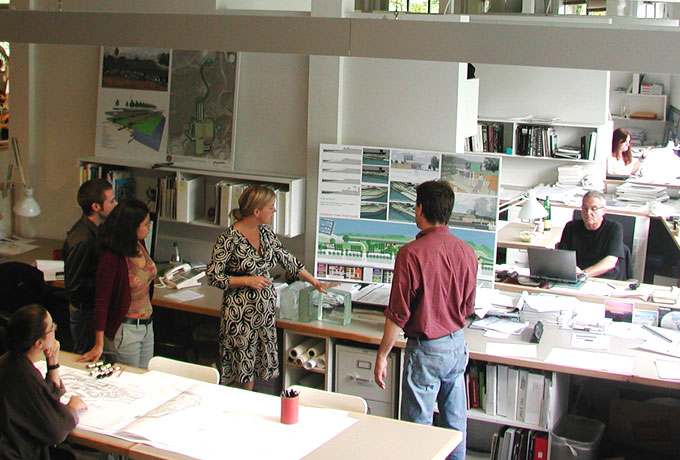
When designers at Sasaki Associates urge clients to pursue green strategies, they can point to successes at their own building in Watertown, Massachusetts, which recently achieved a Gold rating in LEED for Existing Buildings (LEED-EB).

Until LEED-EB was released, according to Meredith Elbaum, AIA, sustainable design director for the firm, it was hard for the company’s internal green team, dubbed GreenLAB, to set priorities for renovations, purchasing decisions, and site maintenance. LEED gave GreenLAB, formed in 2003, a framework and metrics to measure its success.


  • By adopting an open plan, painting ceilings white, and choosing energy-efficient lighting fixtures, GreenLAB reduced electricity usage in the building by 35%. After the changes, the utility company called, wondering if the building’s meter was broken.


  • A 2007 “dumpster dive” showed that 50% of trash could have been recycled. The team also found half-used rolls of toilet paper that the maintenance company had been prematurely replacing. Clarifying the cleaning contract and replacing some paper products with hand dryers cut down on paper waste.


  • Adding renewables to the building seemed like a laudable goal, but consulting engineer Nico Kienzl of Atelier Ten said that “putting renewables on this building would be like putting a hybrid engine in a Hummer!” Sasaki focused on improving energy efficiency instead.


  • GreenLAB decided to use Green Seal-certified paper products. Says Elbaum, “We noticed that one company was putting Green Seal stickers on their boxes. We thought they looked fishy so we checked and, sure enough, they were not certified.”


  • Elbaum notes that pursuing LEED-EB certification is an ongoing process and that Sasaki will need to recertify in 2013 at the latest. She notes that there are three keys to successful LEED certification: the support of top management, the support of the facilities director, and the integration of all of the operations changes into a regular process of evaluation. It’s a lot to stay on top of for a company that occupies a little over 75,000 ft2 (7,000 m2) and, Elbaum says, may require a full-time position.


Published December 31, 1969

(2009, January 2). Do-It-Yourself at Sasaki Associates. Retrieved from https://www.buildinggreen.com/departments/case-study
Add new comment

To post a comment, you need to register for a BuildingGreen Basic membership (free) or login to your existing profile.

