Over 50% of U.S. Population Lives with Unhealthy Ozone Pollution

News Brief

Over 50% of U.S. Population Lives with Unhealthy Ozone Pollution

On May first, the American Lung Association (ALA) reported that 142 million Americans—more than 50% of the population—are now

living in areas with unhealthy levels of ozone air pollution (smog). According to the organization’s

State of the Air 2002 report, a failing grade was received by nearly 400 of the 678 counties that monitor ozone. Of the ten locations with the highest ozone pollution, six are in California (including the top four); the others are the Houston-Galveston-Brazoria, Texas area; Atlanta, Georgia; Knoxville, Tennessee; and the Charlotte-Gastonia-Rock Hill area of North and South Carolina. “It is clearly time to get serious about enforcing all of the provisions of the Clean Air Act so that we place Americans’ health above business and political interests,” said John Kirkwood, ALA president and CEO, in releasing the report. For more information, visit

www.lungusa.org.

Published December 31, 1969

(2002, June 1). Over 50% of U.S. Population Lives with Unhealthy Ozone Pollution. Retrieved from https://www.buildinggreen.com/departments/newsbrief

Add new comment

To post a comment, you need to register for a BuildingGreen Basic membership (free) or login to your existing profile.

Nation's Largest Solar Roof Dedicated in Dublin, CA

News Brief

Nation's Largest Solar Roof Dedicated in Dublin, CA
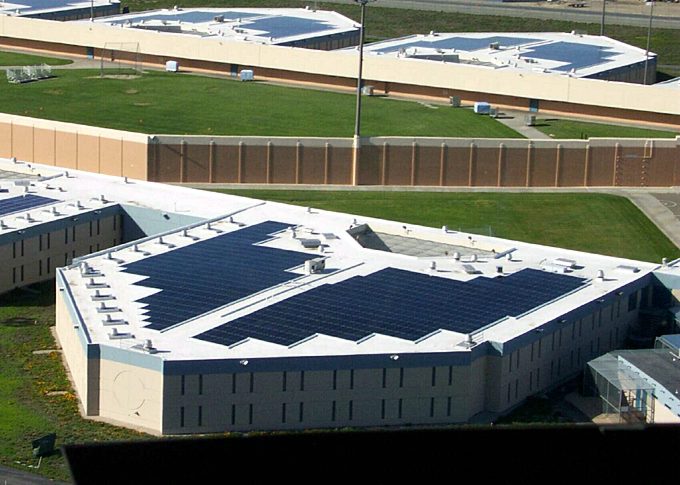
On Earth Day, April 22, the Alameda County Board of Supervisors dedicated

the nation’s largest rooftop solar electric system—located atop the Santa Rita Jail in Dublin, California.

The 1.18 MW photovoltaic (PV) system is an expansion of a 640 kW PV system that was completed in the summer of 2001. The PowerGuard® system, which covers approximately 3 acres (1.2 ha) of the jail’s roof, was built by the PowerLight Corporation of Berkeley. The patented solar roof tiles insulate and protect the roof while generating electricity from sunlight. The PowerGuard tiles are fabricated with PV cells produced by both AstroPower and BP Solar. The system has reduced the jail’s peak summer demand consumption of grid-generated electricity by 35% and is projected to save Alameda County approximately $425,000 per year—or $15 million over the 25-year life of the project. The rooftop system provides enough electricity to power about 1,000 homes.

Published December 31, 1969

(2002, June 1). Nation's Largest Solar Roof Dedicated in Dublin, CA. Retrieved from https://www.buildinggreen.com/departments/newsbrief


Add new comment

To post a comment, you need to register for a BuildingGreen Basic membership (free) or login to your existing profile.

New Hampshire Regulates CO2 from Power Plants

News Brief

New Hampshire Regulates CO2 from Power Plants

Generally not known for regulatory zeal, New Hampshire has become the

first state to regulate carbon dioxide emissions from power plants. On May 9, Gov. Jeanne Shaheen signed into law House Bill 284 (the “Clean Power Act”), establishing limits for carbon dioxide—along with sulfur dioxide, nitrogen oxides, and mercury—emitted by existing fossil-fuel-fired electric power plants. To meet requirements of the Clean Power Act, New Hampshire Public Service Company, owner of the state’s three fossil-fuel power plants, must either install new technology to reduce emissions or purchase emissions credits from other power plants that have already reduced their pollution—or use a combination of the two strategies. The legislation includes incentives for utilities to make their pollution reductions either in the state or nearby—so that New Hampshire residents will benefit from the pollution reductions.

Published December 31, 1969

(2002, June 1). New Hampshire Regulates CO2 from Power Plants. Retrieved from https://www.buildinggreen.com/departments/newsbrief

Add new comment

To post a comment, you need to register for a BuildingGreen Basic membership (free) or login to your existing profile.

Oregon Voters Support Law Restricting Sprawl

News Brief

Oregon Voters Support Law Restricting Sprawl

Portland, Oregon voters have spoken out against modifications to an

Oregon state law restricting urban sprawl. A ballot measure brought by Portland developers called for stripping the local governing body, Metro, of its ability to mandate land-use patterns within Portland. According to the state law, Oregon urban areas must define growth boundaries, protecting rural space that falls outside the boundaries. Through a May 21 vote of 57% against the measure and 43% in favor, Portland residents for the fourth time defeated efforts to weaken or altogether eliminate the law.

Published December 31, 1969

(2002, June 1). Oregon Voters Support Law Restricting Sprawl. Retrieved from https://www.buildinggreen.com/departments/newsbrief

Add new comment

To post a comment, you need to register for a BuildingGreen Basic membership (free) or login to your existing profile.

Battery Park City's Environmental Guidelines

News Brief

Battery Park City's Environmental Guidelines

New York’s Hugh L. Carey Battery Park City Authority (BPCA) has released its “

Commercial/Institutional Environmental Guidelines 1.0,” outlining the requirements for future construction in its jurisdiction on the west side of Lower Manhattan. The Guidelines are based on the U.S. Green Building Council’s LEED™ 2.0 rating system, with changes to fit the New York City context and requirements aimed at achieving a LEED Gold rating. These requirements include the use of DOE 2.1 or an equivalent software tool during design (a service to be provided by BPCA), that photovoltaics and fuel cells significantly contribute to the power supply, that underfloor air delivery be used, that urinals be limited to no-flush models, and that at least 50% of roof areas be vegetated (green roofs).

Published December 31, 1969

(2002, June 1). Battery Park City's Environmental Guidelines. Retrieved from https://www.buildinggreen.com/departments/newsbrief

Add new comment

To post a comment, you need to register for a BuildingGreen Basic membership (free) or login to your existing profile.

Ecological Footprint Calculation at Earthday.net

News Brief

Ecological Footprint Calculation at Earthday.net

A new online tool, produced jointly by the Earth Day Network and Redefining Progress, allows individuals in 58 countries to

calculate their impact on the planet. After completing the 15-question survey, participants learn the size of their ecological footprints in global acres (or hectares), each of which corresponds to one acre (or hectare) of biologically productive land or sea on Earth. The method is an adaptation of that used in

Our Ecological Footprint by Mathis and Wackernagel (see

EBN

Vol. 5, No. 3). The tool also determines the number of Earths that would be required to sustain the current global population at each participant’s standard of living. Michel Gelobter, executive director of Redefining Progress, notes that “If everyone lived like the average American, we would need 5.3 planets to support us.” To determine your own footprint, explore methods of lowering it, or learn more about the tool, visit

www.earthday.net/footprint.stm.

Published December 31, 1969

(2002, May 1). Ecological Footprint Calculation at Earthday.net. Retrieved from https://www.buildinggreen.com/departments/newsbrief

Add new comment

To post a comment, you need to register for a BuildingGreen Basic membership (free) or login to your existing profile.

Atrazine Disrupts Hormones in Frogs

News Brief

Atrazine Disrupts Hormones in Frogs

Atrazine, America’s most common herbicide,

disrupts hormones in frogs, according to findings published in the April 16 issue of

Proceedings of the National Academy of Sciences. The University of California–Berkeley team found lowered testosterone levels and hermaphroditism (possessing both male and female sex organs) in frogs exposed to atrazine levels as low as 0.1 parts per billion (ppb), 30 times lower than the U.S. Environmental Protection Agency (EPA) drinking water limit of 3 ppb. Atrazine levels have been measured at 40 ppb in Midwest rain and river water, and several parts per million in agricultural runoff. Atrazine has been popular in some 80 countries for 40 years as an herbicide on corn, soybeans, and other crops. It has been banned in several European countries and is currently under EPA review. A decision on acceptable levels is expected in August.

Published December 31, 1969

(2002, May 1). Atrazine Disrupts Hormones in Frogs. Retrieved from https://www.buildinggreen.com/departments/newsbrief

Add new comment

To post a comment, you need to register for a BuildingGreen Basic membership (free) or login to your existing profile.

Reorganization at DOE EERE Office

News Brief

Reorganization at DOE EERE Office

The

DOE office of Energy Efficiency and Renewable Energy (EERE) is going through a major restructuring by Assistant Secretary for EERE David Garman. Announced in mid-March and to take effect on May 1, the changes will streamline operations of the office, reducing the number of layers in the EERE hierarchy from as many as eight currently to only four. Thirty-one program offices will be combined into 11: Solar; Wind and Hydropower; Geothermal; Building Technologies; Distributed Energy, Electricity Infrastructure and Reliability; Industrial Technologies; FreedomCAR and Vehicle Technologies; Hydrogen and Infrastructure; Weatherization and Intergovernmental Grants; and Federal Energy Management Program. Garman says there will be no reduction in work force as a result of the reorganization.

Published December 31, 1969

(2002, April 1). Reorganization at DOE EERE Office. Retrieved from https://www.buildinggreen.com/departments/newsbrief

Add new comment

To post a comment, you need to register for a BuildingGreen Basic membership (free) or login to your existing profile.

Ice Shelf in Antarctica Collapses

News Brief

Ice Shelf in Antarctica Collapses

The mammoth

Larson B Ice Shelf in Antarctica has disintegrated, possibly due to global warming, say scientists. According to a Planet Ark story on March 20, scientists at the British Antarctic Survey predicted four years ago that the ice shelf would eventually disintegrate, but they were “astounded by the speed of the breakup.” The 1,250 square-mile (3,250 km2) ice shelf, which is larger than the state of Rhode Island and 650 feet (200 m) thick, disintegrated in less than a month. Because the ice shelf was already floating, its breakup will not raise sea levels, though its departure could hasten the seaward flow of land-based glaciers in Antarctica, which would raise sea levels. The Antarctic Peninsula has warmed by 4.5˚F (2.5˚C) over the past century—far more than other parts of Antarctica or the rest of the world.

Published December 31, 1969

(2002, April 1). Ice Shelf in Antarctica Collapses. Retrieved from https://www.buildinggreen.com/departments/newsbrief

Add new comment

To post a comment, you need to register for a BuildingGreen Basic membership (free) or login to your existing profile.

Production Tax Credit Extended

News Brief

Production Tax Credit Extended

The economic stimulus package signed into law by President Bush on March 9 (the Job Creation and Worker Stimulus Assistance Act of 2002 – H.R. 3090) includes an

extension of the renewable energy production tax credit, which expired at the end of 2001. This 1.5¢/kilowatt-hour (adjusted for inflation) tax credit for production of electricity from wind, solar, biomass, and geothermal sources of energy has been a major factor in the rapid growth of the wind energy industry in the U.S. over the past few years, and its extension was considered critical. The legislation extends the Production Tax Credit retroactively to January 1, 2002 through the end of 2003. Renewable energy proponents are still hoping to enact a five-year extension of the Production Tax Credit as part of the comprehensive energy legislation being debated by Congress.

Published December 31, 1969

(2002, April 1). Production Tax Credit Extended. Retrieved from https://www.buildinggreen.com/departments/newsbrief

Add new comment

To post a comment, you need to register for a BuildingGreen Basic membership (free) or login to your existing profile.