Massachusetts Technology Collaborative Announces Green Buildings Program

News Brief

Massachusetts Technology Collaborative Announces Green Buildings Program

On March 21, the Massachusetts Technology Collaborative (MTC) announced the beginning of their

$14.6 million “Green Buildings Program” that will provide grants for projects throughout the state. The two components of the program are the Green Schools Initiative (in cooperation with the Department of Education) and the Green Buildings Initiative for commercial and institutional projects. Grants of up to $500,000 per project will be awarded for feasibility studies, design and construction assistance, or public awareness and education. Funding will come from the $150 million Renewable Energy Trust established by the State Legislature in 1998. MTC executive director Mitchell Adams sees great potential in the new program: “This financing offers a powerful incentive that will lead to some of the most energy-efficient buildings ever constructed in Massachusetts.” For more information, call MTC at 508/898-9226 or visit their Web site at

www.mtpc.org.

Published December 31, 1969

(2002, April 1). Massachusetts Technology Collaborative Announces Green Buildings Program. Retrieved from https://www.buildinggreen.com/departments/newsbrief

Add new comment

To post a comment, you need to register for a BuildingGreen Basic membership (free) or login to your existing profile.

Energy and Water Use Lower in Civano

News Brief

Energy and Water Use Lower in Civano

Studies conducted by Al Nichols Engineering, Inc., an independent engineering firm, show that

energy and water use in houses at the Community of Civano (see

EBN

Vol. 9, No. 7) is significantly lower than that of typical area homes. Energy use in houses at Civano for the 12-month period ending August 31, 2001 is 50% lower than a baseline of energy usage during 1998 and 1999 in Tucson homes built to meet the 1995 Model Energy Code. Civano homeowners saved between $533 to $781, or about $54 per month, on their energy use during this time. For the 12-month period ending July 1, 2001, water use was 65% lower than the baseline of water usage in average Tucson homes during August 2000. To achieve these savings, the public areas and many of the Civano homes use reclaimed water for landscape irrigation, 15 of the 150 homes now built in Civano were constructed with rainwater collection systems, and xeriscape design and permaculture are used for individual homes and public areas.

Published December 31, 1969

(2002, April 1). Energy and Water Use Lower in Civano. Retrieved from https://www.buildinggreen.com/departments/newsbrief


Add new comment

To post a comment, you need to register for a BuildingGreen Basic membership (free) or login to your existing profile.

UK's First Cardboard Building

News Brief

UK's First Cardboard Building

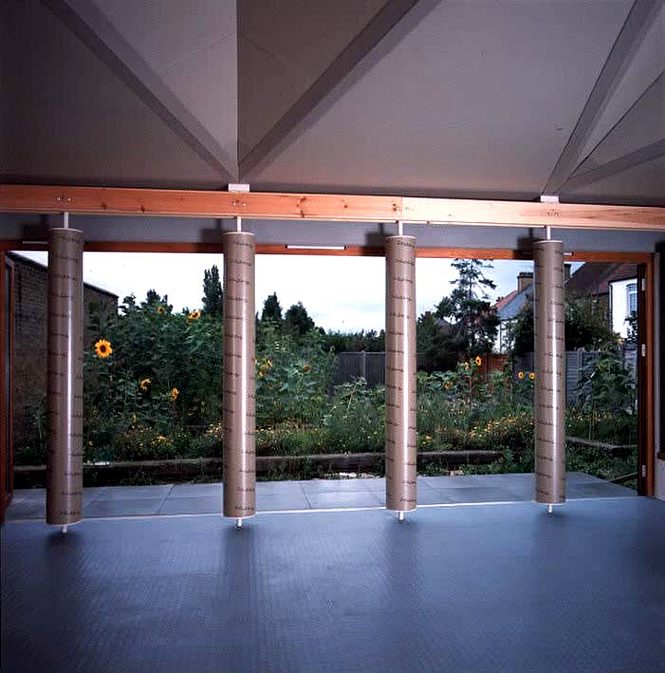
The Westborough Primary School in Westcliff-on-Sea, Essex, has just completed the

United Kingdom’s first cardboard building.

Buro Happold Engineers collaborated with Cottrell & Vermeulen Architecture to create the single-story, 20- by 50-foot (6 x 15 m) structure, which will serve as a meeting space and teaching tool for the town’s after-school club. The cardboard building is constructed largely of honeycomb-sandwiched panels and tubes, which serve as support columns, demonstrating that cardboard is a versatile and stalwart construction material. The oft-presumed threat of fire is thwarted by natural properties of the dense material, causing it to react to flame much as solid timber does; the cardboard is also treated with a fire-retardant and waterproofing varnish. Ninety percent of the materials in this building were recycled and, at the end of its anticipated 20-year life span, 90% will be recyclable. For more information, look online at

www.cardboardschool.co.uk.

Published December 31, 1969

(2002, April 1). UK's First Cardboard Building. Retrieved from https://www.buildinggreen.com/departments/newsbrief
Add new comment

To post a comment, you need to register for a BuildingGreen Basic membership (free) or login to your existing profile.

Immaculate Heart of Mary Sisters' Motherhouse Undergoes Green Renovation

News Brief

Immaculate Heart of Mary Sisters' Motherhouse Undergoes Green Renovation

The Sisters, Servants of the Immaculate Heart of Mary (IHM), have begun

a multimillion-dollar “green” renovation of their 1930s Motherhouse in Monroe, Michigan. The building serves as a retirement and healthcare facility for 250 of their senior members. The completed renovation, expected in 2003, will feature increased daylighting, a geothermal heating and cooling system, and energy-efficient lighting. The surrounding 280-acre (110 ha) campus is also being overhauled. Extensive native landscaping will employ indigenous plants and include a 5-acre (2 ha) meadow savanna. One of the most innovative changes will be the introduction of a graywater recycling system. Separate pipes will route water from sinks and showers through an emergent marsh, pond, and wet meadow before it is finally chlorinated, marked with blue dye, and reused to flush toilets throughout the facility. The renovated Motherhouse is expected to use 55% less water than the original facility. For details, see the IHM Web site:

www.ihmsisters.org/future-motherhouse.html.

Published December 31, 1969

(2002, April 1). Immaculate Heart of Mary Sisters' Motherhouse Undergoes Green Renovation. Retrieved from https://www.buildinggreen.com/departments/newsbrief

Add new comment

To post a comment, you need to register for a BuildingGreen Basic membership (free) or login to your existing profile.

Presentation Proposals for GBC's Conference & Exposition Due

News Brief

Presentation Proposals for GBC's Conference & Exposition Due

Presentation proposals for the U.S. Green Building Council’s

First International Conference & Exposition (November 13–15, 2002) are due by April 1. Visit

www.usgbc.org to submit an abstract.

Published December 31, 1969

(2002, March 1). Presentation Proposals for GBC's Conference & Exposition Due. Retrieved from https://www.buildinggreen.com/departments/newsbrief

Add new comment

To post a comment, you need to register for a BuildingGreen Basic membership (free) or login to your existing profile.

SIP Problems in Juneau

News Brief

SIP Problems in Juneau

Houses built with

structural insulated panels (SIPs) are failing in Juneau, Alaska at an alarming rate. Failure is typically occurring at the roof peak, where the well-insulated, thick expanded polystyrene SIPs join. This problem was first publicized in the January 2002 issue of the

Journal of Light Construction. According to SIP expert Steve Andrews, who has investigated the problems, one issue is Juneau’s extremely wet and cold climate. With an average of 200 rainy days per year, producing more than 90 inches (230 cm) of rain, the city has just 36% sunshine (compared with 43% in Erie, Pennsylvania—the cloudiest location in the Lower 48) and over 9,000 (Fahrenheit) heating degree days (5,000°C HDD). Initial investigations show that most failing SIPs were installed without proper foam sealing or a separate polyethylene air/vapor barrier.

Published December 31, 1969

(2002, March 1). SIP Problems in Juneau. Retrieved from https://www.buildinggreen.com/departments/newsbrief

Add new comment

To post a comment, you need to register for a BuildingGreen Basic membership (free) or login to your existing profile.

Landscape Architecture Survey

News Brief

Landscape Architecture Survey

Meg Calkins of the University of Illinois at Urbana Champaign, in cooperation with the American Society of Landscape Architects (ASLA), is conducting a

survey of landscape architects to find out about their involvement in green building projects. The researchers are especially interested in identifying barriers and obstacles to more effective implementation of green practices in landscape design. To access the online survey, go to

www.asla.org/members/survey/survey.html.

Published December 31, 1969

(2002, March 1). Landscape Architecture Survey. Retrieved from https://www.buildinggreen.com/departments/newsbrief

Add new comment

To post a comment, you need to register for a BuildingGreen Basic membership (free) or login to your existing profile.

Bush's Global Warming Initiative

News Brief

Bush's Global Warming Initiative

President Bush unveiled his long-awaited

global warming initiative on February 14. Rather than seeking to cap (or reduce) actual greenhouse gas emissions, the initiative calls for a reduction in “greenhouse gas intensity”—the amount of greenhouse gases produced per dollar of gross domestic product (GDP). Specifically, the plan calls for an 18% reduction in this greenhouse gas intensity over the next 10 years—from 183 metric tons per million dollars of GDP to 151 metric tons per million dollars of GDP. This reduction would be achieved through voluntary emissions reductions, advances in energy technologies, and tax credits for various renewable energy and energy-efficient technologies. According to the Natural Resources Defense Council, however, the reduction in greenhouse gas intensity would probably happen anyway, since our economy has been getting more energy-efficient for years. From 1990 to 2000, the U.S. greenhouse gas emission intensity fell by 17.4%. The Sierra Club says that under the Bush plan, total U.S. greenhouse gas emissions in 2010 will exceed by 36% what would have been permitted under the Kyoto treaty.

Published December 31, 1969

(2002, March 1). Bush's Global Warming Initiative. Retrieved from https://www.buildinggreen.com/departments/newsbrief

Add new comment

To post a comment, you need to register for a BuildingGreen Basic membership (free) or login to your existing profile.

PV Update - 2001

News Brief

PV Update - 2001

2001 was a good year for the

photovoltaics (PV) industry. World cell/module production jumped 36% from 288 to 391 peak megawatts (MW), according to the March 2002 issue of

PV News. Since 1994, growth in world PV production has increased 460%! In the U.S., PV production grew 33.8% in 2001, from 75 to 100 MW. The three largest producers in the U.S. in 2001 were Siemens Solar (now Shell Solar) at 39 MW, AstroPower at 26 MW, and Solarex (part of BP Solar) at 25 MW. For information about

PV News, visit

www.pvenergy.com.

Published December 31, 1969

(2002, March 1). PV Update - 2001. Retrieved from https://www.buildinggreen.com/departments/newsbrief

Add new comment

To post a comment, you need to register for a BuildingGreen Basic membership (free) or login to your existing profile.

Shell Buys Siemens Solar

News Brief

Shell Buys Siemens Solar

Shell Renewables

, one of five core businesses of the Royal Dutch/Shell Group, has acquired that portion of the old

Siemens Solar Industries that they did not already own. In March 2001, Siemens AG sold a portion of their photovoltaic (PV) subsidiary, entering into a joint venture comprised of Siemens, E.ON Energie AG, and Shell. Each of those partners owned about a third of the venture, which was known as Siemens und Shell Solar GmbH. The new business, owned 100% by Shell, will be known as

Shell Solar. It will remain headquartered in Camarillo, California and will control about 15% of the global PV market.

Published December 31, 1969

(2002, February 1). Shell Buys Siemens Solar. Retrieved from https://www.buildinggreen.com/departments/newsbrief

Add new comment

To post a comment, you need to register for a BuildingGreen Basic membership (free) or login to your existing profile.

