Ocean Surface Waters Are Warming Near Equator

News Brief

Ocean Surface Waters Are Warming Near Equator

Ocean

surface waters near the equator are warming at an “alarming” rate, according to analysis by the National Oceanic and Atmospheric Administration (NOAA) released on July 28. Between 1984 and 1996, water temperatures have risen approximately 0.1°F (0.056°C) per year, which the researchers say is far more than can be explained by atmospheric warming. If this trend continues, coral reefs will be damaged severely, say the researchers.

Published December 31, 1969

(2000, September 1). Ocean Surface Waters Are Warming Near Equator. Retrieved from https://www.buildinggreen.com/departments/newsbrief

Add new comment

To post a comment, you need to register for a BuildingGreen Basic membership (free) or login to your existing profile.

Global Coal Initiative to Research Clean Technologies

News Brief

Global Coal Initiative to Research Clean Technologies

In announcing a

Global Coal Initiative to research clean coal technologies, the Electric Power Research Institute forecasts a fourfold increase in worldwide power demand by 2050. “Meeting this estimated demand will require the equivalent of building a new 1,000-megawatt power plant somewhere in the world every two days for 50 years,” according to an August 2 press release. The research will focus on both near-term issues around coal combustion and on advanced coal power plants that will be able to generate electricity from coal “with virtually no air pollutant by-products—and with negligible or no net emissions of carbon dioxide.” For more on EPRI’s work with technology development, visit

www.epri.com/destinations/.

Published December 31, 1969

(2000, September 1). Global Coal Initiative to Research Clean Technologies. Retrieved from https://www.buildinggreen.com/departments/newsbrief

Add new comment

To post a comment, you need to register for a BuildingGreen Basic membership (free) or login to your existing profile.

Study Attempts to Quantify Impacts of LEED

News Brief

Study Attempts to Quantify Impacts of LEED

A study commissioned by the City of Portland, Oregon attempts to quantify the impacts of applying the LEED Rating System to city buildings. Allen Lee and his associates at XENERGY, Inc. examined three relatively new buildings and found that they could have achieved 32 LEED points (the minimum number required in the LEED 2.0 ballot version) with little or no increase in first cost. They found that the LEED measures would have reduced life-cycle costs to the city. Beyond these quantifiable savings, worker productivity and broader societal benefits were also found to be very significant. The full report can be downloaded from www.ci.portland.or.us/energy/reports.htm, or contact Rob Bennett, Portland’s Green Building Initiative manager, at 503/823-7725.


Published December 31, 1969

(2000, September 1). Study Attempts to Quantify Impacts of LEED. Retrieved from https://www.buildinggreen.com/departments/newsbrief

Add new comment

To post a comment, you need to register for a BuildingGreen Basic membership (free) or login to your existing profile.

Lowe's Releases Statement on Wood Purchasing Policies

News Brief

Lowe's Releases Statement on Wood Purchasing Policies

Newsbriefs

On August 8, after lengthy consultation with a number of environmental groups,

Lowe’s Companies, Inc. released a progressive statement on its wood purchasing policies. Among other measures, the policy aims to identify ancient forests and eliminate wood purchases from them, and to discourage conversion of native forests to plantations. The statement specifically identifies the Forest Stewardship Council as the company’s preferred certification scheme: “FSC certification will be given preference over other certification systems.” With 1999 sales of $15.9 billion, Lowe’s is the world’s second largest home improvement retailer. Number one, Home Depot, made a similar commitment last year (see

EBN

Vol. 8, No. 9).

Published December 31, 1969

(2000, September 1). Lowe's Releases Statement on Wood Purchasing Policies. Retrieved from https://www.buildinggreen.com/departments/newsbrief

Add new comment

To post a comment, you need to register for a BuildingGreen Basic membership (free) or login to your existing profile.

Gainesville's Trees Save Energy

News Brief

Gainesville's Trees Save Energy

Recent doctoral work in geography by Ryan Jensen at the University of Florida-Gainesville revealed that the city of Gainesville has twice the leaf coverage of the nearby city of Ocala. When Jensen then checked average utility bills from the two cities, he found that Ocala residents were paying $126 more per year than Gainesville residents. While several factors could be involved in this effect—the ratio of apartments to single-family homes is higher in Gainesville, for example, and Ocala is a bit further south—researchers feel certain that

urban tree coverage is a significant contributor to these energy results. The analytical computing technique that Jensen used involves artificial neural networks that mimic biological systems. This technique would have to be modified for use in other cities with different types of tree coverage.

Published December 31, 1969

(2000, September 1). Gainesville's Trees Save Energy. Retrieved from https://www.buildinggreen.com/departments/newsbrief

Add new comment

To post a comment, you need to register for a BuildingGreen Basic membership (free) or login to your existing profile.

LEED Residential Update

News Brief

LEED Residential Update

The U.S. Green Building Council’s success with a green building rating system for commercial buildings has led to the formation of a task force to develop a residential LEED system. Approximately 40 experts in energy-efficiency, indoor air quality, materials, and sustainable land development recently met at the Johnson Foundation’s Wingspread conference facility in Racine, Wisconsin to develop the first draft of the residential program. A key aspect of this program’s development—an element that LEED for commercial buildings did not have to address—will be the relationship between any residential LEED system and the many existing local and regional green building programs, as well as national programs such as ALA’s Health House. Work on the LEED-R program criteria will continue over the next six to nine months. For more information look online at www.usgbc.org or call the Council’s transitional Washington, D.C. office at 202/429-2081 (good through September).


Published December 31, 1969

(2000, September 1). LEED Residential Update. Retrieved from https://www.buildinggreen.com/departments/newsbrief

Add new comment

To post a comment, you need to register for a BuildingGreen Basic membership (free) or login to your existing profile.

Hilliard House in Henrico County, VA

News Brief

Hilliard House in Henrico County, VA

Newsbriefs

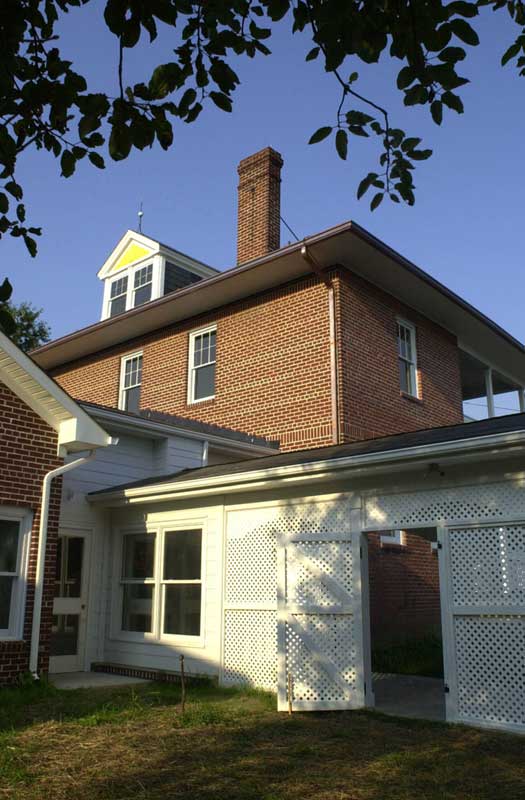
On July 25, 2000, the Henrico Community Housing Corporation in Virginia celebrated the opening of Hilliard House, a transitional housing facility near Richmond for up to 30 women and children. Thanks largely to the efforts of HCHC Board President Karl Bren,

Hilliard House is also a distinctly green project. The $1.2 million project included the renovation of an existing house and barn, and the construction of four new structures. “The green features are an integral part of our overall program design of healing and respect for all living things,” notes Bren. Everything from site protection during construction and native landscaping to energy efficiency, low-toxicity materials, and water conservation was included in the facility. For more details, contact Elizabeth Palen, executive director, at 804/261-0818, or HCHcorp@aol.com.

Published December 31, 1969

(2000, September 1). Hilliard House in Henrico County, VA. Retrieved from https://www.buildinggreen.com/departments/newsbrief

Add new comment

To post a comment, you need to register for a BuildingGreen Basic membership (free) or login to your existing profile.

Climate Neutral Mortgage from UK

News Brief

Climate Neutral Mortgage from UK

A British mortgage lender, Norwich and Peterborough Building Society (N&P), has teamed up with the environmental group Future Forests to make its green mortgage “climate neutral.” Homes must have a Standard Assessment Procedure rating of 80 or greater to qualify (80 out of 100 in an energy rating program similar to our HERS). N&P, through Future Forests, plants 8 trees per year for 5 years to offset the estimated carbon dioxide production associated with the home’s operation (at the end of five years, homeowners are given the option of continuing the relationship with Future Forests and their plantings and forest maintenance). The estimates on carbon dioxide production are based in large part on work done by the Edinburgh Centre for Carbon Management. Future Forests was established in 1989 and works with companies including Mazda, Avis, and Fiat. Trees are planted in new and established forests all over Great Britain, and plans have been developed to support plantings in selected areas of Guatemalan rainforest.


Published December 31, 1969

(2000, September 1). Climate Neutral Mortgage from UK. Retrieved from https://www.buildinggreen.com/departments/newsbrief


Add new comment

To post a comment, you need to register for a BuildingGreen Basic membership (free) or login to your existing profile.

Plum Creek Timber Acquires The Timber Company

News Brief

Plum Creek Timber Acquires The Timber Company

Plum Creek Timber Company

, based in Seattle, announced on July 18 an agreement to acquire

The Timber Company—the division of Georgia-Pacific that has owned and managed all 4.4 million acres (1.8 million ha) of G-P’s timberland. The combined company, with 7.9 million acres (3.2 million ha), will be the second-largest private timberland owner in the U.S. The transaction is valued at approximately $4 billion, including $1 billion of The Timber Company debt, and is expected to be completed in early 2001. Plum Creek was the first company to have 100% of its land third-party-certified under the Sustainable Forestry Initiative (a less rigorous, industry-managed, certification program than that developed by the Forest Stewardship Council).

Published December 31, 1969

(2000, July 1). Plum Creek Timber Acquires The Timber Company. Retrieved from https://www.buildinggreen.com/departments/newsbrief
Add new comment

To post a comment, you need to register for a BuildingGreen Basic membership (free) or login to your existing profile.

Sustainability in Architectural Education

News Brief

Sustainability in Architectural Education

On June 30, 2000 two dozen representatives of various design-related organizations (joined by deans from some of the nation’s leading architecture schools via video teleconference) met at the World Resources Institute in Washington, D.C. to discuss

sustainability in architectural education. The event was organized by The American Institute of Architects’ Committee on the Environment and WRI, and included a panel discussion sponsored by

Architectural Record magazine. A model for the discussion was research conducted by WRI on environmental education at business schools, which suggests that at least some schools are highly responsive to public rankings of their green performance. Topics of debate included whether sustainable design is best taught in classes dedicated to that subject or integrated into standard design studies, and whether there is merit to ensuring that students master basic design skills before introducing them to the raft of environmental considerations. An interesting twist suggested by Rosalie Genevro of the Architectural League of New York, and reinforced by others, is that what the U.S. design profession really lacks is creative mechanical engineers! It was noted that since World War II, engineering education in the U.S. has focused on industrial applications, and thus mechanical engineers learn only about equipment, while in Europe engineers are still taught about the buildings themselves.

Published December 31, 1969

(2000, July 1). Sustainability in Architectural Education. Retrieved from https://www.buildinggreen.com/departments/newsbrief

Add new comment

To post a comment, you need to register for a BuildingGreen Basic membership (free) or login to your existing profile.

