EcoSmart Healthy Properties Folds

News Brief

EcoSmart Healthy Properties Folds

EcoSmart Healthy Properties

, LLC, which provided consulting and marketing services for green building in the commercial and hospitality sectors and operated a showroom for green products on Wall Street in New York City, has ceased operations. At press time, details about the reasons for the closure and possible future plans were unavailable.

Published December 31, 1969

(2000, January 1). EcoSmart Healthy Properties Folds. Retrieved from https://www.buildinggreen.com/departments/newsbrief

Add new comment

To post a comment, you need to register for a BuildingGreen Basic membership (free) or login to your existing profile.

ED&C New Editor

News Brief

ED&C New Editor

Kristin Ralff Douglas

has left her position as Managing Director of the U.S. Green Building Council to take over as editor of

Environmental Design and Construction magazine. Douglas replaces John Sailor, who initiated the magazine and led it through its successful first two years.

Published December 31, 1969

(2000, January 1). ED&C New Editor. Retrieved from https://www.buildinggreen.com/departments/newsbrief

Add new comment

To post a comment, you need to register for a BuildingGreen Basic membership (free) or login to your existing profile.

Results of IAQ Industry Survey

News Brief

Results of IAQ Industry Survey

A survey of

comments from key players in the IAQ industry published in the January 2000 issue of

IEQ Strategies reveals some interesting trends. Asthma, especially in children, is seen as an increasingly important health issue related to IAQ. Overall, the importance of VOCs and tobacco smoke as air quality issues is declining, while concern about moisture-related problems, including mold and other microbials, is increasing.

Published December 31, 1969

(2000, January 1). Results of IAQ Industry Survey. Retrieved from https://www.buildinggreen.com/departments/newsbrief

Add new comment

To post a comment, you need to register for a BuildingGreen Basic membership (free) or login to your existing profile.

How Will NJ Spend $1 Billion from "Societal Benefits Charges"?

News Brief

How Will NJ Spend $1 Billion from "Societal Benefits Charges"?

Final details are expected in February on how over $1 billion that will be collected by the New Jersey electric utility industry over the next eight years from “

Societal Benefits Charges” will be spent. The electric restructuring legislation passed in 1999 calls for about three-quarters of the money to go to energy efficiency measures and the remainder to support clean energy technologies. The energy portion will be used to subsidize the cost of fuel cells and renewable energy technologies such as wind and solar by 50% to 60%, according to Ashok Gupta of the Natural Resources Defense Council in New York.

Published December 31, 1969

(2000, January 1). How Will NJ Spend $1 Billion from "Societal Benefits Charges"?. Retrieved from https://www.buildinggreen.com/departments/newsbrief

Add new comment

To post a comment, you need to register for a BuildingGreen Basic membership (free) or login to your existing profile.

Affordable Housing Projects Web site

News Brief

Affordable Housing Projects Web site

The City Design Center at the University of Illinois at Chicago is seeking entries for Design Matters, an Internet catalog of

affordable housing projects built since 1985 that demonstrate high quality and value to their occupants and to society at large. Projects will be selected by the Center and its nationwide advisory team based on a range of criteria, including life-cycle costs, aesthetics, accessibility, safety, adaptability, energy efficiency and resource efficiency. Details at affordablehousing.aa.uic.edu, or send a fax to 312/996-2076 requesting information.

Published December 31, 1969

(2000, January 1). Affordable Housing Projects Web site. Retrieved from https://www.buildinggreen.com/departments/newsbrief

Add new comment

To post a comment, you need to register for a BuildingGreen Basic membership (free) or login to your existing profile.

Burning of Household Trash Releases Many Toxins

News Brief

Burning of Household Trash Releases Many Toxins

According to an article in the January 4 edition of the

New York Times, the

backyard burning of household trash may release more dioxins and furans into the atmosphere than are released by all of the nation’s municipal incinerators. An estimated 20 million people in the U.S. burn their trash in uncontrolled backyard incinerators. A single such barrel may release more of these highly toxic chlorinated compounds than a municipal incinerator serving tens of thousands of households, according to the article. The research was conducted by the U.S. Environmental Protection Agency’s Open Burning Test Facility in Research Triangle Park, North Carolina and will be reported fully in the February issue of the journal

Environmental Science & Technology. The research also indicated that recycling may worsen this problem—with recyclables taken out of the waste stream, the remaining trash has a higher concentration of materials containing chlorine, such as PVC plastics.

Published December 31, 1969

(2000, January 1). Burning of Household Trash Releases Many Toxins. Retrieved from https://www.buildinggreen.com/departments/newsbrief


Add new comment

To post a comment, you need to register for a BuildingGreen Basic membership (free) or login to your existing profile.

Stratospheric Ozone Levels Over Europe Have Dropped

News Brief

Stratospheric Ozone Levels Over Europe Have Dropped

The European Space Agency reported in early December that

stratospheric ozone levels over parts of Belgium, Britain, The Netherlands, and Scandinavia have dropped significantly—though not as low as levels above the Antarctic. Measurements taken in The Netherlands found localized ozone levels to be two-thirds below the norm for this time of year, according to a December 3 article from Reuters. Stratospheric ozone blocks the most damaging ultraviolet radiation; with loss of ozone, skin cancer rates have increased. Though ozone levels are projected to begin recovering within a few years due to reduced emissions of ozone-depleting substances already achieved, non-governmental organizations have been critical of the United Nations for not acting more aggressively to ban the fumigant methyl bromide, which is significantly more destructive of ozone than HCFCs.

Published December 31, 1969

(2000, January 1). Stratospheric Ozone Levels Over Europe Have Dropped. Retrieved from https://www.buildinggreen.com/departments/newsbrief
Add new comment

To post a comment, you need to register for a BuildingGreen Basic membership (free) or login to your existing profile.

NFRC Standardizing Energy Performance Reporting for Windows

News Brief

NFRC Standardizing Energy Performance Reporting for Windows

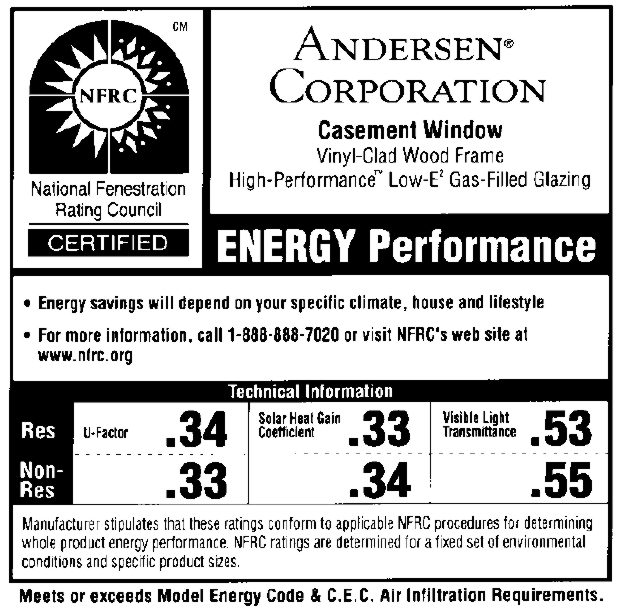
The National Fenestration Rating Council (NFRC) is taking some significant steps forward in its efforts to standardize

energy performance reporting for windows. Most recently, the Council has determined that, as of January 2000, participating manufacturers will be required to certify solar heat gain coefficient and visible light transmittance for all products submitted for certification. Until now only U-value information has been required. Earlier in the year the NFRC updated its comprehensive

Certified Products Directory and approved a procedure for rating and certifying the performance of site-built products. This last change allows the rating system to include many site-glazed systems used in commercial buildings. The NFRC can be reached at 301/589-6372, or on the Web at

www.nfrc.org.

Published December 31, 1969

(2000, January 1). NFRC Standardizing Energy Performance Reporting for Windows. Retrieved from https://www.buildinggreen.com/departments/newsbrief

Add new comment

To post a comment, you need to register for a BuildingGreen Basic membership (free) or login to your existing profile.

Increase in Rate of Loss of Open Space to Development

News Brief

Increase in Rate of Loss of Open Space to Development

The

rate at which open space is being lost to development has more than doubled since 1992, according to a report released by the U.S. Department of Agriculture’s Natural Resources Conservation Service (NRCS) in early November. During the decade 1982 to 1992 and excluding Alaska, 13.9 million acres (5.6 million ha) were converted from farmland, forest, and wetland to development in the U.S., while during the five-year period of 1992–97, almost 16 million acres (6.5 million ha) were developed. The states of Texas, Pennsylvania, Georgia, Florida, and North Carolina lead the nation in land converted to development since 1992. The dramatic increase in developed land is particularly surprising in Pennsylvania, where 1.1 million acres (0.45 million ha) were developed between 1992 and 1997 while the population increased by only 6,000 people (0.05%) from 1992 to 1998. Nationwide, an average of 3.2 million acres (1.3 million ha) of open space were developed annually between 1992 and 1997, compared with 1.4 million acres (0.57 million ha) per year between 1982 and 1992. For more information, visit the NRCS 1997 National Resources Inventory web site:

www.nhq.nrcs.usda.gov.

Published December 31, 1969

(2000, January 1). Increase in Rate of Loss of Open Space to Development. Retrieved from https://www.buildinggreen.com/departments/newsbrief

Add new comment

To post a comment, you need to register for a BuildingGreen Basic membership (free) or login to your existing profile.

Palmade, CA Will Purchase Power from Renewable Sources

News Brief

Palmade, CA Will Purchase Power from Renewable Sources

In other

green power news, the city of Palmdale, California has announced that it is following Santa Monica’s lead (see EBN

Vol. 8, No. 6, p. 3) in purchasing its municipal power from renewable sources. Green electricity will be purchased from Commonwealth Energy Corporation in Tustin, California.

Published December 31, 1969

(2000, January 1). Palmade, CA Will Purchase Power from Renewable Sources. Retrieved from https://www.buildinggreen.com/departments/newsbrief

Add new comment

To post a comment, you need to register for a BuildingGreen Basic membership (free) or login to your existing profile.
