Smithsonian Exhibit on Solar Power

News Brief

Smithsonian Exhibit on Solar Power

function pop(URL){

win = window.open(URL, "win", "toolbar=no,location=no,directories=no,status=no,menubar=no,scrollbars=yes,resizable=yes,width=740,height=500");

win.focus();

}

Newsbriefs
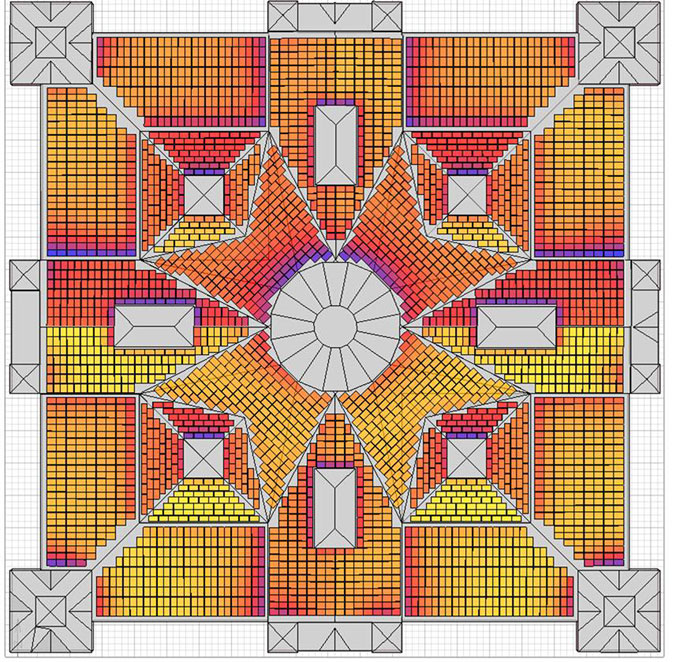
The Smithsonian Institution has opened an outdoor exhibit showing off

the technology, science, and art of solar power. The show, “Under the Sun: An Outdoor Exhibition of Light,” will run through September 6 at the Enid A. Haupt Garden at 1000 Independence Ave. SW in Washington, D.C. Following the show in Washington, the exhibit will begin a two-year tour. Among the exhibit highlights are a solar glass pavilion that uses photovoltaic (PV) power to operate the ventilation and lighting systems, a 25-foot diameter (8 m) sundial and 24-hour clock, and a solar fountain with PV cells artfully installed on a sculptural curved surface. Organized by Cooper-Hewitt National Design Museum with support from the U.S. Department of Energy and BP Solarex, the exhibit first opened in New York City (see

EBN Vol. 7, No. 4, p. 6).

Published December 31, 1969

(1999, July 1). Smithsonian Exhibit on Solar Power. Retrieved from https://www.buildinggreen.com/departments/newsbrief

Add new comment

To post a comment, you need to register for a BuildingGreen Basic membership (free) or login to your existing profile.

Sales of CFLs Increasing

News Brief

Sales of CFLs Increasing

Worldwide sales of

compact fluorescent lamps (CFLs) are increasing. According to the World Resources Institute report

Vital Signs, CFL sales increased 24% during 1997—to 356 million. CFL sales are increasing 3% to 5% per year, though they still only represent 128 the sales volume of incandescent lamps. However, due to the longer life of CFLs, they now represent 26% of the combined light output of the two light sources. While North America and Western Europe accounted for 70% of CFL sales worldwide in 1992, these two markets account for only half today.

Published December 31, 1969

(1999, July 1). Sales of CFLs Increasing. Retrieved from https://www.buildinggreen.com/departments/newsbrief

Add new comment

To post a comment, you need to register for a BuildingGreen Basic membership (free) or login to your existing profile.

Email Forums Expanding

News Brief

Email Forums Expanding

E-mail Forums Expanding

The e-mail discussion group on green building, cosponsored by

EBN, Iris Communications, and CREST, has been going strong since September 1996. The number of participants has been surprisingly stable at just over 500, including subscribers to the digest version, which compiles all the day’s posts into one long message. Complete archives from this list are available (and searchable!) at

www. crest.org, under “Discussion Groups.”

Now a separate e-mail group has formed to focus explicitly on environmental issues affecting large buildings. This discussion is sponsored by Drew George, along with

EBN and Iris. At press time, this list is only a few weeks old but already has over 60 participants. Instructions for joining both lists can be found on the E Build Web site:

www.BuildingGreen.com.

Published December 31, 1969

(1999, July 1). Email Forums Expanding. Retrieved from https://www.buildinggreen.com/departments/newsbrief

Add new comment

To post a comment, you need to register for a BuildingGreen Basic membership (free) or login to your existing profile.

New Fluorescent Lamp Disposal Ruling from EPA

News Brief

New Fluorescent Lamp Disposal Ruling from EPA

On June 28, the U.S. Environmental Protection Agency issued

a new rule regarding the disposal of fluorescent lamps. Under the new rule, fluorescent lamps will be treated as “universal waste,” a designation that will reduce the regulatory burden on businesses that generate such wastes. EPA issued the first universal waste rule in 1995 to streamline environmental regulations for wastes produced in relatively small quantities by large numbers of businesses. The universal waste rules reduce the amount of hazardous waste reaching municipal landfills and incinerators by encouraging greater recycling and proper disposal. Standards for storing, transporting, and collecting universal wastes will be less burdensome for businesses, but the hazardous waste requirements for recycling, treatment, or disposal must be complied with fully, according to the EPA. Fluorescent lamps contain small quantities of mercury. Each lamp contains just a tiny amount, but about a billion of the lamps are disposed of annually in the United States. For more information, visit the EPA Web site (www.epa.gov) and look under “Laws and Regulations,” or call the RCRA Hotline at 800/424-9346 or 703/412-9810. For recycling options, contact the newly formed Association of Lighting and Mercury Recyclers at 707/942-2197.

Published December 31, 1969

(1999, July 1). New Fluorescent Lamp Disposal Ruling from EPA. Retrieved from https://www.buildinggreen.com/departments/newsbrief

Add new comment

To post a comment, you need to register for a BuildingGreen Basic membership (free) or login to your existing profile.

Kyocera buys Golden Genesis PV merger

News Brief

Kyocera buys Golden Genesis PV merger

Photovoltaic manufacturer

Kyocera International has acquired

Golden Genesis Company (previously Photocomm), creating the world’s largest PV manufacturer/system provider. Total annual sales will exceed $1 billion. Kyocera is headquartered in Kyoto, Japan.

Published December 31, 1969

(1999, July 1). Kyocera buys Golden Genesis PV merger. Retrieved from https://www.buildinggreen.com/departments/newsbrief

Add new comment

To post a comment, you need to register for a BuildingGreen Basic membership (free) or login to your existing profile.

Y2K Environmental Problems

News Brief

Y2K Environmental Problems

Lots of little glitches keep popping up during

testing for Y2K preparedness. One recent glitch was not so little. In the San Fernando Valley of California, 4 million gallons (15 million l) of raw sewage were spilled onto a 10-acre (4 ha) section of the Sepulveda Dam Recreation Area when a gate controlling sewage transfer from a main pipeline was accidentally closed—a malfunction traced to a programming error made in 1985. Fortunately, there was no release of sewage into the Los Angeles River.

Published December 31, 1969

(1999, July 1). Y2K Environmental Problems. Retrieved from https://www.buildinggreen.com/departments/newsbrief

Add new comment

To post a comment, you need to register for a BuildingGreen Basic membership (free) or login to your existing profile.

US Wind Power Goal Announced

News Brief

US Wind Power Goal Announced

On June 21, U.S. Energy Secretary Bill Richardson announced a goal of meeting 5% of the nation’s electricity needs with

wind energy by 2020. The target calls for 5,000 MW of wind power capacity to be installed by 2005, and 10,000 MW to be installed by 2010. “Wind energy has been the fastest growing source of energy in the world during the past decade,” Richardson said at the opening session of the American Wind Energy Association’s annual conference in Burlington, Vermont, “and now represents a major economic opportunity for the United States.” As part of the

Wind Powering America initiative, nearly $1.2 million in wind power grants were announced by Richardson for projects in ten states. For details, visit the Web site:

www.eren.doe.gov/windpoweringamerica.

Published December 31, 1969

(1999, July 1). US Wind Power Goal Announced. Retrieved from https://www.buildinggreen.com/departments/newsbrief

Add new comment

To post a comment, you need to register for a BuildingGreen Basic membership (free) or login to your existing profile.

TX Restructuring Mandates Renewables

News Brief

TX Restructuring Mandates Renewables

Newsbriefs

A

Texas bill on electric utility restructuring, signed into law by Governor George W. Bush on June 18, mandates the development of renewable electric power generation. The law requires a total of 2,000 megawatts (MW) of new power production from renewables by 2009, with incremental levels specified by 2003, 2005, and 2007. All for-profit electricity providers in Texas must meet these requirements either through direct generation or through a credits trading program. These are the most aggressive requirements of any state deregulation law to date. The Texas Electric Restructuring bill also includes provisions to substantially reduce pollution emissions from 130 “grandfathered” power plants in Texas by May 1, 2003, and to encourage energy efficiency improvements through incentives and customer access to energy efficiency providers.

Published December 31, 1969

(1999, July 1). TX Restructuring Mandates Renewables. Retrieved from https://www.buildinggreen.com/departments/newsbrief

Add new comment

To post a comment, you need to register for a BuildingGreen Basic membership (free) or login to your existing profile.

Weyerhaueser Buys M-B

News Brief

Weyerhaueser Buys M-B

Weyerhaeuser

’s pending purchase of the Canadian forest products company

MacMillan Bloedel (MB), announced on June 21, has raised concerns among environmentalists that the company may not honor MB’s plan to phase out clearcutting of old-growth coastal Douglas fir trees in British Columbia (see

EBN

Vol. 7, No. 7). The

Vancouver Sun reported in its July 14 edition that Weyerhaeuser is committed to sticking with MB’s plan. Bill Gaynor, president of Weyerhaeuser Canada has set minds at ease by stating that the company is committed to MB’s plans, which include phasing out clearcutting over four years, adopting variable-retention harvesting, and using alternative harvesting methods in sensitive areas. “They have embarked on a learning and adaptive course and we are going to step into that and continue,” Gaynor was reported saying.

Published December 31, 1969

(1999, July 1). Weyerhaueser Buys M-B. Retrieved from https://www.buildinggreen.com/departments/newsbrief

Add new comment

To post a comment, you need to register for a BuildingGreen Basic membership (free) or login to your existing profile.

Earth Smart is Back in Portland

News Brief

Earth Smart is Back in Portland

Portland General Electric’s Earth Smart

residential construction program, abruptly discontinued in 1997 (see

EBN

Vol. 7, No. 3, p. 5), is now back. The previous program was terminated after PGE was purchased by energy giant Enron. Enron’s influence, however, may be a positive factor in that the program is no longer limited to all-electric homes. Participation in the program is likely to be limited, however, as builders must pay both annual fees to qualify and per-house fees to cover the cost of assessing the homes. Earth Smart-certified houses get to use the label in marketing but see little in the way of more tangible benefits.

Published December 31, 1969

(1999, July 1). Earth Smart is Back in Portland. Retrieved from https://www.buildinggreen.com/departments/newsbrief

Add new comment

To post a comment, you need to register for a BuildingGreen Basic membership (free) or login to your existing profile.


