Year: 
2006
Volume: 
15
Issue: 
2

Study Ranks U.S. 28th on Environment

News Brief

Study Ranks U.S. 28th on Environment

A pilot study by Yale and Columbia universities ranked the U.S. 28th in environmental performance. The 2006 Environmental Performance Index ranked countries based on sixteen indicators related to environmental health, air quality, water resources, productive natural resources, biodiversity and habitat, and sustainable energy. New Zealand scored first among all countries, earning 88 out of 100 possible points. Sweden, Finland, the Czech Republic, the U.K., and Austria also scored 85 points or higher. The U.S. scored 78.5 points, coming in behind most of Western Europe, Canada, Malaysia, Japan, Costa Rica, Colombia, Australia, Taiwan, and Chile. The full report is online at www.yale.edu/epi/.

Published December 31, 1969

(2006, February 1). Study Ranks U.S. 28th on Environment. Retrieved from https://www.buildinggreen.com/ebn/february-2006

Add new comment

To post a comment, you need to register for a BuildingGreen Basic membership (free) or login to your existing profile.

2005 Among Hottest Years on Record

News Brief

2005 Among Hottest Years on Record

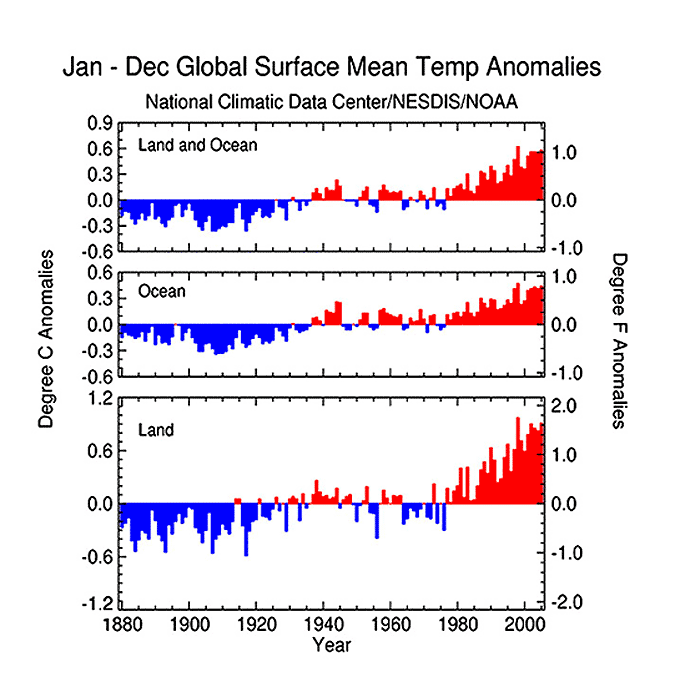
2005 was among the hottest years on record, according to several organizations and government agencies. Two analysis systems used by the National Oceanic and Atmospheric Administration (NOAA) place 2005 warmest ever recorded and second only to 1998, during which a strong El Niño episode contributed to warming. The National Aeronautics and Space Administration (NASA) found 2005 to be the warmest on record. The World Meteorological Organization, whose data is not yet final, believes 2005 is likely to have been among the warmest four years on record. The year also set records in several other climate-related areas, including several related to hurricanes. “The observed rapid warming,” according to NASA, “gives urgency to discussions about how to slow greenhouse gas emissions.”

Published December 31, 1969

(2006, February 1). 2005 Among Hottest Years on Record. Retrieved from https://www.buildinggreen.com/ebn/february-2006

Add new comment

To post a comment, you need to register for a BuildingGreen Basic membership (free) or login to your existing profile.

2005 Sets Record for Weather-Related Costs

News Brief

2005 Sets Record for Weather-Related Costs

2005 set a new record, according to estimates from the Munich Re Foundation, with more than $200 billion in economic losses due to weather-related disasters. Of that total, more than $75 billion was covered by insurance companies. Hurricane Katrina caused much of that loss, with damages estimated at $125 billion, of which about $45 billion was insured, according to the Foundation. “There is a powerful indication from these figures that we are moving from predictions of the likely impacts of climate change to proof that it is already fully underway,” says the Foundation’s director, Thomas Loster. “Above all, these are humanitarian tragedies that show us that, as a result of our impacts on the climate, we are making people and communities everywhere more vulnerable to weather-related natural disaster.” The previous record of $145 billion was set in 2004.

Published December 31, 1969

(2006, February 1). 2005 Sets Record for Weather-Related Costs. Retrieved from https://www.buildinggreen.com/ebn/february-2006

Add new comment

To post a comment, you need to register for a BuildingGreen Basic membership (free) or login to your existing profile.

Mazria Launches Architecture 2030 to Combat Climate Change

News Brief

Mazria Launches Architecture 2030 to Combat Climate Change

Ed Mazria, AIA, author of

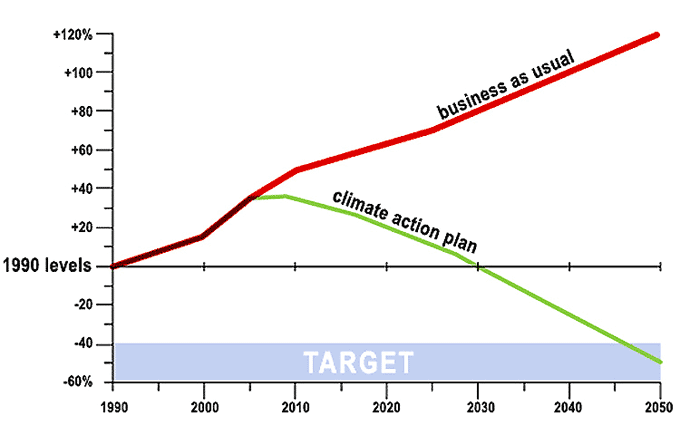
The Passive Solar Energy Book and a leading advocate for energy efficiency in buildings, has created an organization to amplify his call to action. Architecture 2030 aims to “conduct research and provide information and innovative solutions in the fields of architecture and planning, in an effort to address global climate change,” according to its website. Mazria has identified architects as potential drivers of a solution to global warming: “We control what goes into the construction of a building . . . we can change the industrial sector at the stroke of a pen,” he says. Architecture 2030 was created by Mazria Inc. Odems Dzurec, an architecture and planning firm, and sponsored by the nonprofit New Energy Economy. The organization is online at www.architecture2030.org.

Published December 31, 1969

(2006, February 1). Mazria Launches Architecture 2030 to Combat Climate Change. Retrieved from https://www.buildinggreen.com/ebn/february-2006

Add new comment

To post a comment, you need to register for a BuildingGreen Basic membership (free) or login to your existing profile.

Ten Years Later: Strawbale in the Building Codes

News Brief

Ten Years Later: Strawbale in the Building Codes

Ten years ago,

Environmental Building News (EBN) reported on the first building codes for strawbale construction (see

EBN

Vol. 5, No. 1). The State of Nevada had recently passed a mandate requiring local jurisdictions to permit strawbale buildings, and California had approved voluntary guidelines that could be adopted at the local level. On January 1, 1996, the County of Napa, California, adopted that state’s strawbale building guidelines, becoming the first government body to officially adopt a strawbale building code. The next day, the City of Tucson and County of Pima, Arizona, adopted one that had been in development there for more than two years (and upon which the California guidelines, along with most subsequent strawbale codes, were based). Later that month the State of New Mexico approved a draft of Standards for Non-Loadbearing Baled Straw Construction, which was adopted into its state building code in 1997. Over the next half-dozen years, strawbale codes were adopted in many California jurisdictions, as well as in parts of Texas, Colorado, Arizona, and Nebraska, and the entire state of Oregon.

The alternative materials and methods clause in the model codes, and now in the International Code Council’s International Building Code® (IBC), has always been an open door to strawbale, but “having it specifically included in the codes gives it much more credibility in many people’s eyes—including building officials, lenders, and the insurance industry,” Martin Hammer, a Berkeley, California, architect who has been working with strawbale codes since 2001, told

EBN. The move toward codification does seem to have improved the perceived legitimacy of strawbale. Getting permitted is much less difficult than it once was, even for the significant percentage of permitted strawbale structures built in code-enforced areas that have no specific codes for strawbale in place.

Chris Magwood, who leads the Sustainable Design and Construction course at Fleming College in Haliburton, Ontario, and has authored two books about strawbale building, told

EBN that “code activity in the U.S. has made it much easier to get approvals here in Canada,“ where no strawbale codes exist. At one point, according to Magwood, the Ontario Straw Bale Building Coalition considered creating a strawbale code for its area but decided that the cost and the effort weren’t justified. Over one hundred strawbale structures, including urban projects, have been built in the Ontario area in recent years without significant permitting difficulties.

Strawbale buildings are also going up in areas of the U.S. without enforced building codes (and certainly some small number are sneaked in under the radar of local officials). Most are probably examples of reasonably good craftsmanship, and a few may represent the very best strawbale has to offer, but the overall performance and serviceable lifespan of some of them is anybody’s guess. “I think codes serve a purpose—maybe simply to help monitor good construction versus bad construction,” says Joyce Coppinger, director of the Green Prairie Foundation for Sustainability in Lincoln, Nebraska, publisher of

The Last Straw.

Hammer concurs. “The worst that happens with no code is that failures get built,” he says, stating that the benefits of a well-written code outweigh the freedoms of building in a vacuum. Since failures often get more attention than successes, he senses the danger of a skewed perception. “When there’s no code or guidelines, people invent things—not always very well. However, innovation has always been one of the strengths of strawbale building, so we need a code that still allows that while addressing preventable disasters.”

Some have argued that codification is a double-edged sword, particularly when the regulated item is neither proprietary nor sponsored by any industry; a prescriptive code can ultimately mandate less-than-best practices for decades despite initial good intentions. The issue of climate-applicability is also a concern—as Coppinger notes, “California’s code is good . . . but is it appropriate for Massachusetts?”

Hammer thinks both issues can be handled appropriately in a single, universal document but concedes, “Even with a very clear and explicit provision that other techniques or methods can be permitted to satisfy the intent, if something’s in black and white, it creates inertia.” The next step, he believes, is to incorporate a carefully crafted set of performance and prescriptive minimum standards for strawbale construction into the IBC as an appendix. An appendix, rather than an amendment of the code itself, would fall somewhere between nothing and a mandatory provision—a common groundwork that could be more readily adapted by local jurisdictions throughout the country to their unique conditions. In the meantime, Hammer is working on a strawbale building code requested by the State of California to replace its guidelines and to reflect recent testing, experience, and understanding.

The Spring 2006 issue of

The Last Straw (No. 53) will include a thorough review of strawbale building codes, as well as an extensive report on recent strawbale testing.

For more information:

Martin Hammer, Architect

Berkeley, California

510-525-0525

mfhammer@pacbell.net

The Last Straw

Lincoln, Nebraska

402-483-5135

thelaststraw@thelaststraw.orgwww.thelaststraw.org

Published December 31, 1969

(2006, February 1). Ten Years Later: Strawbale in the Building Codes. Retrieved from https://www.buildinggreen.com/ebn/february-2006

Add new comment

To post a comment, you need to register for a BuildingGreen Basic membership (free) or login to your existing profile.

Ecological Design and Building Schools: Green Guide to Educational Opportunities in the United States and Canada

News Brief

Ecological Design and Building Schools: Green Guide to Educational Opportunities in the United States and Canada

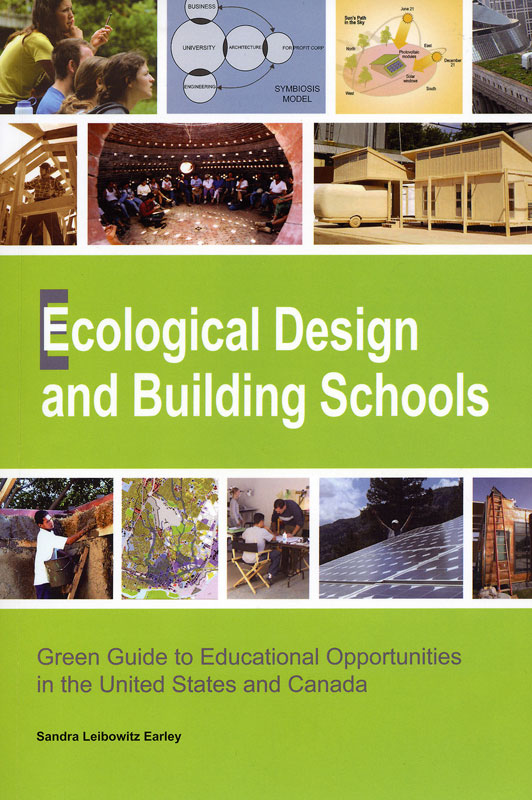
by Sandra Leibowitz Early. New Village Press, Oakland, California, 2005.

Softcover, 178 pages, $19.95.

Update: (March 29, 2006)

New Village Press has posted this book's missing page on its website. To view it, visit www.newvillagepress.net/cover_ecoDesign.html, and click on "Errata page 84/85."

Searching for a master’s in architecture program myself, I was delighted to hear about

Ecological Design and Building Schools. I have been looking for a school that places ecological design at the center of its curriculum and not at the fringe; I’ve also been searching for reputable programs that would add practical, hands-on building experience to my design education.

One of the strengths of Earley’s book is that it includes programs that meet both of these interests. It lists a total of 82 programs, in varying shades and styles of green, in three categories:

•Continuing education, nonprofessional—owner-builder schools and educational institutes offering workshops of all types and styles;

•Continuing education, professional—associations and resource centers, including the U.S. Green Building Council, that offer training programs for professionals; and

•Higher education—colleges and universities offering degree programs.

At the heart of the book, 24 pages of charts of survey results offer meaty information about what type and style of teaching is offered where; unfortunately, the results suffer from a format that renders them difficult to read, and some of the content appears to have been jumbled in the layout, with one two-page spread repeated and another omitted.

The charts and listings are supplemented by an excellent overview of the field, first with a historical perspective—beginning with the establishment of the Society of Building Science Educators in 1982—and then with an essay surveying the various types of programs available. Those involved in developing educational programs in sustainable design will also appreciate the directory of curriculum resources.

Though the book is comprehensive in its coverage, it runs into a problem of depth. Short profiles of several programs, survey results, and “lightly edited” blurbs submitted by the schools give the reader the ability to note programs of interest, but in the end the book offers more to students searching for programs with specific courses in specific geographic locations than students hoping to discern between master’s-level programs to make career decisions. It does not give a sense of how various programs are regarded in the field, and it does not provide enough information for the reader to compare programs within the same category.

Nonetheless, the book’s achievement—pulling this wide range of programs into one directory—should not be underestimated. This title is well on its way to becoming a much-needed clear and comprehensive description of the educational offerings available in the field of ecological design.

Published December 31, 1969

(2006, February 1). Ecological Design and Building Schools: Green Guide to Educational Opportunities in the United States and Canada. Retrieved from https://www.buildinggreen.com/ebn/february-2006

Add new comment

To post a comment, you need to register for a BuildingGreen Basic membership (free) or login to your existing profile.

National Review of Green Schools: Costs, Benefits, and Implications for Massachusetts

News Brief

National Review of Green Schools: Costs, Benefits, and Implications for Massachusetts

A Report for the Massachusetts Technology Collaborative by Gregory Kats, Capital E. Available free at www.cap-e.com. December 2005, 66 pages.

Following up on their influential 2003 report “The Costs and Financial Benefits of Green Buildings” (see “Green Building Pays” in

EBN

Vol. 12, No. 11), Greg Kats and his team at Capital E have applied similar methods and reached similar conclusions regarding schools. For the Green Schools reports Kats analyzed cost and performance data for 30 schools, of which 12 are in Massachusetts. He then applied Massachusetts-based factors for energy costs, teacher salaries, and other parameters to arrive at his conclusions.

On average, the report finds that green schools are built at a premium of 1.5% to 2.5%, or about $4/ft2 ($40/m2). For this premium, it shows a net present value benefit of $60 to $70/ft2. Only about $15 of that accrues directly to the school, however, mostly from energy and water savings, improved teacher retention, and lower healthcare costs. That $15 translates into nearly $200,000 per year of additional resources available for an average school (after any first-cost premium is paid for), according to Kats.

The largest benefit in Kats’ analysis is based on the presumed increased earning potential for students whose achievement is improved by the high-performance schools. While the actual value is highly uncertain, Kats defends the inclusion of this number as a conservative estimate, based on the relatively strong data indicating fewer sick days and better test scores for students in green schools.

Due to limitations in the available data, the report’s assumptions regarding energy savings, water savings, and other benefits are mostly from simulations and predictions rather than measured savings. Based on evidence from other sources that measured savings often fail to live up to predictions, these numbers may be somewhat optimistic. Hopefully more actual measured data will become available over time to increase confidence in the analysis. In the meanwhile, however, this report is the most comprehensive and rigorous attempt we’ve seen to quantify the costs and benefits.

Published December 31, 1969

(2006, February 1). National Review of Green Schools: Costs, Benefits, and Implications for Massachusetts. Retrieved from https://www.buildinggreen.com/ebn/february-2006

Add new comment

To post a comment, you need to register for a BuildingGreen Basic membership (free) or login to your existing profile.

EPA Calls for P3 Award Entries

News Brief

EPA Calls for P3 Award Entries

The U.S. Environmental Protection Agency (EPA), along with dozens of government, industry, and nonprofit partners, is accepting applications for the 2006 P3 Award, a design competition for scientific and technical solutions to environmental challenges. “P3 highlights people, prosperity, and the planet—the three pillars of sustainability,” according to the program website. The contest is limited to undergraduate or graduate institutions of higher education located in the U.S., but EPA encourages collaboration with industry, nonprofit organizations, government, and the scientific community, as well as with schools outside the U.S. Winning teams will receive up to $10,000 each to research and develop their projects as well as the chance to compete for up to $75,000 to further develop their designs, implement their projects in the field, and bring them to the marketplace. Submissions are due February 20, 2006. Details are online at http://es.epa.gov/ncer/p3/.

Published December 31, 1969

(2006, February 1). EPA Calls for P3 Award Entries. Retrieved from https://www.buildinggreen.com/ebn/february-2006

Add new comment

To post a comment, you need to register for a BuildingGreen Basic membership (free) or login to your existing profile.

Zody Wins Good Design Award

News Brief

Zody Wins Good Design Award

The Zody™ chair from Haworth, Inc., was granted a 2005 Good Design™ Award from the Chicago Athenaeum Museum of Architecture and Design. The international program recognizes “designers and manufacturers for advancing new and innovative product concepts and originality and for stretching the envelope beyond what is considered standard product and consumer design.” The Zody, which contains up to 51% recycled content and is up to 98% recyclable, has earned Gold certification through MBDC’s Cradle to Cradle™ rating system. For more on the Zody or MBDC’s rating system, see

EBN

Vol. 14, No. 7. Haworth is online at www.haworth.com.

Published December 31, 1969

(2006, February 1). Zody Wins Good Design Award. Retrieved from https://www.buildinggreen.com/ebn/february-2006

Add new comment

To post a comment, you need to register for a BuildingGreen Basic membership (free) or login to your existing profile.

DOE Announces 2006 EnergyValue Housing Award Winners

News Brief

DOE Announces 2006 EnergyValue Housing Award Winners

The U.S. Department of Energy (DOE) has announced the winners of its annual EnergyValue Housing Awards, designed to promote and improve the energy efficiency of new homes in the U.S. The program is funded by DOE’s Building America Program and the National Renewable Energy Laboratory with support from several private sponsors, including BuildingGreen. AndersonSargent Custom Builder, LP, based in Waxahachie, Texas, was named Builder of the Year. Other winners were awarded in five categories (affordable, custom, factory-built, multifamily, and production) and three climate regions (cold, moderate, and hot). The winners are profiled at www.nahbrc.org/evha/.

Published December 31, 1969

(2006, February 1). DOE Announces 2006 EnergyValue Housing Award Winners. Retrieved from https://www.buildinggreen.com/ebn/february-2006

Add new comment

To post a comment, you need to register for a BuildingGreen Basic membership (free) or login to your existing profile.