A crew of five works steadily —lowering rafters, pulling nails, cleaning mortar off bricks, bundling oak strip flooring—turning an old building into carefully stacked lumber, palleted bricks, and windows organized by size. They call themselves a deconstruction services team. They take buildings apart in pretty much the reverse order of their construction and salvage for reuse as much material and as many building components as possible. Is this 1901 or 2001? Is this a technique of the past, limited to a small and diminishing number and type of buildings, or is it an innovative revival/adaptation with the potential of dramatically improving the resource-efficiency of both the demolition and the construction industries?
As far as
EBN can determine, the term
deconstruction took hold at the first Used Building Materials Association (UBMA) meeting in Canada in 1996. The term was invented or invoked to place an emphasis on disassembly and salvage for reuse—in contrast to
demolition which places emphasis simply on building removal. Although the term is sometimes limited to
manual disassembly of buildings, we use the term in this article to mean both manual and mechanical approaches —and to include the second step of reusing the materials.
Assessing Demolition and Salvage Potential Nationwide
Because so much deconstruction takes place informally or as a component of conventional demolition, quantifying the practice has been notoriously difficult. Let’s start by taking a look at how many buildings are coming down each year. In June 1998, the U.S. Environmental Protection Agency produced for the first time the report
Characterization of Building-Related Construction and Demolition Debris in the United States (EPA530-R-98-010). Although estimating this waste stream has long represented a challenge, credible estimates for both residential and non-residential demolition debris are provided in Table 1 below.
Figuring out how much construction and demolition (C&D) waste is recovered—recycled and reused—is even more difficult.
The EPA report cited above estimates a recovery rate of 20% to 30% while a recently released National Association of Demolition Contractors report
, Demolition … The First Step in Reconstruction, claims that “demolition contractors successfully deal with all types of structures, routinely achieving rates of materials recovery of 80 to 90 percent or more.” Most important, neither report distinguishes between recycling and reuse (see the sidebar on page 11 for an exercise on salvage potential). What we do know about the nature of the recovery rate is the following:
•The demolition industry has a heritage of reuse—just two generations ago or less, dismantling buildings for reuse was the norm in the demolition industry.
•Increased mechanization, labor rates, and worker protection laws have all favored recycling or disposal of C&D materials over dismantling for reuse.
•Changes in building systems—complex load pathways, monolithic structural systems, non-modular components—and the increased use of composite materials, laminates, and adhesives can favor C&D recycling or disposal over reuse.
•While there appears to be plenty of room for increasing building salvage and reuse, there is no shortage of commonly cited obstacles.
Meeting the Challenges of Deconstruction
The most interesting result of investigating reasons why deconstruction does
not work is how many examples emerge of how it
does work. Overcoming some of the obstacles—greater time requirements, higher cost, complex materials management—has to do with innovation in finding ways to make deconstruction work. But behind all of these factors lies the link between construction and demolition: building design and building type largely determine how well suited any particular building is for disassembly.
It’s ironic that vacant buildings often sit for years before they have to “come down yesterday” to meet the demands of the new developer and the project’s financier. Since deconstruction can take longer than straight demolition, many contractors identify time—not cost—as the biggest obstacle to taking a building apart instead of knocking it down. Tiffany Wilmot of Wilmot & Associates, a leading waste management consulting firm based in Nashville, Tennessee, comments, “Just recently we watched as $300,000 worth of building materials, electrical fixtures, and store components in a downtown mall were bulldozed.” Wilmot & Associates had completed an inventory of reusable stock for the property owner but, citing time constraints, the owner had the entire property demolished.
R. W. Rhine, Inc. of Tacoma, Washington has an interesting solution for many of the large, timber-framed buildings coming down in the Pacific Northwest. The company, which basically “de-panelizes” buildings, has customized much of its machinery to snip the building into sections that can be transported to its yard on flatbed trailers for complete disassembly. On-site work with this approach takes about the same amount of time as demolishing for disposal or recycling. Another big advantage to their approach is worker safety. “Manual disassembly takes place at ground level away from all of the machinery except a forklift,” says Jamie Van Noy, salvage yard supervisor for R. W. Rhine. The company notes that this approach took time to develop and requires a large facility, but it eliminates or greatly reduces the time crunch.
Cost
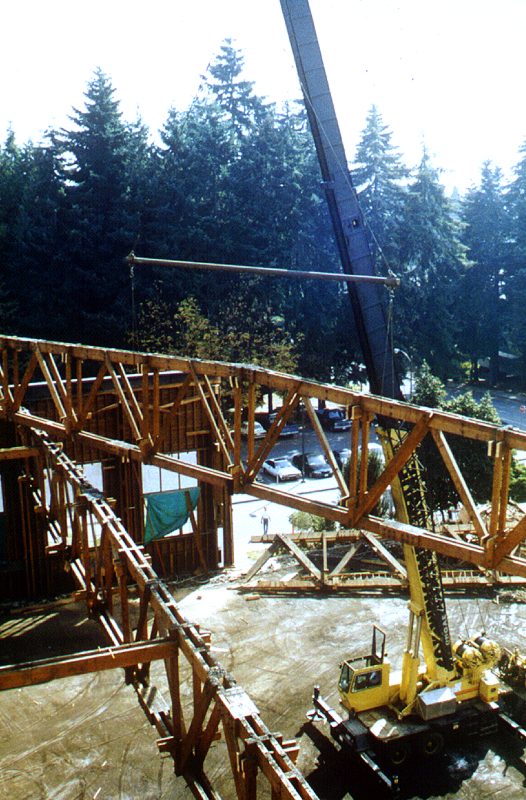
The Litchfield company salvages trusses from the University of British Columbia’s Armouries building. Timbers from the building were reused on the same campus.
Source: Matsuzaki Wright Architects If there are higher costs of deconstruction, they must be offset by avoided disposal fees and added revenues from reusable materials. Cost-effectiveness is always going to be case-specific, but in the building trades the myth that recycling and/or reuse always costs more is especially entrenched. Not all contractors are created equal. It takes expertise to protect the full value of materials during disassembly and a different set of skills to work the markets for full value of salvaged building materials.
On a well-documented deconstruction project in British Columbia, the Pacific National Exhibition Showmart demolition contract was awarded to the lowest bidder, D. Litchfield & Co. The 68-year old, 45,000-square-foot (4,200 m2), post-and-beam building was deconstructed over a 10-week period during which all the timbers, lumber, plywood, and fir flooring—over 1,800 cubic yards (1,375 m3) or 25% of the total material—were salvaged for reuse. “With a timber-framed building like this, going with deconstruction is a no-brainer. But we were the lowest bid because our company specializes in the techniques of disassembly and the sale of salvaged materials,” says Corinne Fulton, one of the principals of D. Litchfield. In business since 1957, the company operates a full-scale salvage yard and an antique store in addition to their demolition company.
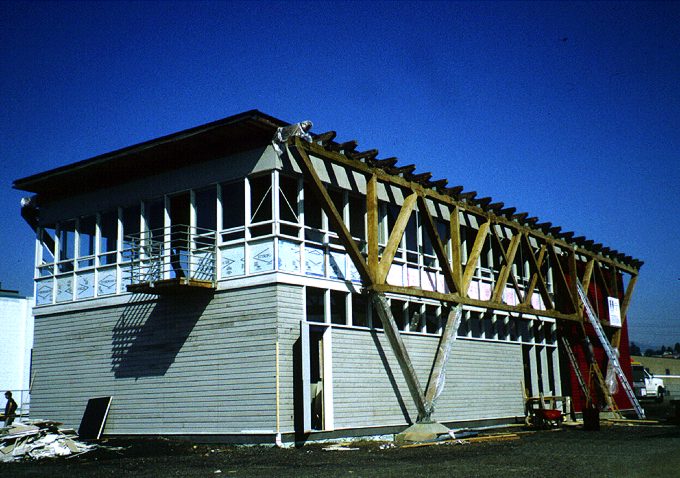
The City of Vancouver’s Asphalt Materials Testing Lab is shown under construction with salvaged wood trusses, glulam beams, wood siding, and rigid insulation, plus windows site-constructed of salvaged glazing.
Photo: Greater Vancouver Regional District If materials from a building removal project are being recycled instead of landfilled, there are issues of storage, inventory, and markets. With salvage for reuse, however, the materials management requirements are much more demanding.
Even commodity items, such as brick and lumber, have to be stacked, transported with care, and matched to specific demand. Other materials, such as electrical fixtures, doors, windows, and cabinetry, have much more exacting storage requirements and narrower demand. There are two primary solutions to the challenge of salvaged materials management: sale-from-site and vertical integration. With sale-from-site the building’s salvageable content is fully inventoried (quantity, condition, ease-of-removal) and potential buyers tour the property to bid on materials or a site sale is organized for the general buying public. Vertical integration means that the demolition/dismantling company also operates a construction company and/or salvage yard to handle the salvaged building materials in-house.
Tiffany Wilmot describes the tour-and-bid process they used as part of the materials recovery plan for the new NFL Stadium in Nashville—the property contained mostly 1950s vintage warehouses and light-industrial/small-business buildings: “In a matter of two weeks, we conducted detailed building inventories, set up property tours for potential buyers from our business contacts, and sold $130,000 worth of materials before demolition work on the site even began.” When Aspen Skiing Company scheduled a site sale for the salvaged building materials from their Sundeck Restaurant deconstruction project with very limited advertising, they had no idea that 20 pickup trucks would be lined up in their Buttermilk Mountain parking lot an hour before the scheduled start. “We sold just about everything in less than four hours—100 sliders and 80 windows [all Pella products less than 10 years old], a few 40-foot beams, dozens of fir closet doors, and even a dumpster full of plywood and wooden beams,” reports Auden Schendler, environmental manager for Aspen Skiing Company. “One contractor came from 200 miles away to buy all of the remaining sliders for a motel renovation project he was working on.”
Some firms are set up to feed salvaged materials from their demolition operations into their construction company. “We are always on the lookout for the right materials and timing to match up dismantling projects to construction projects,” states Don Rachel, President of Veit & Company. Over the years, Veit & Company has used the vertical integration of their company’s operations for everything from deconstructing and reconstructing a 126-unit pre-cast lintel beam mini-storage facility to the refitting of a fitness center’s roof truss system into a church and a sugar beet mill. When there is no match, Veit has a long-standing business relationship with a salvage broker and marketing firm that has a national network for moving all the used building materials that Veit can supply.
Building design and type
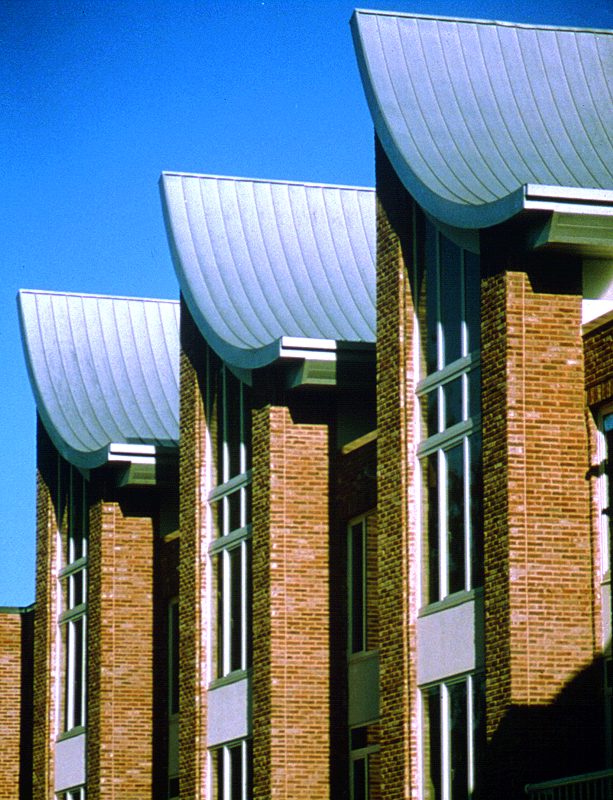
The C. K. Choi Building’s exterior is salvaged brick from a road in Yaletown, Vancouver.
Photo: Greater Vancouver Regional District Just as not all contractors are created equal with respect to deconstruction, neither are all buildings. Some building systems are more readily disassembled or yield higher-value salvaged materials than others. We hear the most about large timber-framed buildings, but any modular or panelized design lends itself to deconstruction. When one of the 10-year-old parking ramps at the Twin Cities International Airport was slated for removal as part of airport expansion, the ramp’s designing engineer and a developer client asked the demolition contractor, Bolander & Sons, if they would consider recovering the 10 ft x 60 ft (3 m x 18 m), 29-ton (29.5 tonnes), pre-stressed concrete T-beams for reuse at a two-story parking lot on a different property. Bruce Bolander, president of Bolander & Sons states, “Salvaging this type of structure was a first for our company, but with the designing engineer on board and detailed blueprints for the project, we knew we could do the job.” The beams were designed in such a way that they came out pretty much the way they went in. “The project took us longer and was more labor-intensive than it would have been without salvage for reuse, but the next time around with what we have learned, we can be even more efficient in our approach,” he said.
Had the ramp been a poured-in-place, reinforced-concrete structure, it could not have been salvaged.
What about the 245,000 residential units coming down every year? “The notion that you can cost-effectively take apart run-of-the-mill residential buildings manually for the two-by-fours and bricks with today’s labor costs, low tipping fees, hazardous materials regulation, and worker safety requirements—I just don’t buy it,” states Steve Clements, president of Cornerstone Material Recovery, an innovative waste management firm in Richmond, Illinois. Federal agencies, however, want to make sure that, if there is a cost-effective way to take their buildings down that
also cultivates local natural and human resources, it is fully considered. Agencies such as the Department of Housing and Urban Development (HUD) and the Department of Defense (DOD) have literally tens of thousands of residential units slated for removal over the next decade. According to Brad Guy, interim director of the Center for Construction and the Environment at the University of Florida, “The abandoned buildings can become a resource for community development—the materials, the jobs, the businesses are kept or developed in place.” Both HUD and DOD currently have feasibility studies under way investigating deconstruction potential. HUD has a one-half billion dollar annual investment in HOPE VI public housing redevelopment projects that include the removal of approximately 100,000 housing units, and DOD has thousands of buildings slated for removal as part of Base Realignment and Closure (BRAC) activities.
There are successful nonprofit and public/private partnerships involving the deconstruction of light-frame residential housing. “A key to our or-ganization’s approach to residential deconstruction is the tax credit value the property owner obtains,” says Mike Krause, executive director of the Green Institute in Minneapolis, Minnesota. The insti-tute’s nonprofit status means that the value of materials salvaged by their deconstruction team can be claimed as a tax-deductible charitable donation by the property owner. Krause continues: “This value makes it possible for many property owners to take on the extra time and expense associated with deconstruction.” The Green Institute operates both a deconstruction business (with two full-time crews of five) and a retail used building materials store with a gross annual revenue in 1999 of over $560,000.
In Hartford, Connecticut, the local housing authority and a family-operated demolition firm—Mannafort Brothers—teamed up to not only train public housing authority residents in deconstruction but also to create a small resident-owned deconstruction business. The residents completed a job training program in an alliance with a local trade union and began their business by deconstructing six housing units in a 8,250-square-foot (766 m2), three-story building. State and local grants supported the small business development, and Mannafort subcontracts manual disassembly on their work to the resident-owned deconstruction business. “This was just good business,” says Mo-desto Rey, construction manager for Mannafort. “Why not invest in the community, get the materials we need for our company’s operations, and improve the skill level of the local labor pool?” Mannafort Brothers is a fourth-generation family contracting business that started out, interestingly enough, as a salvage company.
So, is deconstruction a technique of the past, limited to a small and diminishing number and type of buildings, or is it an innovative revival/adaptation with the potential of dramatically improving the resource-efficiency of both the demolition and the construction industries? We think the answer is yes to both propositions. The number of deconstruction classics—doug-fir, timber-framed warehouses and light-framed Victorian mansions—is dwindling. But innovative approaches to building removal abound, and the way we build
today—both in terms of design-for-disassembly and designing-in salvaged materials—will have a profound impact on decon-struction’s potential
tomorrow. The principles presented in our checklist are offered as guidance for maximizing deconstruction’s potential.
Not all buildings today or in the future will be suitable for deconstruction. There is enormous potential, however, in both the way we take down, and the way we build, our structured environment to maximize resource-efficiency through salvage and reuse of building materials. The economics for this approach to demolition and design will only improve as the production of new materials increases the pressure on our natural resources and environment and we take our old buildings back to the future.
(2000, May 1). Deconstruction: Back to the Future for Buildings?. Retrieved from https://www.buildinggreen.com/feature/deconstruction-back-future-buildings