
Blog Post
Last week, I addressed some of the benefits of capturing waste heat from power plants and distributing it to buildings--a technology referred to as combined heat and power or CHP. This week we'll look at how this idea could be implemented in... Read more
Blog Post
Blog Post
Twice each month, BuildingGreen publishes an email news bulletin with current news and product information briefs. Sign up here — it's free. We will never share or sell your email address, and you may unsubscribe at any time.
Read the current bulletinBlog Post
News Analysis
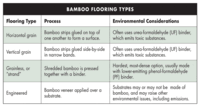
Bamboo flooring is typically made by slicing bamboo poles into strips. These are destarched by boiling, glued into boards, and milled. Preservative treatment—often boric acid, though more harmful chemicals may be used—is applied during this process. Most bamboo flooring uses a urea-formaldehyde (UF) adhesive in the lamination process... Read more
Blog Post
The majority of our electricity in the United States is generated by using a heat source to boil water and produce high-pressure steam, which then spins a steam turbine hooked up to a generator. To generate this steam, our utility companies burn fossil fuels like coal... Read more
Blog Post
Blog Post
While energy prices have dropped from their record highs a few months ago, many area residents are still wondering how they'll pay for heat this winter. The most common fuel in northern New England,... Read more
Blog Post
Today the Department of Energy's Building Technologies Program launched the Zero Energy Buildings Database with an offering of three Zero Energy Buildings (ZEBs) and one near-ZEB. A lot of work has been put into defining ZEBs and you can learn about the different types at the Net ZEB page. Also make sure to look at the overview page for each... Read more
Blog Post
Twice each month, BuildingGreen publishes an email news bulletin with current news and product information briefs. Sign up here — it's free. We will never share or sell your email address, and you may unsubscribe at any time.
Read the current bulletinBlog Post
Maverick NYC mechanical systems designer Henry Gifford has long been a critic of LEED, arguing that it encourages the wrong things, and doesn't go far enough to ensure that certified buildings really save energy or provide good air quality. I have great respect for Gifford and the work he does to design and commission low-energy buildings with... Read more
Blog Post
Blog Post
In this final installment about insulation we'll take a look at the family of rigid boardstock materials. Unlike fiberous or spray-foam insulation that is installed in wall or ceiling cavities between the studs, rafters, or joists, boardstock insulation is applied either on the interior or exterior surface,... Read more
Blog Post
Blog Post
News Brief
In response to provisions in the Energy Independence and Security Act of 2007, the U.S. Department of Energy (DOE) launched its Zero Net Energy Commercial Building Initiative in August 2008.
To support that initiative, which aims to develop marketable net-zero energy commercial buildings by 2025, DOE also announced a cooperative effort... Read moreNews Brief
Aspen, Colorado, already has a strong residential program for promoting energy conservation and renewable energy. The Renewable Energy Mitigation Program, or REMP, requires builders of large homes (those over 5,000 ft2, or 500 m2) or those with snowmelt systems, spas, or heated pools, to install renewable energy systems or pay a mitigation fee... Read more
News Analysis

News Brief
The certification applies to the first phase of the development, which includes a total of 93 residential units and... Read more


