
News Analysis
The recent ruling to allow logging on several thousand acres of old-growth forest in western Oregon was portrayed in the national media as a blow to environmentalists, but the action may not prove so damaging in the end. While the ruling permits logging on 13 of the 44 sites that were under consideration by the so-... Read more
News Brief
Energy Source™ Directory
Life has been a whole lot easier around the office since theEnergy Source Directory arrived. Assembled and published by Iris Communications, this is the most complete and most useful guide to specialized products and materials used in energy-efficient construction that we've seen. The 500-page directory is... Read more
News Brief
Carol Venolia, Publisher/Editor
If “progressive construction” can be defined as pushing the tools and techniques of conventional builders in the direction of less environmental destruction, then Building With Nature’s material goes beyond progressive, into the forefront of visionary thinking about construction. This bimonthly newsletter, now... Read moreNews Analysis
A study published in the June 5, 1992, issue of
Science by researchers at the Lawrence Livermore National Laboratory and the Institute of Atmospheric Physics at the University of Arizona suggests that smoke emitted into the atmosphere from human activities may be having a significant effect in counteracting... Read more
Product Review
The company's promotional material is the epitome of environmentally friendly packaging—like a Ben & Jerry's annual report. The article reprints sent were even bound in a jacket made from corrugated cardboard. So we were quite intrigued by the product. Syndecrete™ is a lightweight, pre-cast,... Read more
Explainer
News Brief
The American Institute of Architects convention in Boston this past June was the setting for a changing of the guard in the American architectural establishment. The Institute’s first woman president took the reins, the Committee on the Environment became its largest and fastest growing committee, and the first installments of the Environmental... Read more
Feature
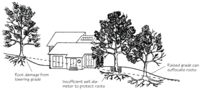
Carefully stake the building site and driveway, remove trees that are within the excavation area or too close, then erect a fence to keep heavy equipment off fragile soils and away from nearby trees.
Protecting trees and the local ecosystem when building on previously unbuilt land is a vitally important—yet often overlooked—part of environmentally responsible construction. Healthy trees and shrubs can reduce a home’s environmental impact and directly benefit homeowners in a number of ways:
•Enhancing comfort by shielding the house... Read more
Op-Ed
Introducing the first issue of our newsletter.
Buildings have a tremendous impact on the environment. In North America, buildings and the building industry account for about 30% of carbon dioxide emissions, 35-40% of ozone depletion, 20-30% of municipal solid waste, vast quantities of natural resource consumption, and dramatic loss of open space each... Read more
Feature
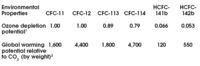
Ozone depletion and global warming are two of our most serious environmental problems—and foam insulation materials containing CFCs (chlorofluorocarbons) contribute significantly to both of these problems. The environmentally concerned builder or designer should make it a highest priority to avoid them. Even many of the non-CFC alternatives... Read more
Feature
Susan Maxman is the first AIA president to make sustainable design a priority.
Q.Where would you say architects as a group stand on environmental issues?
A.Architects tend to be reactive rather than proactive. It is important that we take the lead on these environmental issues. The architecture schools in particular tend to be conservative. They just aren’t... Read more
Forum topic
Hi Gurus,
It seems odd to think about leases now, during a time when most business are giving up leases or reducing their footprints, but there are still leases going on! Please share this link to any clients of yours who might be interested and sign up yourself if you want to advocate to your clients to consider these leases!
... Read more
Forum topic
Hello friends,
Here’s another upcoming event that BuildingGreen has been hiding up our sleeve: a San Francisco Bay Area Mini-Summit! A summary is below, see the registration page for more details or to sign up. This event is intended for SF locals, so folks who work farther afield can join, with the knowledge that Bay Area-specific... Read more
Forum topic
Peeps, in case you haven't gotten the email blasts--the AIA wants YOU! Now is the time to throw your hat into the ring for volunteering on the following committees/groups:
2030 Working Group (with Keith Hempel! and Ashley Mulhall!) A&D Materials Pledge Working Group (build on the amazing work Lona Rerick and others have been doing for... Read moreForum topic
Has anyone used a commercial heat pump water heater for a large protect? I have found a few manufacturers for this technology, but want to make sure this is a viable and cost approach to electrical eliminate gas on a path to all electric.
Forum topic
Happy Friday Everyone!
Hoping to add a bit of excitement to the end of your week:
Here is the Sustainable Construction Leaders 2020 Summit Report.
Enjoy!
RoseAnn for Candace, Nadav, and the BuildingGreen team
Forum topic
We should probably agree on the correct spelling for what we at BuildingGreen are calling "BITuser." I noticed that on the Salesforce portfolio screenshot provided by Dennis, it's spelled "BIT User."
BITuser has the advantage of more closely resembling LEEDuser, but it has the disadvantage of looking a little weird in all-caps, as in... Read more
Quiz
Welcome to the quiz portion of Measuring Energy Use in Buildings: Do Our Metrics Really Add Up?.
Learning Objectives
Upon completing this course, participants will be able to:
1. Explain the differences between site energy, source energy, and energy cost.
2. Summarize three ways in which source energy can... Read more


