
News Brief
In May 2008, the Internal Revenue Service (IRS) issued a letter clarifying the rules for using the federal solar investment tax credit in conjunction with tax-exempt bond financing in affordable housing projects. The tax credit provides incentives for businesses purchasing solar arrays; it is set to expire at the end of 2008, although bills... Read more
News Analysis
EBN
Vol. 17, No. 6). Although the ordinances vary in scope and timeframe as well as stringency,... Read more
News Brief

The program, a partnership between the... Read more
News Analysis
News Brief
In what may be a sign of backlash against the decades-long trend toward larger houses, the Los Angeles city council unanimously passed an ordinance in May 2008 limiting the footprints of new and renovated houses in many neighborhoods—affecting about 304,000 lots—to about half their lot size.
The Neighborhood Character Ordinance, commonly... Read moreNews Analysis
The Sustainable Choice certification and label for furniture is based on... Read more
News Brief
According to a recent report by the International Facility Management Association (IFMA), rising utility costs have led to increased overall operating costs even as energy consumption has dropped. The report, “Benchmarks V: Annual Facility Costs,” pulls data from over 1,000 survey responses from IFMA members.
Operating costs have risen 10%... Read moreNews Brief
The U.S. Green Building Council (USGBC) first released LEED for Existing Buildings: Operations and Maintenance (LEED-EB) in November 2007. The reference guide for the system is due out in June 2008, and, as of July 1, all projects seeking certification must register under the new version.
Among the many changes are the addition of a green... Read moreNews Analysis
SierraPine, a major U.S. manufacturer of composite paneling and other products, has achieved certification under the Forest Stewardship Council (FSC) standard for chain-of-custody procedures. As verified by a third party, SierraPine has the proper protocols in place to track FSC-certified forest products as they move through its manufacturing... Read more
Op-Ed
In regions of the country that rely primarily on heating oil or propane for heat, including the Northeast and parts of the Upper Midwest, something pretty surprising has happened over the past six months. The cost of delivered heat from these fuels has risen above that of electricity—even when that electricity is used for electric-resistance... Read more
News Brief
Students entering the Master of Real Estate Development (MRED) program at Arizona State University in the 2008–2009 academic year will be required to study the U.S. Green Building Council’s LEED Rating System and take the LEED Professional Accreditation exam.
Begun in 2006, the program is one of only five in the nation to offer the master’s-... Read moreNews Brief
Promoting green building can be “extremely profitable” for real-estate professionals, according to one educational company, illustrating a trend in a market reeling from the subprime-mortage crisis.
Tampa-based Green Real Estate Education, a company that hosts courses for real estate agents, house inspectors, mortgage officers, and... Read moreNews Analysis
Noting the potential water savings of a waterless urinal, Niki Bradley, marketing director for Waterless, said, “We wanted to develop a more sustainable, environmentally... Read more
News Brief
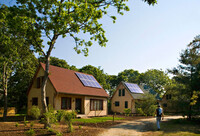
On Martha’s Vineyard, an island where affordable housing is in short supply, nine single-family, detached, green homes were recently developed and funded by the Island Affordable Housing Fund and sold for 25%–50% of the median home sale price on the island; one additional home in the cluster was sold at the market rate.
The homes,... Read more
Op-Ed
Two readers offer more details on Massachusetts' building code requirements for air barriers.
There is misinformation in the article on air barriers [see EBN Vol. 17, No. 6]. Massachusetts has a requirement of 0.004 cfm/ft2 @ 75 Pa for materials, not assemblies. Big difference. Massachusetts’ requirements are the same as the National Building Code of Canada. Massachusetts does not have a requirement for the airtightness of assemblies or... Read more
Feature
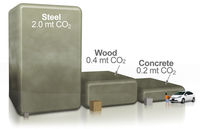
Everyone seems to be talking about measuring carbon footprints and designing carbon-neutral buildings, but these terms mean different things to different people. Some focus just on operating energy, while others also look at transportation, materials, and other building-related emissions. As with so many things, the results depend on what you count and how you count it.
Historically the amount of CO2 in the atmosphere hovered just under 300 parts per million (ppm), but it’s now approaching 400 ppm. CO2 is not the most powerful of the greenhouse gases on a per-molecule basis—not by a long shot—but it is by far the most common and most significant of those generated by humans. Various targets have been proposed... Read more
Product Review
AirTap is an affordable heat-pump module that can be retrofit onto a conventional electric or gas water heater. The unit has a first-hour rating of 42.5 gallons, an efficiency of 240%, and a GAMA-tested energy factor of 2.11.
UPDATE November 17, 2022: This product is no longer available. Thank you, Sandra Lester, for pointing this out.
The engineers at AirGenerate (previously Beyond Pollution) appear to have done something remarkable: create an affordable, effective, heat-pump water heater that can be retrofit onto a conventional gas or electric water heater... Read more
News Analysis
Forbo’s Marmoleum sheet and tile linoleum products have been available in the U.S. for over ten years, in that time becoming popular for their attractive appearance, biobased content, low maintenance requirements, and good environmental performance (see
EBN
Vol. 7, No. 9). In some markets that are more sensitive to first costs,... Read more
News Brief
Joining a growing list of industry trade associations led by The American Institute of Architects and the U.S. Green Building Council, the American Society of Interior Designers (ASID) officially adopted the 2030 Challenge in June 2008. The challenge, spearheaded by the nonprofit Architecture 2030, calls on the building industry to reduce... Read more
Blog Post